







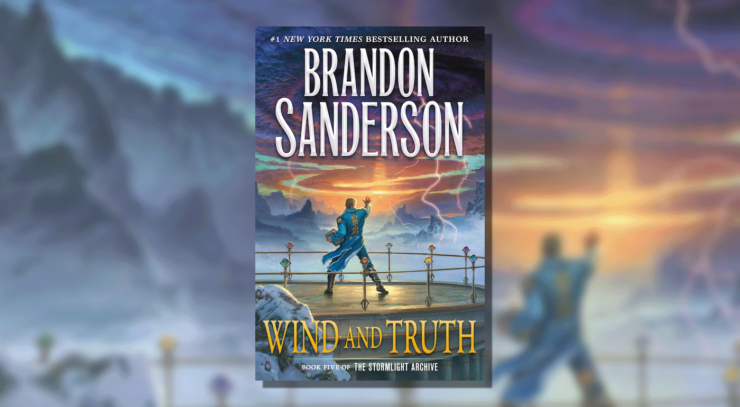
Happy Reread Monday, Cosmere Chickens! We’re really getting into the thick of it now, as we approach the home stretch: Szeth’s flashbacks are nearing their unfortunate conclusion, Navani finally manages to break free of the Spiritual Realm (but is forced to leave Dalinar behind), Kaladin prepares to cross blades with Nale, and… what’s this? Odium claims that Jasnah has been working for him all this time?! We’re in for a wild ride this week, so please join us as we dig into chapters 105 through 108!
The book has been out long enough that most of you will hopefully have finished, and as such, this series shall now function as a re-read rather than a read-along. That means there will be spoilers for the end of the book (as well as full Cosmere spoilers, so beware if you aren’t caught up on all Cosmere content).
Paige’s Commentary: Plot Arcs
Continuing with Day Nine, we start this week with chapter 105, titled “Points of Transition.” We join Navani in her vision at the palace in Kholinar on the day Elhokar died. She’s able to communicate with the Sibling for a moment and is told to find a “point of transition.”
When she sees Elhokar ascending the steps near Aesudan’s rooms, she gets emotional but makes a random excuse for being there and quickly encourages her son to continue. It’s not hard to convince him, as she’s good at manipulating the visions now.
She finds Gavinor, who realizes that it’s really her so he asks her why Grampa is terrible and why he hates everyone. Oh, Odium’s been working on him hard, hasn’t he?
Then Elhokar is there, but it’s not really him—it’s Odium wearing Elhokar’s face. Navani almost recognizes his voice and attempts to manipulate him into taking her to where Dalinar is, but he’s on to her now. So she flees with Gav to the Oathgate and convinces vision-Kaladin to initiate a transfer… It takes her and Gav to her rooms at Urithiru.
POV Shift!
Venli goes to visit Sigzil and he tells her his idea. She thinks that it won’t work… though she has an idea of how to make it work. She informs Sig—and adds that they need Jasnah.
Chapter 106, a Szeth flashback that takes place nine years ago, is titled “Cardinal Sin.” Szeth is involved in a battle. The first battle. They’ve won the day, but he had to do pretty much all the work himself; he tells the acolytes they need to do better and that they must now secure the town.
But the townsfolk don’t thank him for liberation. They obey, but they don’t believe that the Voidbringers have returned. He doesn’t know how to proceed and suddenly, the Voice pops into his head. It tells him that the Honorbearers are hiding from him and he realizes that he needs to draw them out. He orders his army, such as it is, to march toward the Stoneward monastery. He needs a real army, one that he knows the Honorbearers won’t ignore.
Chapter 107 is an Honor flashback titled “Voidbringer.” There has been war and the damage has been done to Alaswha, which is now known as Ashyn. Odium shows up and shows no remorse at the loss of life, though Tanavast does.
Tanavast sees Nale and his uncle, Makibak, when a king named Jezrien arrives and offers to make peace. He says Ishar is trying to find a way off this world and urges Makibak to gather his people and go with them.
Tanavast flees, weeping, to be with Kor and when the portal opens and the people arrive in Roshar… Rayse has come with them.
And so we get a glimpse into some of the history behind the destruction of the home the humans left behind. Even Odium admitted that it had gone too far, but the power of the Shard didn’t really care. It just desired more passion, always more passion.
Chapter 108 is titled “Service.” Szeth, with Kaladin in tow, is journeying toward the Skybreaker monastery. Ashamed, he tells Kaladin that he has decided that he must kill. Kaladin doesn’t argue, surprisingly enough. And then Kaladin asks how he can help.
After Kal goes on about how there are always more people to fight, Szeth asks him point-blank what he should do. He wants to know whether he should fight or refuse at the next monastery. Kaladin won’t weigh in, though Szeth reminds him that Dalinar commanded him to help Szeth.
Kaladin insists that he is trying to help and that he’ll support Szeth no matter what he decides to do, but that it has to be Szeth’s decision. Szeth realizes that Kaladin is being honest and that he truly seems to have healed and found peace, and his outlook shifts. Reframes.
The road was no longer a path toward doom or death. It was a way forward.
Strange, how much could change because of a conversation.
Seems like that talk therapy is starting to work!
Then they approach the monastery and observe that it’s been attacked, though it has been some time since it happened. Still, they see some people and when they arrive, Nale is waiting there. Szeth asks if he will be required to fight the Herald; Nale tells him no, that he need only accept his fate.
Then he tells Szeth that he must obey unquestioningly at the next monastery, following Nale’s commands—but Szeth tells him no. He says he must first know the cost. Then he asks about the darkness, wanting to know what is going on and who the Unmade is. Nale refuses to tell him and again demands that Szeth swear an oath of blind obedience.
Szeth refuses a second time, insisting he has the right to choose. So Nale says that he now must fight. Szeth refuses to engage, and prepares to be struck down. Then a spear stops Nale’s Blade.
POV Shift!
Kaladin is quite annoyed with Nale, who tells him he can’t interfere. Ignoring this, Kaladin asks Szeth if he wants help and Szeth says that he does. He tells Nale that Kaladin is his champion.
Kaladin consults silently with Syl and even the Wind chimes in to caution Kaladin. He and Nale agree to use no Stormlight, and they proceed to fight.
POV Shift!
Jasnah’s point of view section begins with barely a reference to a matter of the Shattered Plains and then she meets with Queen Fen at Taln’s temple in Thaylen City. Fen is skeptical about whether it is really Taravangian who now holds the Shard of Odium. She wonders aloud why Jasnah has prepared so vigorously—studying all night and consulting with Wit via spanreed—when Thaylenah is obviously not going to join Odium. Heh.
Taravangian shows up, unassuming and friendly, and they commence their discussion. Fen straight out tells him that she won’t join with him, but he convinces her to hear him out. She realizes that it really, truly is Taravangian, and he invites them to sit.
Then Taravangian throws Jasnah off by saying that she will be the reason Fen decides to join him. We’ll get to witness that not-so-fun discussion in a future article.
Dun-dun-dunnnn…
Lyn’s Commentary: Character Arcs and Maps
Elhokar/Navani
For this was Elhokar Kholin at his finest, perhaps the brightest moment of his life, leading with confidence. Rescuing his son. Standing shoulder to shoulder with a Radiant.
How ironic, that what Odium intended to be the most hurtful of memories to show Navani turned out to be the one that was the most healing. Seeing her son like this, beginning his transition into Radiance and becoming a better man, helps to salve some of the guilt and pain that she’s been carrying with her. Once again, Odium’s surety that he is omniscient backfires. He may understand a lot about what drives people, but he doesn’t understand everything, and he never could. No one can understand everything about another person, not without living their life.
Gavinor
He’d been hearing his father all through these visions. Navani looked back toward Elhokar—who had left the conversation with Aesudan and stood alone in the center of the room, staring toward her, a hint of a smile on his lips. His face in shadow.
Unfortunately, Odium is rather effective at manipulating a child. Throughout the entirety of the book, he’s been whispering in poor Gav’s ear, gaining his trust as he masquerades as Elhokar. Gently nudging the boy from one life path onto one of his own choosing. I find this to be the most disturbing of the actions Odium takes—this corruption of an innocent child as a means towards his end. He subjects Gav to trauma and lies to him, turning him against those who love him most.
Navani
Why look backward? She couldn’t save Elhokar. But she could save Gav.
I’m so, so impressed with Navani. Her strength of character in these last few chapters is unmatched. She unflinchingly does what she must, manipulating Odium right back, and breaks free of a trap that has been cunningly created for her by a god. What an absolute legend.
Overall Character Note on the Radiants
Most telling, she passed someone in a Radiant uniform, weeping and shivering, her stare hollow as she whispered about a distinctly new pain. Rlain had told her the truth: spren could be killed.
This bodes ill for all the Radiants. We’ve seen what breaking the bond does to the spren—they become deadeyes, wandering the Cognitive Realm as mindless zombies. How much worse will it be for the humans subjected to the breaking of that bond on the other side? We see a hint of it in The Sunlit Man, but I suspect that Sigzil deals with it better than most of them will.
Szeth
As his line stalled—a few of them staring, disbelieving, at the deaths they’d caused—he lowered, then infused one of the holy boulders outside this town and sent it crashing among the enemy ranks.
I find it… ironic? Fitting? Horrible? That Szeth is mirroring his own beginning here at the “end” of his childhood arc. He began this path by killing with a stone, and he’s ending it by killing with stones.
“You will have to do better,” he snapped at his troops, and saw them deflate, sag. Well, good. They had been embarrassing, and he’d needed to do all the work.
OUCH. Damn… Szeth could definitely take some lessons in leadership from Kaladin or Adolin. He’s their polar opposite, leading by demeaning and exerting his superiority rather than by gaining trust and loyalty.
He’d imagined thousands flocking to him. […] Instead, the people wanted to ignore him.
We see this time and again, not only in Roshar, but in the real world as well. Change is hard, and scary, and people as a general rule would rather continue on in an imperfect situation than face the harrowing reality that change for the better is possible.
Now… do I believe that Szeth would have changed things for the better? The Szeth that we see here in these flashbacks?
Sadly, no. He’s immature, and lacks the learned experience that he’d need to be a true leader. I find it fascinating that he’s about the same age here that Kaladin and Adolin are when they gain their first commands, yet their leadership styles are so vastly different. Szeth has been taught all the wrong lessons, and his empathy is lacking, if not entirely non-existent.
The fight you’ve wanted is building. You just need to push it over the tipping point […]
It’s awfully telling that Szeth doesn’t stop to consider, “Hey, how come the Unmade I’m building an army to eventually come and destroy is encouraging me to do just that? That seems kinda weird, doesn’t it?” He’s focusing on all the wrong things. He’s thinking of the strategy and not questioning the motives. Which tracks for Szeth, doesn’t it? He never wanted to question. He wanted to get his orders and follow them. And now that he’s in charge, giving the orders? He’s still not questioning.
“Tell me what to do,” Szeth said. […]
“What do you feel you should do?”
Classic therapist. Szeth is still looking for people to take that responsibility of choice from him. If he takes the responsibility, then he’s accountable for all that follows. We’re seeing reflections of that in his flashbacks—when he did step up and begin leading, it went very poorly for him, and for those he led. It’s no wonder that he doesn’t trust himself.
Szeth opened his mouth. And an oddity slipped out.
“No.”
I can only imagine that Kaladin is in the background, fist-pumping victoriously, while Syl flips Nale the bird.
“I was broken before!” Szeth shrieked. “I was ripped away from my perfect life and pounded and forged and beaten into a weapon! […] If I can’t have the life I want, I at least deserve to choose what I’m walking toward instead!”
And so we see the culmination of all of Kaladin’s hard work… and of Szeth’s self-questioning. He takes responsibility. He refuses to allow another to take that from him, and chooses it for himself.
I’m so proud of him.
Tanavast
I, GOD, HELD THE BODY OF A DEAD CHILD AND WEPT AS THE SKY BURNED.
Well… that’s one way to start a chapter, eh?
I SAW A KING TRYING TO MAKE AMENDS WITH HIS ENEMY. THEY STOOD UPON A MOUNTAIN OF CORPSES, BUT MAYBE…
I’d just like to point out what a poignant turn of phrase this is.
Nale
NALE WAS SEARCHING AMONG THE DEAD. HE COULD NOT SEE ME, BUT HE SCREAMED WHEN HE FOUND THE BODY OF HIS SISTER, AND HELD HER.
The more I learn about Nale, the more curious I am to see his whole story. I wonder if we’ll see it someday.
Kaladin
At first, it helped me to divide everyone into us and them, then focus only on protecting the us. […] I started to realize, Szeth, there can always be more them.
I really love this gradual realization for Kaladin’s character. We’ve seen it growing for five books, as he engaged in battle after battle. It’s only here, in this book, that he’s finally allowed the peace to pause and reflect back on these things.
“Then I had to step up and take responsibility. Become one of the people who made decisions. If I wanted the killing to stop, I had to make it stop. From the top, as a leader.”
And even this wasn’t successful. Will he perhaps make this change with the Heralds, between books? Will his therapy help them to heal and shape them into a group of tacticians working towards nothing but peace? Only time will tell.
Jasnah
After dealing with an interesting matter involving the battle at the Shattered Plains, Jasnah met Fen […]
OH COME ON, really?!
Drew’s Commentary: Invested Arts & Theories
I’ve probably said this a half dozen times already over the course of this reread, but there’s still so much we don’t understand about the Spiritual Realm. The Sibling gives us a solid metaphor here, regarding the mechanics of making perpendicularities out of the Spiritual and back to the Physical:
You can’t make one that leads out in the same way, the Sibling said. It’s like you’ve slid down a tall mountain slope, and are now at the base, trying to get back up.
That’s a pretty clear image. There’s a sort of “gravity” to the Realms, and the Spiritual Realm is at the bottom. You can’t just slip back up to the Physical, and instead have to use a gondola that’s already been set up to reach the peak. Those gondolas are perpendicularities.
The way I explain this to myself, at least with current knowledge, is that souls/Spirit Webs are made of Investiture and are attracted to the Investiture permeating the Spiritual Realm. That’s the “gravity” at work here, preventing the easy slip-n-slide of a Bondsmith perpendicularity. I’m sure we’ll learn much more in time—Isles of the Emberdark hints at all sorts of Spiritual things with dragons, so we might have to wait until Dragonsteel—but this is a good enough explanation for me right now. If you have a different headcanon around this phenomenon, I’d love to hear it in the comments!
“Zoral, he who was named the Voidbringer, is dead,” HE SAID.
Chapter 107 is titled “Voidbringer”, and certainly that title can apply to Odium. The chapter ends with Odium’s arrival on Roshar, after all. But we can make strong arguments that it applies to Honor, as well—he who granted Surges to those who resisted on Alaswha, and turned it into Ashyn as a result.
But this Zoral sticks out to me. We don’t really know anything about him, besides that he was the king of Odium’s forces on Alaswha. The title Voidbringer, given to a human during that struggle, is evocative. It makes me wonder just how he was using his Surges, and if he was in direct contact with Odium. Maybe Odium even joined him in some manner on the battlefields.
Because if pretty much everyone was using these unbound Surges in such a catastrophically destructive fashion, it’s strange that one in particular would be given such a title. Sure, he’s a king, but… I dunno. “Voidbringer” is such a fraught word in the context of this series, and especially in the context of these events.
Heck, maybe this Zoral wasn’t actually using the same Surges, and was in fact using Voidbinding—something that we still haven’t seen in any substantial manner or learned about at all. That Voidbinding chart is still sitting at the end of The Way of Kings, unexplained and teasing us with its point symmetry and warped perspectives of glyphs and shifted Surges aligning with seemingly nonsensical Void-Orders.
Is it some esoteric Invested Art that was used on Alaswha? Is this going to be something about the post-Retribution Knights Radiant and their Surges? Is the lack of Stormlight and the necessity of using Warlight going to fundamentally change how these Invested Arts operate?
While considering that and taking notes as I read this scene, it occurred to me just how much ground Sanderson still has left to cover in the last five books on Roshar. There are still a few Orders of Knights Radiant about which we know very little—Elsecallers, Stonewards, and Dustbringers chief among them—not to mention the added twist of Enlightened spren possibly warping things with the Orders we’re already quite familiar with.
What happens if an enlightened honorspren bonds someone? How different will that Windrunner look from Kaladin? We know that Renarin and Rlain have unusual powers as Enlightened Truthwatchers (though I will always insist that seeing the future seems like a natural resonance power for an Order that can use Illumination and Progression—shedding light forward, yeah?), and the implication is that anyone bonded to a spren touched by Sja-anat would be able to navigate the Spiritual Realm like them.
With all of that still on the horizon, we have the entirety of Voidbinding to uncover. And what of the Old Magic? Will we be seeing, well, any of that, now that Cultivation has fled Roshar? When I consider the pace at which Sanderson revealed elements of the world and magic through Wind and Truth, I’m left scratching my head and wondering just how packed the remaining books will be—and how much that is going to affect the actual storytelling pace.
We’ll be keeping an eye on the comment sections of posts about this article on various social media platforms and may include some of your comments/speculation (with attribution) on future weeks’ articles! Keep the conversation going, and PLEASE remember to spoiler-tag your comments on social media to help preserve the surprise for those who haven’t read the book yet.
See you next Monday with our discussion of chapters 109 through 112!

IDK if this is a common theory, or perhaps already doubtful based on some fact I’m missing, but I suspect that Voidbinding only distorts other magics. Could there be a better magic for Odium than one which only twists and corrupts what already exists, doing nothing on its own?