







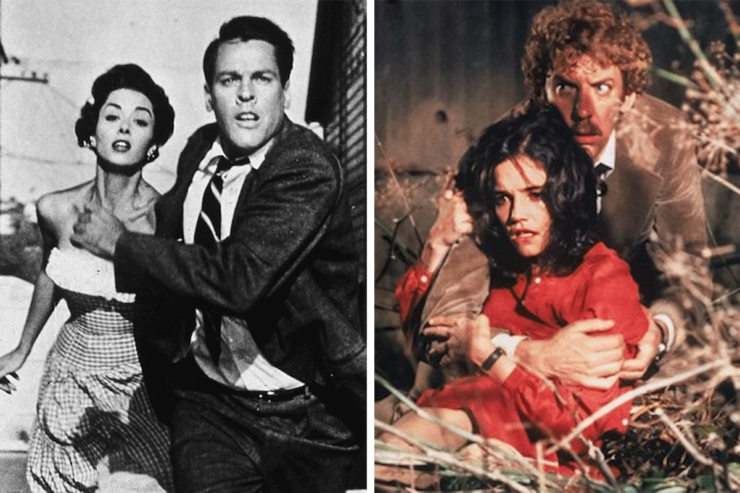
Invasion of the Body Snatchers (1956) Directed by Don Siegel. Written by Daniel Mainwaring, based on The Body Snatchers by Jack Finney. Starring Kevin McCarthy, Dana Wynter, Larry Gates, King Donovan, and Carolyn Jones.
Invasion of the Body Snatchers (1978) Directed by Philip Kaufman. Written by W.D. Richter, based on The Body Snatchers by Jack Finney. Starring Donald Sutherland, Brooke Adams, Leonard Nimoy, Jeff Goldblum, and Veronica Cartwright.
Right. So. I admit I was hoping to be writing this week’s piece in a very different context.
There wasn’t any sort of deep conceptual motive when I picked two very political American movies to watch during the American election, because there isn’t more to the timing of my choices than, “Hey, I want to watch these movies, this will be interesting.” This time, I did sort of think, in the back of my mind, that I would have something to say about today’s political environment. I was also thinking that context would be—and have been working very hard for several months toward—a very different, much less awful result.
These are very political movies, and there is no avoiding that. I’ve said before that all film and all sci fi is political on some level, but it is especially true for Invasion of the Body Snatchers. That is an important and enduring part of its legacy—one that evolves depending on when we look at it, how we look at it, and who is doing the looking. But that evolution is not a flaw. It’s simply part of how we experience stories, especially those stories that get under our skin.
So let’s start here: Don Siegel’s 1956 film and Philip Kaufman’s 1978 film are both wonderful movies.
They’re great! This is one of cinema’s best examples of fantastic source material leading to a fantastic remake. Kaufman made his movie in a time when remakes were not a major force in the American film industry, and his was very much a labor of love. He was a big fan of the 1956 movie, and he spoke to Siegel during the making of his version. The two films have always been intertwined more deeply than we might expect, if we only consider the current state of the never-ending remake/reboot movie releases.
(Note: I haven’t seen the versions from 1993 and 2007, at least not that I can remember. And we’re probably going to watch Robert Rodriguez’s The Faculty (1998) at some point in the future, as a variation on this theme that deserves its own consideration.)
Back in November and December of 1954, Collier’s magazine serialized The Body Snatchers by Jack Finney. It tells the story of how the sleepy California town of Mill Valley is invaded by aliens from outer space. Aliens have come to Earth in the form of plant-like pods which grow duplicate bodies to replace the humans one by one. The serial was published as a novel the next year, with the amazing tagline “Was this his woman—or an alien life form?” I think we can all agree that is a worthy question.
Somehow the story caught the eye of film producer Walter Wanger. Wanger would later achieve Hollywood infamy as the producer of Joseph Mankiewicz’s notorious Cleopatra (1963), a film that is known for running through its initial budget before they recorded even ten minutes of usable film and nearly bankrupting Twentieth Century-Fox. Before that, in the mid-1950s, Wanger was a lifelong Hollywood veteran who was trying to recover from another production mess; he had nearly bankrupted himself with his 1948 Joan of Arc, an independent production starring Ingrid Bergman. After a few rough years, Wanger found himself at Allied Artists, which is where he pitched an adaptation of Finney’s The Body Snatchers. Luckily, Invasion of the Body Snatchers did not bankrupt anybody.
Unlike Wanger’s big, historical, money-draining epics, this one was always intended to be a low-budget thriller, the sort of film that would be made quickly and cheaply. Wanger and director Don Siegel nixed a plan to film it in the real Mill Valley, as Marin County proved too rich for their budget. Instead they stuck to places around Los Angeles to create the fictional town of Santa Mira. This is not a film that utilizes a lot of special effects, just the pulsing, foaming bodies and the doppelganger bodies. According to some sources, Siegel had the production crew make those bodies in secret, because a studio exec objected to any sort of nudity in the film, even the kind of nudity that comes from plants belching out foam-covered human mimics.
Something I love about Siegel’s movie is that while it’s rightfully considered a sci fi horror classic now, it is rooted firmly in the film noir tradition. Screenwriter and novelist Daniel Mainwaring was known for writing hard-boiled mysteries, one of which he adapted into the noir classic Out of the Past (1947) starring Robert Mitchum and Jane Greer; he had also worked with Siegel on another Mitchen and Greer film, 1949’s The Big Steal. Their noir credentials were rock-solid, and it shows. Cinematographer Ellsworth Fredericks and production designer Edward Haworth leaned into the noir approach with the film’s visual style: high contrast, deep shadows at sharp angles, off-kilter camera angles, deep focus where what’s happening in the background is as important as the foreground, and so on.
It’s an interesting and effective choice because there is nothing noir about the setting. This is a small town full of farmers and neighbors and nice people, not a big city with criminals and scoundrels and femme fatales. Many scenes take places in full California sunlight during the daytime. Children and families are central to the story. But the shadows are there, the angles are there, so when night falls and darkness surrounds the characters—just as they realize they absolutely can’t fall sleep—we’re already unsettled and waiting for the worst.
The worst comes in waves, in a series of deliberate inversions of everything mundane and familiar. The boy who is first terrified of his mother, then embracing her. The mother who emotionlessly promises that soon her baby won’t cry anymore. Becky Driscoll’s (Dana Wynter) fearful admission about her own father. The onion-layer sequence of revelations about authority figures—fathers, uncles, doctors, police, even the phone operators we call for help—all turned to pod people. Their memories are intact, but their humanity is gone. It’s bleak and relentless, all culminating in the scene where Miles Bennell (Kevin McCarthy) is standing on the highway, screaming at the passing cars, desperate for somebody to listen.
The film was supposed to end there, with Bennell on the highway and the very strong implication that his warning would go unheard. That was the ending Mainwaring wrote and Siegel filmed, and they were both happy with it. It was a change from Finney’s novel, which ends with the aliens voluntarily leaving Earth. But that ending turned out to be too depressing for the studio, who demanded the framing scenes and Bennell’s voiceover be added to suggest a more optimistic outcome.
I am far from the first person to point out the obvious: The frame and the ending change the story significantly. A story in which people in positions of authority and power (doctors, cops, government officials) can come in and save the day is a very different story than one in which all of those positions of authority and power are already part of the danger. Throughout the story, Bennell and Driscoll’s search for help has failed over and over again, because everybody they approach has already been replaced. That progression is terribly, marvelously bleak. The growing desperation and fading hope are palpable.
Then that ending comes along like a record scratch, undermining so much of the story’s essential horror. There is help after all! The world can be saved! Call the government, call the FBI. There is somebody out there who can fix this with the correct application of power and resources.
That ending changes the story completely, and that change is even more pronounced when we think about the politics of the film.
A lot of words have been spilled over the decades about how to interpret the 1956 Invasion of the Body Snatchers. Theories sit at opposite ends of a single spectrum: with the aliens as a metaphor for McCarthyism and the communist witch hunts infecting the nation and Hollywood at the time, or the aliens as a metaphor for the Communists those investigations were seeking to uncover.
Author Jack Finney stated that he had no political allegory in mind when he wrote his novel; Walter Mirisch, the production head at Allied Artists, said the same thing about the movie. But, well, they would say that, wouldn’t they? This was Hollywood in the 1950s. The industry was still dealing with the ongoing investigations of the House Unamerican Activities Committee (HUAC) and the subsequent Hollywood blacklists. While filmmakers were finding ways to talk about McCarthyism and blacklisting both directly and indirectly, there was still risk in doing so, even using indirect metaphors.
For an example, let’s take a brief detour to the Wild West.
High Noon (1952) is among the most legendary of Westerns to ever come out of Hollywood. It’s an early and incredibly influential revisionist Western—that is, a Western that delves into the darker, more serious, more realistic themes that had often been romanticized or ignored in more traditional Westerns. High Noon is also notorious for being one of the most high-profile films to be caught up in the HUAC fallout. Screenwriter Carl Foreman, who had been a member of the American Communist Party years before, was among those called to testify before Congress; he would refuse to name names and would eventually be blacklisted for refusing to cooperate. That happened right when he was writing High Noon. The film’s producer and Foreman’s one-time friend, Stanley Kramer, tried to dissolve their partnership to fully separate himself and the movie from Foreman. On the other hand, actor Gary Cooper and director Fred Zinneman—men who stood at far opposite ends of the political spectrum—both publicly supported Foreman and objected to his blacklisting.
The whole story of the political context of High Noon is fascinating and well worth reading. But what’s relevant here is that everybody (in the industry, at least) knew that High Noon—a Western about a man having to decide whether to protect an ungrateful town from outlaws or leave to spare himself and his wife—was a political allegory commenting on America in general, and specifically on Hollywood, in the 1950s. Foreman would later talk about how the experience of testifying before the HUAC and being blacklisted while others stood idle or eagerly encouraged the blacklisting had influenced how he wrote High Noon. As quoted in that Vanity Fair article, he once said, “As I was writing the screenplay, it became insane, because life was mirroring art and art was mirroring life.”
I share this detour to illustrate what the political environment was like in Hollywood in the 1950s. High Noon is another movie that has been interpreted as both anti-McCarthyist and anti-communist—even though the screenwriter was very clear, to the point of nearly destroying his own career, which one of those is accurate.
That, too, is important context. Invasion of the Body Snatchers screenwriter Daniel Mainwaring is sometimes named as a blacklisted writer, but that doesn’t seem to be accurate, as he has abundant credits through the era; it’s also been suggested that Mainwaring let his name be used to “hide” blacklisted screenwriters so they could keep working in secret. I haven’t found any statements from him confirming or denying any of this, but it’s possible that information is out there, just beyond the scope of my current research.
As for the director, Don Siegel expected that Invasion of the Body Snatchers would be interpreted as a criticism of McCarthyism, and not as a metaphor for communists lurking in nice American towns. It seems that he neither deliberately emphasized nor tried to avoid that interpretation. He made a film with a political allegory on purpose, but his intended theme was broader, bigger, less specific to a singular series of contemporaneous political events. He wanted to comment more generally on something he saw in human nature. Those ideas made it into the film in something Bennell says: “I’ve seen how people have allowed their humanity to drain away. Only it happened slowly instead of all at once. They didn’t seem to mind… All of us—a little bit—we harden our hearts, grow callous.”
Siegel especially hated the ending the studio forced on Invasion of the Body Snatchers, and it’s easy to see why. The slow draining away of humanity, the death of compassion and empathy, those are not things that can be fixed by calling up J. Edgar Hoover’s FBI in the midst of an ongoing, hysterical wave of political persecution and asking them to save the day.
These days, in a post-Blade Runner (1982) world, a director who hates studio meddling sometimes gets a chance to edit and release the film again. Siegel didn’t get that chance (although there have been times over the years when his film has been shown without the framing scenes), but in a way he did get a more fitting ending. It’s just that the better ending came along in somebody else’s movie.
When Invasion of the Body Snatchers came out in 1956, in the audience was twenty-year-old Philip Kaufman, a college student studying history at the University of Chicago. Kaufman recalls discussing the film with friends, asking the same questions about its political meaning that we’re still asking today. Kaufman began making his own films in the mid ’60s, and by the mid ’70s was known as an interesting director who still hadn’t quite managed a commercial success. He was reluctant to take on Invasion of the Body Snatchers because remakes weren’t really a thing in Hollywood at the time.
Sure, there have always been remakes in the film industry. Even Georges Méliès’ A Trip to the Moon (1902) was almost immediately remade (without permission) as Segundo de Chomón’s Excursion to the Moon (1908). International remakes, both approved and not, are common around the world. During the studio era, many directors remade their own films to include sound or color as technology advanced. One thing that has always been true is that filmmakers love telling the same stories over and over again.
But ’70s Hollywood was going through a phase of gritty individualism and stubborn innovation in cinema; this was the era of the revered auteur directors of “New Hollywood.” So remakes weren’t popular, and they were certainly not standard fare the way they are these days, where it can often feel like cynically cashing in on nostalgia is the only thing Hollywood knows how to do anymore.
Kaufman decided to do it anyway. And what do you get when you get one of those respectable auteur American directors to remake a great political ’50s sci fi film for the late ’70s?
You get a masterpiece. That’s what you get. You get a fucking masterpiece.
Kaufman’s Invasion of the Body Snatchers is a brilliant movie. It is so good! It retains love and respect for the original—not just for the plot, but for the tone, style, and emotional impact—while updating the setting, characters, and themes. The cast is fantastic, the production is fantastic, and the overall story is so wonderfully, painfully bleak that it makes me want to run outside and do a screechy pod-person scream just from being overwhelmed by it all.
Along with screenwriter W.D. Richter (who would later go on to direct The Adventures of Buckaroo Banzai Across the 8th Dimension in 1984), Kaufman didn’t make very many changes to the story, and those changes they did make are sensible for the time and place. Miles Bennell (Donald Sutherland) and Elizabeth Driscoll (Brooke Adams) are now public health officials; the Bellicecs (Jeff Goldblum and Veronica Cartwright) are quirky bathhouse owners; Bennell’s psychiatrist friend Kibner (Leonard Nimoy) is a celebrity self-help guru.
All of the character tweaks are related to the most significant change: shifting the setting from a generic, fictional small town to the vibrant, chaotic city of San Francisco in the ’70s.
Kaufman loved San Francisco and chose to film everything on location, which shows in the movie’s extreme attention to detail. Cinematographer Michael Chapman had also worked on Martin Scorsese’s Taxi Driver (1974) and knew a thing or two about filming a gritty city to maximum effect. Kaufman and Chapman fully embraced the noir style of the 1956 film, with deep shadows and unique camera angles, as well as some Orson Welles-style off-horizontal images that grow more pronounced as the world is knocked further off balance. Legendary sound designer Ben Burtt created the urban soundscape of crowds, cars, trolleys, and those damn omnipresent garbage trucks—as well as the scream. Yes, he’s the one we can blame for that scream.
The pods themselves are gooier, grosser, more fitting for a setting where nothing is pristine, nobody expects cleanliness, and those ominous garbage trucks are trundling everywhere. The pods of the 1956 film are eerily inert, the bodies they produce deliberately blank. But in 1978 they’re organic and alive. They reach for their targets. They squelch.
But setting isn’t just about the physical characteristics of the location. The mood and atmosphere of the city are very distinct as well. This is the San Francisco of George Moscone and Harvey Milk, vibrant music and arts movements, political activism for queer rights, feminism, and multiculturalism, and a big dose of woo-woo California-typical psychology and spiritualism—but it was also the San Francisco of the Zodiac Killer, Jim Jones’ Peoples Temple, and was, of course, known as pornography capital of America due to its lucrative porn and sex industries. In cinema, very familiar to ’70s moviegoers, San Francisco had served as the setting for a lot of crime movies, including Dirty Harry (1971), which was directed by none other than Don Siegel.
It is, in other words, about as different a setting from a homogenous small farming town as one could get. The small-town America represented by the fictional Santa Mira in Siegel’s 1956 film never really existed, but the idea of such places existed, and that idea is what the film disrupts with paranoia and fear. What Bennell finds when he returns from a few weeks away is the breakdown of things that 1950s American told itself (however falsely) it held dear: family bonds and community trust.
All of that has to change in the new setting. For one thing, the anti-Communist hysteria of the ’50s had faded; that sort of political allegory would never make sense for a story set in a city where neighbors had spent the ’60s joining communes rather than hunting communists. But there is still community, and that community is every bit as important as that of a small town. Bennell might not trust his urban neighbors—he’s a city health inspector, it’s his job to be distrustful—but he knows them. He knows the restaurant owners, the homeless men, the dry cleaners. He knows both the smug self-help guru and the unpublished writer who despises him.
The film pushes back on the idea that big city life is isolated and anonymous. There is a community here, however messy and chaotic and acrimonious it is, and people still notice when the city’s humanity begins to slip away. All of the human traits the alien pod people want to remove—the good and the bad, the loving and the distrustful, the sublime and the ugly—are part of human communities. Not the idealized, whitewashed communities represented by America’s false, damaging image of its small towns, but real human communities, the kind where different kinds of people who all want different things in different ways still learn to live alongside each other.
Both films are careful to specify that the pod people’s memories aren’t gone, nor do they anticipate their daily lives will change much. They see that continuity as part of their persuasion tactic for recalcitrant humans and don’t understand why it doesn’t work. They don’t understand that their offer of normalcy makes the future they offer even more appalling than a more violent or warlike invasion scenario. There is unique horror in the bland and mundane, in the feeling that the world will end and humanity will vanish, but what remains will still go through the motions.
I love this movie, and I also find parts of it very uncomfortable to watch. It is, for a significant chunk of its running time, a movie about a woman desperately trying to get one man in her life to believe that something is very wrong with another man in her life, and while Bennell listens, he also enlists another man to explain away her worries and doesn’t believe her until he sees it with his own eyes. Brooke Adams is fantastic as Elizabeth Driscoll (and her chemistry with Donald Sutherland is sublime), and shifting the original plot to center her suspicions about her partner is a powerful change. It’s her experience, her relationship, her fear, rather than having her relay somebody else’s suspicions secondhand, as in the 1956 film. That focus is an important part of the film’s emotional impact.
It’s also an important part of the social context. The second-wave feminism of it all is right there in flashing neon lights, when Driscoll says, “I’m afraid there’s something wrong with my partner,” and she’s right. There is something wrong. But it’s not that she is afraid of commitment, as Kibner says. (He may or may not already be a pod person when he says it; I’m unclear on the timing of his replacement.) And it’s not because she is regretting that she might be with the wrong man, as her interactions with Bennell suggest. Those are all a part of her emotional state, but they are not the source of her fear. But, well, we would live in a very different world if women’s fears were not dismissed as women’s emotional overreactions. By the time anybody believes her it’s too late.
In a way it’s always been too late. The alien spores land in the middle of a large city. Schoolchildren pluck the flowers in the very first scene. When things begin to go wrong, people look for experts—but Bennell and Driscoll are counted among the experts, and they’re as vulnerable as anybody. Everybody they go to for help has already been replaced. A small, rural town might have offered the illusion of isolation and containment, but there is no such reassurance in a big city. It’s heartbreaking when Bennell and Driscoll hear “Amazing Grace” in the darkness and believe, for a few brief moments, that there is a way to escape, only to have those hopes thoroughly dashed.
Which brings us to the ending. Kaufman made a point of talking to Siegel early in the film’s development. Actor Kevin McCarthy joined the conversation as well. That’s how both Siegel and McCarthy ended up with cameos in the film: Siegel as the taxi driver, McCarthy as the man shouting “They’re here!” on the street. The connection was deliberate; Kaufman wanted a concrete connection between the films, wanted people to remember McCarthy’s character in 1956 shouting that same warning. All three men were also in agreement that the studio-forced ending of Siegel’s film was a mistake, and they brainstormed new endings together.
Kaufman kept his chosen ending secret during filming and production, and it’s often called a “twist” ending. I’m not sure that’s quite the right word. It’s a shocking ending, yes. It’s horrifying. It’s brilliant. It’s also inevitable, and that’s what makes it so painful. The flowers were everywhere before anybody even noticed them. It was always going to end this way.
Watching these two movies now, in this time of unending horrors, is quite the experience. I’m not in a state of mind where I can find it reassuring that people have always been using art and stories to cry out against the insidious, invasive callousness that arises when people choose conformity and control over empathy and care. Art is humanity’s mirror, and the wrongness we see in the mirrors of these films, in their dark endings, is persistent across decades and generations.
What an awful feeling it is to see ourselves reflected so strongly in Veronica Cartwright’s Nancy Bellicec, to have run and hidden and survived only to discover that her last human connection is now gone, and so is her chance of escaping. What an awful feeling it is to see ourselves in Kevin McCarthy’s Miles Bennell as he stumbles onto the highway, only to be ignored because the drivers are too concerned with their own lives to notice a plea for help and a warning of danger.
It’s very uncomfortable to look in that mirror. But it’s worse to look away.
What do you think of these films? Or any other versions of Invasion of the Body Snatchers, including Jack Finney’s source novel and the various television shows that have borrowed from the story? There is obviously a lot I didn’t get a chance to talk about, so feel free to share any thoughts about these films!
Here is a bit of Hollywood trivia I didn’t mention above: In the 1956 movie, the gas meter reader who surprises the characters in the basement is played by none other than Sam Peckinpah, who would later direct many influential films, including the revisionist Western The Wild Bunch (1969) and the brutal, controversial thriller Straw Dogs (1971). Peckinpah was working on Invasion of the Body Snatchers as a dialogue coach.
Next week: We’re going across the pond for an alien invasion on a very different scale with Joe Cornish’s Attack the Block. Watch it on MAX, Apple, Amazon, and Microsoft.

So that means Ben Burtt is responsible for two iconic screams, Body Snatcher and Wilhelm. (He didn’t create the Wilhelm scream, of course, but he turned it into a running gag and a cultural meme.)
I’m a little unclear on how the replacement of real people with pod people is an allegory for McCarthyism. I guess it ties into that speech of Bennell’s about losing empathy? That blacklisted writers and filmmakers were surprised to discover how many people they thought they could trust transformed into soulless minions of orthodoxy and turned them in to HUAC? (I almost wrote “that speech of McCarthy’s,” but that would’ve been confusing.)
Yeah, I think that’s the general gist re: McCarthyism. From what I’ve read, it seems to be the feelings of fear and betrayal that people would turn on their friends and colleagues and all fall in line to protect themselves rather than stand up for them. But it’s an imperfect metaphor that was never meant to be precise–I do actually believe that Jack Finney didn’t intend any direct political allegory when he wrote the story, and Siegel was always clear that he was thinking about things in a more general sense.
The only thing I know about Finney’s political views, or at least what I felt they might be, is from his time-travel novel Time and Again. They could charitably be described as simplistic (the 19th century was mostly a lovely innocent time, all of our problems were caused by World Wars I & II) unless I’m badly misremembering.
It’s plausible to me that The Body Snatchers wasn’t meant as a political screed; it reads to me like Finney was just taking the personal horror of this fantasy scenario seriously, while stripping away nearly all of the heightened imagery of earlier alien invasion stories to make banality itself monstrous, and I think that’s what makes it so effective. Of course it’d be impossible for anyone in the 50s not to think to some degree of either communism or fascism when describing any ultra-conformist society, but there was also plenty of commentary in the ’50s about home-grown conformism. The Organization Man came out not long after this, at pretty much the same time as Siegel’s movie.
The scene with the kindergarten students being shepherded off for their afternoon naps, pods in place, in the Kaufman version always sticks with me. Along with the wailing bagpipe “Amazing Grace” being cut off. And, of course, Donald Sutherland. The man-faced dog, though, that was weird!
Oh, that scene with the kids is so powerful.
I love the man-faced dog because it’s a moment of shock-horror that drives home how alien the aliens are, I guess? They’re just incorporating what they find on earth to survive. Sometimes they get it wrong.
Also a very dark joke in two different ways: 1. Here’s a guy who must have had a hard life, he’s got no one but his dog, they probably care about each other more than a lot of people do, and this is what they get. 2. I think it’s implied that the aliens didn’t just randomly get it wrong; Sutherland’s character may have caused this to happen, because he found the pod near the sleeping busker and started trying to crush it, but then panicked and ran away without finishing the job or waking up the guy.
See also The Thing, for more dog-flavored alien badness. Poor pups!
I was a tween when I watched 1978’s Invasion that that final scene absolutely terrified me. I don’t know how I saw it, either. It was either a tv movie or we rented it on VHS and I’ve only seen it once since then, as part of a 24 hour SFF movie marathon I hosted in college. (10/10 highly recommend) I still haven’t seen the original!
And as for the politics of it all…yeah. I could make allegories, but I’m exhausted and the new administration hasn’t even yet begun.
The ending scene is just… man. Even when I’ve seen it several times and know it’s coming, it still gets me. It’s so so so good.
Agree about the exhaustion. I sat staring at my blank document for this article for a while just being like “well what the hell can I even say.”
The shock reveal at the very end is horrifying and effective, but it’s especially great because of the long quiet leadup to it. It’s one thing to be told that the pod people will keep on living out the roles of the original people and going through the motions of human life after they’ve taken over. But seeing these little vignettes of an ordinary day, with just enough creepily coordinated activity to remind you what’s up, and then seeing such an inherently charming and down-to-earth actor moving through that day in a way that could read as either “I’m one of them” or “I’m undercover among them and I’m still in shock”… and doing his little newspaper-clipping ritual… damn.
I’ll never forget seeing the ’78 version for the first time. Somehow I’d managed to not have the ending spoiled for me. Whew, it took my breath away.
I’ve still yet to see the ’93 version, but did see the one from 2007. It was… fine. A couple of nice scenes. Felt more like a TV movie, though.
We’re probably due for another remake. Which, like our pod overlords, I will welcome.
It does seem like the remake cycle should be coming around again soon. I wonder if any current studio or director has picked up the rights? The most recent articles that come up in a quick search are from 2017, saying that Warner Bros. had the rights then.
I really enjoyed this analysis of the two films, though I’ve seen neither of them. Thank you! After reading this, I will be sure to check them out
Good analyses! Thank you for sharing and doing a sidebar on ‘High Noon’.
I was initially puzzled by the uncertainty attributed to the politics in the 1956 film. I first watched it as part of a Media Studies course and to me it seemed obvious that emotion (human) vs lack of emotion (alien) was the main thrust of the film. As a UK teenager who was not aware of the HUAC details I viewed it as the audience perceiving what they want to within that context – Communists are heartless or McCarthyists are heartless – heads or tails! It was only retrospective analysis and the question posed by a teacher (what if the movie had no bookends?) that clarified the directorial intent for me.
We also watched the 1978 film for contrast. What a contrast! Idealised touchy-feely San Francisco becomes genuinely creepy in both daylight and darkness, but ultimately the final horror confronts the viewer in full daylight. No ambiguity here, if you stopped to smell the pretty flowers then you are doomed. Is it reaching to suggest that it’s a metaphor for the flower power generation (and their ideals) being ground underfoot?
I have since seen echoes of this story in other films that are not immediate remakes. ‘The Faculty’ might be one such but I always took that one as a riff on ‘The Puppet Masters’ by Heinlein. The one that really stuck for me was ‘Halloween III’ which is ironic given the recent Carpenter pieces here. I’m sure there are many others, and a proper remake for streaming is overdue; the original story really does have legs/tentacles/pseudopods.
Along with The Puppet Masters there’s the 1953 movie Invaders from Mars, which The Faculty could be riffing on as well. Both of those are more along the lines of “aliens can stick something into your brain and control you, but you’re still human & can be saved” than Finney’s premise, although they’re super different from each other in style.
A lot of people did take The Body Snatchers to be a riff on The Puppet Masters, and I semi-get it. Heinlein’s slugs and Finney’s pods both seem to have no technology of their own, they’re very physically vulnerable, they rely entirely on each possessed person putting them on or near other people. That was a distinctive approach to alien invasion at the time. But Heinlein, even when his idea for the monsters was unusually simple and visceral, couldn’t resist putting them in an aggressively science-fictional high-action setting, telling us that there’s lots of space travel and there’s been a limited nuclear war even though those added basically nothing to the story (one of the few good choices in the 1994 movie was to just set it in the present). He also made it very obviously about anticommunism.
Oh, but your experience of the interpretation is exactly what I went through to. I watched it and read a bit about the conflicting interpretations and was very puzzled–until I read up about the bookending scenes and the ending and realized just how significantly that changes the story.
I haven’t read either book, but I have seen a lot of comparisons between The Puppet Masters and The Body Snatchers–from what I’ve read, at the time Finney’s story was serialized people noted (and criticized) its similarities to Heinlein’s novel.
The 1993 film isn’t really close enough to count as an adaptation but more a parallel story of a different group of characters confronted with the pods, but it’s an interesting take, with a central character who has a much harder time getting anyone to listen to her in the first place, a fractured family, and I liked the spin on the ending as well, a solid third option after the ways the first and second films ended.
I’ve always seen the Kaufman version as a lament for the counterculture of the 60s and 70s. Everyone’s going straight and wearing suits. It’s the rise of the Yuppies, before that term had passed into common usage.
Confession: I’ve never seen the 1978 Body Snatchers all the way straight through in one sitting, though it feels like I’ve seen the whole film in fits and starts. I need to rectify that sometime. The Siegel film is a longtime favorite, though, despite (or because) it traumatized me one afternoon when a local TV station aired it as part of a “Dialing for Dollars” kind of show when I was a very small child; I spent weeks convinced there were pods in the woods behind our apartment building.
As for Abel Ferrara’s 1993 version, which I watched earlier this year: YMMV, but I found it a bit of a hot mess lacking in any of the usual qualities that make Ferrara interesting most of the time.* The politics, I think, are supposed to be a critique of GHW Bush’s America, the militarism that led to the first Iraq War and the hypocrisy baked through the “family values” of the Reagan/Bush era, but I don’t think any of it ever really clicks together. It may entirely be a matter of Ferrara struggling to imprint his sensibilities about matters like faith and ethics onto somebody else’s adaptation of somebody else’s story for somebody else’s production (it’s one of Ferrara’s few major studio projects, and he’s almost definitely one of those filmmakers whose eccentricities and preoccupations make him indie to the core).
_____
*Typically, Ferrara is interesting even when your immediate reaction when the credits roll is “What did I just watch?” (David Lynch is another director whose work is like that.) Body Snatchers somehow fails to even be all that interesting, alas.
Great piece. I especially liked your comments about urban community; I’ve seen other critics talk about the ’78 movie as if it was out to make city life look scary and anonymous from the start, and I think your take is way more accurate.
I was lucky to see Kaufman speak at a screening of the movie in SF about 10 years ago. It was delightful— he seemed to have absolutely loved making it, and made it sound like the cast was very into it as well. And the way he talked about the city also makes me think your interpretation is right on. (I don’t remember the details though, wish I’d taken notes!!)
Saw the Ferrara remake, didn’t get a whole lot out of it— setting it on a military base was different at least, but if that was meant to make a point about conformity it was not much of a point IMO— fairly good-looking creepy movie though.
The most recent take on it that I’ve seen is Edgar Wright’s The World’s End. The confrontation with the aliens at the end of that is a very direct homage to Finney’s book, which is hard to pull off because that type of “You humans just value freedom too much, this isn’t worth the trouble” thing can come across as a self-congratulatory cliché from an earlier period of SF, but I think Wright makes it work by playing it as exasperated comedy in kind of a Douglas Adams mode, & also by his choice of what happens next.
I watched the 70’s version earlier in the year, I’m still amazed that I didn’t get spoiled by the end. I mean, I had seen the meme, but didn’t realize what it meant until I got to the end. I’ve heard people saying that the 70s movie is better than the 50s. As I watched the 50s version I couldn’t understand why and then that ending – I figured that was why people preferred the 70s version. I’m happy to learn that the 50s ending wasn’t planned by the director. It’s sp out of left field, it makes no sense. I didn’t have an issue with the framing because I was sure that the framing was going to be used at the end to reinforce the hopelessness of it all. I kept expecting that the end would be something like the doctors saying they believed Bennel and that they would call some people and ask for help and tell Bennel he could finally rest and he would go to sleep; and then the final shoot would be the doctors putting a pod near him and closing the door.
I am way behind. life caught up and I’ve not been able to watch the movies in a timely fashion. that said, I did watch both of these movies one weekend when I was actually ahead of the film club game momentarily. they are both excellent, but starkly different. I loved the sense of hope in the earlier film more than the shocker ending of the latter, but both were superbly executed and were perfect for their setting and time. the 1978 film’s television ads made me the child skittish about the twilight and the dark for a while. that may be why I left it so long to watch these. wish I’d gotten to it sooner.