







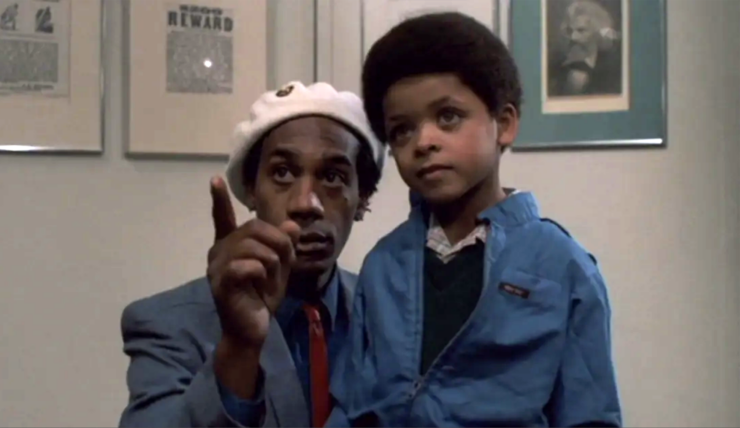
The Brother From Another Planet (1984) Directed by John Sayles. Starring Joe Morton, Darryl Edwards, Steve James, Bill Cobbs, and David Strathairn. Screenplay by John Sayles.
Over the past several weeks we’ve watched movies that were inspired by literature, political events, and other films, so it’s time for something different. It’s time for a movie that came to the director in a series of dreams.
In a 1984 interview with Cinefantastique, John Sayles describes where he got the idea for The Brother From Another Planet. But he doesn’t simply say he dreamed up the idea. He explains that he had three different dreams with snippets of scenarios that weren’t good ideas for movies, but together they led him to a workable idea. He wrote the screenplay in six-day flurry, then made the movie using his own money, which included some from a MacArthur Genius Grant and some from the payment he received for the screenplay adapting Jean M. Auel’s Clan of the Cave Bear.
The Brother From Another Planet was filmed across for four weeks on location in Harlem in March of 1984, mostly at night and in the cold, with locals working as extras and an almost entirely Black cast and crew. That crew included cinematographer Ernest R. Dickerson, who was a relative newcomer at the time but would go on to work as director of photography with his film school classmate Spike Lee (including Do The Right Thing (1989) and Malcolm X (1992)) and is now a prolific television director. (Sayles and Dickerson also worked together on Bruce Springsteen’s “Born in the USA” music video.) Sayles and producer Maggie Renzi play roles in The Brother From Another Planet, and Sayles resigned from the Director’s Guild before filming, not because he opposed the Guild’s requirements, but because he couldn’t afford to hire assistant directors.
In other words, The Brother From Another Planet is an indie movie in every way: a passion project made cheap and fast with no studio backing or financing, but with a hell of a lot of talent behind it. It opened in arthouse theaters before expanding to mainstream theaters in large cities, and did end up making quite a profit compared to its budget, but nothing about this film was ever meant to be a big, splashy cinematic spectacle. That makes it quite different from the other films I’ve covered in this column so far, although it’s definitely not the last small-scale indie film we’ll watch.
We begin with an opening so unsubtle that it’s charming in its audacity: An alien from outer space crash-lands on Ellis Island. We even get a close-up of the sign that reads “ELLIS ISLAND IMMIGRATION CENTER,” just in case we’re in danger of missing the point. The alien (Joe Morton) looks basically human, with the exception of his three-toed feet—and his ability to regrow one of those feet after it’s severed in the crash. He spends an uneasy night in the historic building, hearing echoes of the past via some psychic ability, before catching a ride across the water and into the heart of New York City.
He is both bewildered and awed by what he sees as the quiet early morning gives way to the fast-paced daytime bustle. When he becomes overwhelmed he takes refuge in a sleepy neighborhood bar where the owner (Steve James) is listening to his regulars (Leonard Jackson, Bill Cobbs, and Daryl Edwards) complain about things they’ve obviously complained about a million times before. The older guys miss when Harlem was hip and thriving, but the good old days are gone. This is Harlem in 1984. Times are hard for everybody.
The men don’t know what to make of the stranger, but they help him out. They introduce him to a social worker (Tom Wright), find him a place to stay, and get him some odd jobs fixing arcade games and small appliances—which he can do easily thanks to his alien powers. As he’s getting used to this new life, a couple of alien men in black (John Sayles and David Strathairn) show up looking for him.
The alien hunters provide only the loosest plot structure, but that’s to the movie’s benefit. So much of its charm comes from the vignettes that show the alien navigating life on Earth amongst a brilliant cast of characters, every one of them wonderfully, wholly human: the scene-stealing old guys in the bar, the alien’s temporary landlady and her small family, a fellow arcade worker, a pair of lost tourists from Indiana, a charming nightclub singer. Not all of the vignettes work—the subplot about hunting down a wealthy uptown drug dealer is very clunky—but the majority of them are great, and a few are sublime.
My favorite scene in the entire movie is one of these perfect little gems. The alien is riding the subway when a young man (Fisher Stevens) offers to show him a card trick. The fast-talking card sharp’s trick is an elaborate story that doesn’t have any ulterior purpose. He’s not trying to hustle or cheat the alien; all he’s doing is showing off. He’s very much aware that his silent one-man audience is reacting with confusion and discomfort, but he rolls with it in an easy, accepting manner, building up to the moment the subway reaches his stop. There, the card trickster offers to show the alien one last trick—“I’ll make all the white people disappear”—which he says with a sly but not unfriendly look, right before he and the other white folks exit the train, and of the passengers who remain are the people of color. It’s a moment of connection and an acknowledgement of division, funny and fast but also warm. It’s such a brilliant scene.
Throughout the film, the alien is never named; he’s completely mute and doesn’t introduce himself, although he can understand and communicate. The other characters only ever call him “brother.” We learn nothing about his life before the crash; the only context we get for why the other aliens are pursuing him is a silent exchange with a young boy in a museum exhibit about enslaved people. That might be a problem with a different actor at the center of the film, but Joe Morton’s performance is phenomenal. He’s captivating every moment he’s on screen, with every thought and emotion showing through his expressions and body language. The alien adapts to life on Earth not by directly mimicking what he sees, but by observing and interacting. He’s not a cipher or a mirror, for all that the other characters project their own experiences and assumptions onto him; he’s a person who is learning and changing in a strange new world.
This provides a stark contrast to the alien slave-catchers, who have no interest in getting along with the people of Earth. They view humans as mere obstacles preventing them from catching their quarry. From the human perspective, the men in black are pegged by literally everybody the meet as wrong. It isn’t just that they’re white men in a majority Black neighborhood. The tourists from Indiana in search of their self-actualization conference also stick out like sore thumbs, but they don’t have the same air of disdainful superiority and, as a result, are not treated with the same hostile suspicion. It happens again and again: the humans interpret the alien slave-catchers as cops or government agents, as that is the best human explanation for how off-putting they are, but everybody is aware that it’s not quite right.
I’ve come across a few critics, writing both when the film came out and in later retrospectives, that interpret The Brother From Another Planet as a story about immigrant assimilation. But I don’t think assimilationis what the movie is going for. The film never translates or subtitles any of the non-English languages the people of New York are speaking, and multiple characters are openly hostile toward any hint of policing or immigration enforcement. The overall effect is, in a broad sense, anti-colonial rather than pro-assimilation: the community will welcome you if you aren’t trying to change or exploit them.
Sci fi films with extraterrestrials have always been used for political storytelling, but for a couple of decades after World War II that often meant using aliens as a threat to say something about how humans act and what humans learn in the face of great danger. The aliens might bring a benevolent warning (The Day the Earth Stood Still), present a cautionary example (The Mysterians), represent an overwhelming or repulsive danger (1953’s The War of the Worlds), or serve as an allegory for common fears and paranoia (1956’s Invasion of the Body Snatchers). But starting in the second half of the ’70s, there were more movies telling stories about visiting Earth from the aliens’ point of view. This often meant a more personal exploration of what the alien visitors want, from the kids who are just trying to find their family in Disney’s Escape to Witch Mountain (1975) to David Bowie trying to save his planet in The Man Who Fell to Earth (1976), from the alien castaways who want to go home in E.T. (1982) or Cocoon (1985) to the alien refugees who have to make Earth their new home (Alien Nation, 1988).
It’s not that the other flavors of extraterrestrial film became less common during the late ’70s and into the ’80s; there were still plenty of alien movies being made about monsters and wars and invasions. But the genre did open up to make more room for extraterrestrials who were more us than them.
The Brother From Another Planet is but one example of that shift—and the film knows it. When the alien is with nightclub singer Bernice (jazz legend Dee Dee Bridgewater), there is a moment when Bernice laughs a bit at herself for spending the night with a man whom she knows nothing about, and she wonders, “How come I like you so much? You could be anybody.”
He could be anybody. That’s why this is a movie about an alien and not just some random guy lost in New York. They could be anybody. The tone and style of the films will change, the politics and themes will evolve, but we’ll never stop making movies about aliens coming to Earth, because they could be anybody, and that’s an irresistible opportunity for lovers of science fiction.
What do you think of The Brother From Another Planet as a different type of alien movie from those we’ve watched so far? What about the more indie aspects of its style: the ensemble of vivid characters, the vignette-like structure, the high-color but grounded cinematography? Which of the scenes were your favorites?
Next week: I have no idea what I’ll find to say about Close Encounters of the Third Kind that hasn’t been said hundreds of times before, but I won’t let that stop me… Watch it on Apple, Amazon, Google Play, YouTube, Vudu, Microsoft.

Saw it and loved it when it came out. Incredible acting performance by Joe Morton and the entire ensemble.
Next do Repo Man from the same era.
Joe Morton is truly incredible in this film! Just a joy to watch in every scene.
And yes, Repo Man is on my list! I’m not exactly sure where to fit it in–maybe we’ll do a month with some the best cult classics from the ’80s. That would be fun.
The life of a repo man is always intense.
“An ordinary person spends his life avoiding tense situations. A repo man spends his life getting into tense situations.”
:-)
I figured this series went on hiatus for life reasons or whatever because I check the Latest page(s) here every day or so — and go through until reaching where I left off last — but hadn’t come across a new entry since Ikaris XB-1. Just now, clicking through the “SF Film Club” link atop this post, I see the last couple did go up as scheduled. I even did a site search for The Mysterians a few days ago with no joy, so if you (or Reactor at large) find engagement with this series lower than expected I have a feeling such glitches are to blame.
Re Brother from Another Planet in particular, I haven’t seen it since college and was hoping to watch again before discussion began; I might yet try to do that before reading. Glad to see the series is still going but frustrated to have fallen behind / missed participating.
I remember my sister was quite fond of this film, which was a regular in the rotation at our city’s downtown art/indie theater. I only saw it once, though, either edited for TV or on a rented video, and the only part that stuck in my memory was the “Yamutha” song that accompanied the bar fight, because I found it very distasteful and obnoxious to build an entire song around a childish insult (indeed, I was convinced the lyrics consisted exclusively of those same five words, though it turns out it’s just the refrain).
Seeing it again now, I found it mostly effective, though longer than it needed to be. The first half as the Brother observes and adjusts as life goes on around him was quite engaging, and I liked the exploration of Harlem culture and history. But the whole drug subplot was vague and confusing and seemed like something tacked on as a concession to Hollywood formula. The bit where he suddenly got interested in women and fell for the nightclub singer didn’t really work for me either.
Still, I like the story at the core, and the eventual revelation that the Brother isn’t the first escapee to come to Earth, and implicitly that he didn’t come by accident. The Underground Railroad allegory was effective. The movie has some thematic resonances with Alien Nation, another movie (and vastly better TV series) about alien slaves seeking freedom and a new life in America. Whereas the Brother, with his glowy healing powers and his gentle-innocent nature, is reminiscent of the title character from John Carpenter’s Starman, which came out only three months and a week after this movie (and which also had a pretty good TV series adaptation).
It was interesting to see David Strathairn at this age; he was hardly recognizable. Meanwhile, John Sayles as the other MiB looked surprisingly like John Cleese, if John Cleese were playing Agent Smith from The Matrix.
Is Man Facing Southeast on your list? That was the rep-house double feature back in the day.
It wasn’t before, but it is now! Thanks so much for the suggestion!
I loved when the hunter aliens went to the social services office and demanded cooperation. Cue malicious compliance FTW
(Very late reply as I was traveling…) Fun fact! The actor who plays that civil servant is Maggie Renzi, one of the film’s producers! And I agree so much–that scene is a complete delight. Perfect example of escalating a joke just enough for maximum effect.
I always thought that the lack of funding for indie films in the last decades would force John Sayles to go back to genre films, if not horror at least some urban fantasy or science fiction, and yet here we are.
Finally got a chance to watch this one, and I thought it was a fascinating way to use sci-fi as a lens to examine the Black experience in America. It was very well done. Also kind of crazy to see David Strathairn in this, I didn’t recognize him at all until I read the article.
I didn’t recognize him either! I did a double-take when I saw the credits.
I loved learning years ago that the way that Mr. Sayles made the slave-catchers look “wrong” was by having them (himself, Mr. Straitharn) walk backwards out of the bar, then reversed the film to show them “entering” into it. Just off-kilter enough to give them “uncanny valley” body language.
Yes! I love that fact! And uncanny valley is the perfect way to describe their body language. It’s just weird enough that everybody clocks them as not-quite-right.
Really enjoyed this movie! The card trick scene was also one my favorite ones. The drug plot was very confusing and unnecessary, but it didn’t ruin the experience at all!
I haven’t watched this movie (on VHS) since I was in my early teens, back in the 1990s. I remember my father recommended it to me, perhaps largely on the strength of the “keep an eye out” gag.
I vaguely remember the pacing feeling a little slow, but as a white suburban kid, I may also have been missing a lot of what it was putting down. Probably worth a revisit.
finally getting to watch this. seeing so many things that remind me of other films. in particular, the entryway into Marine Midland Bank (had an account in the 80s when I was a student upstate) looks a lot like a scene from The Matrix. there are shades of The Usual Suspects, and half a dozen other subsequent films. did this have deep and broad influence that I hadn’t imagined, or am I just seeing topical tropes from the 80s??
oh, and the performances are exquisite. Fisher Stevens is always a favorite, but that card sharp bit is awesome. Caroline Aaron is hilarious. there’s a lot here – superb character studies.