







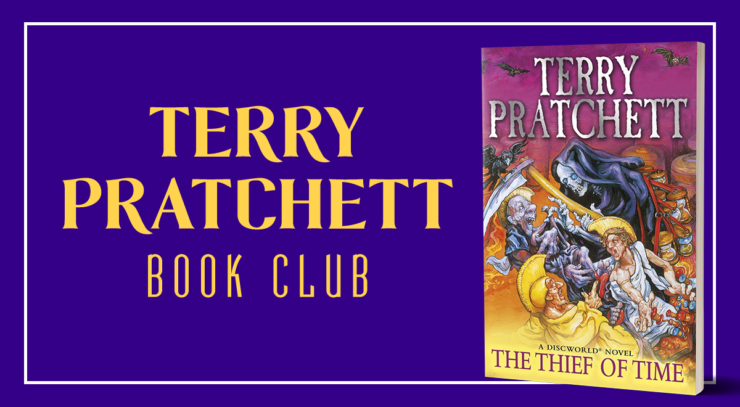
Hickory dickory dock, the Death of Rats ran up the glass clock that stopped Time—or however that dang thing goes…
Summary
Susan and Lobsang are being tracked down by the Auditors in the museum, but come upon a set of signs designed to trap them (one says “Turn Left” but points right, and similar). Eventually a figure comes to their rescue, killing one of the Auditors by shoving a chocolate into its mouth—it’s Lady LeJean, and she takes them up to the attic. There are frozen people who generally live up there, and Lady LeJean is living up there too, and trying to hide and learn, knowing the Auditors have to be stopped. She tells them that Jeremy is just down the passage, and Susan explains that he exists outside time too; he’s Lobsang’s brother. It’s a lie, but Susan needs to make sure they’re safe before she sits Lobsang down and tells him what Nanny told her; they’re actually the same person born twice. She also tells him that his mother is Time. When Lobsang talks, Jeremy mouths the words in his sleep. Lobsang decides to touch Jeremy, everything whites out, and when they come to, Susan sees that both Lobsang and Jeremy are gone… but there’s ribbons of light following her and Lady LeJean, who head to the elevator to get out. The specter (memory) of Lobsang/Jeremy tells Susan to get to the clock, so she and Lady LeJean head off to arm themselves with more chocolate.
Buy the Book
Witch King
Lu-Tze discovers Ronnie true name as they ride through the city, while Susan and Lady LeJean invade the chocolate shop. Susan realizes that the Auditor’s name actually translates roughly to “innumerable legion” and suggests that she change her name to Unity to remind herself that she is one person. Lu-Tze tries to be encouraging to Ronnie, who is actually the personification of Chaos—that’s the name Soak spelled backwards, of course. But Ronnie doesn’t take well to the encouragement, so Lu-Tze goes for insults instead. Ronnie vanishes, leaving behind a group of Auditors who Lu-Tze tries to outwit, but certain Auditors are getting smarter and not falling for the usual tricks. Voices come up on the edge of his senses, and chocolates are thrown across the road, and Lu-Tze almost winds out of time but Susan winds him up again. Death tells the Auditors what is happening is wrong, and as he does this, another figure arrives: the angel clothed in all white of the Iron Book from the porches of Tobrun. Death has to inform him that he’s no longer official in church Dogma, and therefore should not be here. The other horseman arrive and they all notice that the Auditor is behaving like an individual. Death tells it that though they are supposed to ride out, it isn’t written against whom.
Kaos reorders himself around the current concept of chaos (which is basically chaos theory) and rides out. The chocolate-fighting group decides that they need to be unpredictable to distract the Auditors in the way of the clock, and both Unity and Lobsang know that Lu-Tze should be the center of that distraction because he’s going to die. The horsemen are having a hard time, and Death realizes that it’s because the Auditors are effecting how they think because they’re all a bit too human. He tells them to shore up against it, and that’s when Ronnie shows up to ride with them. Lu-Tze’s head is cut off, but he’s still alive because he’s tried the yeti trick. Lobsang takes Susan’s hand so she can make it toward the clock. When they finally arrive, Wen is there holding the Death of Rats, and Lobsang gets to meet his mother. Wen takes Susan aside to talk, and Susan notes her confusion that Lobsang built the clock and is now aiming to destroy it, effectively destroying and saving the world at once. Wen points out that it’s a family trait—this is what Time does. When the conversation is finished, Susan learns that Lobsang will become Time now. Lobsang breaks the glass clock and shatters history, sending them out into the world again.
They find Lu-Tze and Unity, and head to the History Monks’ valley, where the spinners are a mess. Susan realizes that once Lobsang fixes this, he will vanish afterward; he’s no longer human enough to exist as one. Lobsang gets the Procrastinator room running again and is gone. Susan and Unity leave, and Unity asks if Susan liked Lobsang as she had liked Jeremy. Susan doesn’t want to follow that track of conversation and says she’ll help Unity is there’s anything she needs—Unity says she wants hope dying. Lobsang shows up in Lu-Tze’s garden and asks if the fifth surprise of the garden is him. Lu-Tze says he will have to go to the Iron Dojo to fight him and find out. Lobsang finds out from the abbott that by agreeing to this only one of them may walk out. Lobsang asks that Lu-Tze tell him the fifth surprise and he will not harm him. Lu-Tze produces a goofy carnival mask, which he puts on—he never claimed the fifth surprise was any good. They fight, but Lu-Tze beats him; the only way Lobsang can win is by using his powers and turning the man to dust, which he won’t do. Lu-Tze declares that he’s earned his yellow robe, but he won’t take it: He wants the robe of a sweeper. Death and Chaos help Unity die by giving ing her chocolate, and Lobsang shows up in Susan’s classroom cupboard where she’s gone to sneak a chocolate for herself: Even with the nougat center, it’s a perfect moment.
Commentary
Sorry, I just:
IT IS BIG, AND YOU ARE SMALL, AND AROUND YOU THERE IS NOTHING BUT THE COLD OF SPACE, AND YOU ARE SO VERY ALONE.
The other three horsemen looked unsettled, nervous.
“That’s coming from them?” said War.
YES. IT IS THE FEAR AND HATRED THAT MATTER HAS FOR LIFE AND THEY ARE THE BEARERS OF THAT HATRED.
So whenever you feel too afraid at your own smallness against the universe’s vastness, that’s the Auditors talking, taking up space within you. Because they are afraid of life. This is a tool to help when you feel tiny and insignificant and scared. And he’s offering this lesson through Death because Death is basically the closest that Pratchett ever gets to the concept of a benevolent god. Death can make sense of the things that we feel too little to understand.
It’s fine, I’m fine.
I do, however, have one complaint, and it is a very me complaint: It’s lovely, but I don’t think that Lobsang and Susan are actually that… romantic as this beautiful little button on the story? On paper it sounds great—son of Time, granddaughter of Death, who is herself perhaps the personification of helpfulness—by it actually lacks that little twist I was hoping for… which Susan and Unity.
Unity who was innumerable, who was an Auditor, the thing that Susan hates. The two of them pining for the same man, and then realizing that there’s something else going on here. It’s a twofold problem for me, which is part that Pratchett doesn’t really showcase queerness very directly in most of what he’s writing, and also the fact that he tends to treat romance as an afterthought because he’s a pragmatic (and very very British) sort of mind. Susan is sensible because there’s a bit of Susan in him. But Susan was also spending this story looking for the person like her, and it’s so much more moving to me if the person she actually needs is not someone very like her at all.
And I get it, the idea of being in love with Time is just a very sexy thought in abstract, but he already did that in this book with Lobsang’s mother and Wen. Unity is something entirely new, and thematically jives in an entirely different way with Susan’s difficulty with regular people. She’s just the more interesting pick to my mind. And there’s also one of my favorite tropes in there to consider, being the fact that being a woman is entirely incidental to her—she just wound up with the body she had, and figuring out how to be a lady is baffling. Susan trying to help her is equally hilarious.
So it’s fascinating to me because on some levels this book just speaks directly into my brain on the right frequency, but then there’s other bits that feel so discordant, it knocks me off axis. Which is an interesting experience to have in reading, really. I’m not actually complaining about that part. It’s just weird to have certain halves philosophically jive and then scrape up wrong on the other side.
So this is the last Death book, and I’m going to miss having them centered, but this is a fascinating final chapter, as it were. Not that there are final chapters where he’s concerned. Obviously, we’ll be seeing him everywhere, all the time.
Asides and Little Thoughts
- There’s another bit like Death’s acknowledgement of feeling small and insignificant, which is Susan noting that Auditors get into our heads, and that you know it’s them when you find yourself thinking things like “there ought to be a law” and suchlike. Which is equally disturbing.
- Susan has realized that being sensible doesn’t make her right, and that’s growth, girl.
- Just don’t ask about salad cream, says the footnote. It’s right.
- I do love how the horsemen talk about Chaos like their fifth Beatle.
Pratchettisms
The woman looked at the world through panda eyes and her lipstick touched her mouth only by accident.
And this, Susan knew, was her mind telling itself a story.
There was only one survivor and, when Miss Tangerine ate the chocolate, there wasn’t even that.
Lu-Tze regarded the speaker. She looked like a society lady who had just had a really bad day in a threshing machine.
The world had run out of horizons.
In order to fear, you had to be a me. Don’t let anything happen to me. That was the song of fear.
It was a work of art, the sword. It had imaginary velocity, negative energy, and positive cold, cold so cold that it met heat coming the other way and took on something of its nature. Burning cold.
And, as she ran toward it, it moved away. The floor unrolled in front of her, dragging her back. The clock accelerated toward some distant event horizon. At the same time it grew bigger but became more insubstantial, as if the same amount of clockness was trying to spread itself across more space.
All right, this thing was one of them, it was merely wearing—well, at least, had started out merely wearing a body as a kind of coat, but now…after all, you could say that about everyone, couldn’t you?
Next week we start The Last Hero! Which is also, coincidentally, the last Rincewind novel. We’ll read up to:
I THINK WE SHALL HAVE TO CLEAR THE DECKS FOR THIS ONE, said Death

Isn’t Unseen Academicals technically also a Rincewind book? Man, I need to do my own reread. Only problem there is my son just started the series so I’m basically reading each book before he starts it and he’s only halfway through Light Fantastic.
favorite moment
I pretty much love everything about this book, from the eldritch horror that is Jason to the fact that Pterry (GNU) literally didn’t know who the 5th horseman was until he came up with the mirror thing.
And, of course, Untity’s “Death by Chocolate”.
One of my favorite bits, though, is when the band gets back together:
Thoughts
Susan meets LeJean and we discover the Auditors’ weakness – chocolate (presaged by Susan finding the last of her chocolates was nougat “damndamndamndamn!”).
Lobsang meets Jeremy. It turns out we interpreted Nanny’s “he” wrong. They’re not twins, they’re one person in two bodies. They merge, creating Time’s son, a noncorporeal spirit who needs to get to the clock.
Lu-Tze gueses Ronnie’s real name (which was easy, even for someone who had never seen Get Smart). It was Kaos, Soak backwards.
The Horsemen eventually heed Death’s summons but don’t do to well against the Auditors until Chaos (nee Kaos) shows up with his infinitely long, cold sword. Death (who I still think is Ringo) welcomes him back to the band).
It turns out (for those who questioned the yeti scene earlier) that Lu-Tze had studied the yeti to learn their reincarnation trick.
Lobsang and Susan enter the clock and Lobsang talks with his mother, Time, while Susan talks with Wen. Time is going to retire and Lobsang will become the new Time. Also the Death of Rats is rescued (or evicted) from the clock before it is destroyed.
We then get the happily ever after endings, assuming Unity nee Myria LeJean’s wish to die counts (and I believe it does). We also get to see Soto using Qu’s exploding Oddjob hat.
But while the book ends with Susan and a corporeal Lobsang finding true love and snogging in the Supply Cabinet, I’d prefer to conclude with Wen’s words to Susan, “Sooner or later everything causes everything else.”
Thoughts on Emmet’s thoughts
“So whenever you feel too afraid at your own smallness against the universe’s vastness, that’s the Auditors talking, taking up space within you” and, obviously you should immediately consume mass quantities of chocolate.
As far as Susan and Lobsang vs. Unity, I think the key here is Unity’s lack of immortality. From Susan’s perspective Unity, like the animals in the classroom, is destined to die and I can’t imagine Susan wanting a series of temporary relationships. Plus I think Pratchett felt that Susan had no more books in her future and wanted her to have a fairy tale ending.
But far more important is Unity’s perspective on death. Note that this is several years before Terry Pratchett learned of his own pending death but his desires mirrored Unity’s. As one who will probably decline into dementia, I agree with both of them, although mine would involve a single malt and a cigar.
Pratchettisms
“How do you know it’s Man with Big Fig Leaf?” (Lobsang) “I just happen to remember where it is, that’s all.” (Susan)
“I was one of them,” said Lady LeJean. “Now I rather think I’m one of me.”
“Oh, where are my manners? Do sit down. Pull up a small child.” (LeJean)
“But I (Nanny) was thinking, you’re in trouble now my girl, ‘cos it’d all gone myffic.” “Mythic?” said schoolteacher Susan. “Yep. With extra myff.”
There was a discreet drain in the pavement in case people standing in front of the window drooled too much.
Then the teacher within her cut in and added “I hope you brought enough for everybody.” (Susan)
“I suppose . . . because in this world, after everyone panics, there’s always got to be someone to tip the wee out of the shoe.” (Susan)
@@@@@#1 – Only insofar as we see Rincewind in a single scene halfway thru the book. Unseen Academicals is The Lower Decks of the Unseen University focused on the younger generation trying to figure out how to live and survive and thrive in the city.
Another Pratchettism: Ankh-Morpork chocolate was formally as “cheese” and only escaped, through being the wrong color, being defined as “tile grout”.
The bit about being able to follow the directive when there is no elephant took me back to the first week of Geometry, in which we learned the “truth table” for “P implies Q”; the proposition is considered true if P is false, regardless of Q. But the Auditors probably never went to school….
Gandalf said “He who breaks a thing to find out what it is has left the path of wisdom.” That applies to Auditors, though they were never wise.
Kaos and Lu-Tze discuss the original Horsemen becoming less feared, and say Famine isn’t feared in cities, where people “think food grows in stores.” Urban individuals can and do fear (and sometimes-fatally experience) starvation if they can’t afford to buy food (or sufficiently nourishing food). But I guess that’s different from the type of famine where there’s little or no food in the vicinity at all, which can also happen to cities but is probably less constantly on the collective societal mind than it is/was in communities of subsistence farmers who incessantly live one failed crop away from death.
I love that Famine decided to help save the world because a specific food was worth fighting for, though I wouldn’t like salad cream sandwiches.
Thief of Time was a 2002 Locus Award nominee.
Pratchettisms:
“Do unto otters as you would have them do unto you.” –– Lu-Tze misunderstanding Mrs. Cosmopolite
“[..] sanity is defined by the majority, I’m afraid.” — Unity
“Against one perfect moment, the centuries beat in vain.” — Wen
“There is no doubt that being human is incredibly difficult and cannot be mastered in one lifetime.” — Unity
Looking back:
The L-Space Wiki says Wienrich and Boettcher “seems to be” the then-unnamed shop where Death bought chocolate for Miss Flitworth. I don’t remember Reaper Man well enough to know why.
In Soul Music (I think), we’re told that Ysabell’s favorite food was ‘Genocide by Chocolate.’ Now Ysabell’s daughter is committing mass murder with chocolate.
Looking ahead:
There’s a reference to ‘the great chocolate centers of Borogravia and Quirm.’ But as the next book reveals, Borogravia’s state religion forbids the consumption of chocolate, a not-very-new edict. The L-Space Wiki speculates that production for *export* is permitted, and that the original Herr Wienrich and Frau Boettcher might have been Borogravian refugees fleeing persecution and relocating in a place where their products can be locally sold, albeit to a populace partly conditioned to allegedly prefer very bad chocolate.
We’ll see Lu-Tze again.
According to this, the pagination of the next book is the same in all editions except the original hardback. So anyone who has the softcover version can just read up through page 69.
I recently re-read this novel and I enjoyed it much more than I did back in the 90’s 😁 Here’s my new favorite quote from the book:
“She’d never realized how much humans were controlled by their bodies. The thing nagged night and day. It was always too hot, too cold, too empty, too full, too tired… The key was discipline, she was sure. Auditors were immortal. If she couldn’t tell her body what to do, she didn’t deserve to have one. Bodies were a major human weakness.”
wrt Susan+whoever, haven’t we already seen her drooling (discreetly) over a boy in Soul Music? ISTR that wasn’t solely in the interest of justice, although I suppose she could be bi (or even figuring out her real interest once she’s not in a cloud of schoolgirls who mostly don’t have her peculiar background/outlook).
@7: I suspect there are a lot of Roundworld analogies to your speculation of chocolate in Borogravia being allowed only for export. Two that I know of (and Pratchett might have known):
* Jack Daniels “Tennessee Whiskey”, which is made in a county where it can’t be sold. (This was a line in their ads some years ago; Wikipedia tells me there’s now a tiny loophole.) Other distilleries in the area are in the same situation; I remember visiting a place near Lexington KY and being told they couldn’t even give free samples.
* On a 1990 visit, the Carlsberg (Copenhagen) tour guide said that beer in cans wasn’t legal in Denmark; they had to deliver locally in bottles (which had a substantial deposit) but packaged in cans for export to countries that ~”don’t care as much about the environment”.
Oh, and for UK readers (I don’t know about other countries) this was the last Pratchett to have a Josh Kirby cover illustration. He had done them all – as well as the Bromeliad trilogy. A long established SFF illustrator, he died after doing this cover and would be replaced for the rest of the UK Pratchett first editions with Paul Kidby who gets a big intro in The Last Hero – or in the UK first ed anyway.
Several questions.
1. The angel says: “I’ve been thrown out? Just like the damn rabbits and the big syrupy things?” What is this referencing? Moreover, what is the point of the angel? The whole point is people have to believe in you, and if nobody believes in the things the angel represents, why does xe show up at all?
2. “‘But now I have time,’ said Lobsang earnestly. ‘And I hope she’ll understand.'” Who is this “she”? His mother, Time? What does she need to understand?
3. Time retires, and Lobsang replaces her. What does it mean for an anthropomorphic concept to retire? Is there a point Pratchett is making here? Do we know what Time’s plans are after this? (If, indeed, “after” has any meaning for her.)
4. What is the point of the scene in which Lobsang refuses the yellow robe?
5. Emmet says, “[Pratchett] tends to treat romance as an afterthought because he’s a pragmatic (and very very British) sort of mind.”
What does this mean? Do the British have some sort of special relation to romance that differs substantially from the American (or other Western) concept of romance?
Susan realizes that the Auditor’s name actually translates roughly to “innumerable legion” and suggests that she change her name to Unity to remind herself that she is one person.
This is another odd bit. This isn’t the only time that Pterry has used “Unity” as the name for a female character; one of Angua’s awful relatives (in “The Fifth Elephant”) is mentioned as Unity. And in that case, it makes sense, because Angua’s awful brother Wolfgang is basically a Nazi. And the only famous person in Roundworld to be called Unity was Unity Mitford, one of the awful Mitford sisters, who actually was a Nazi. This is an association that’s very obvious to Pratchett’s readers, or at least his British readers… so it’s weird that Myria’s turn to the good is marked by her taking the same name rather than, say, Una.
Ankh-Morpork chocolate was formally as “cheese” and only escaped, through being the wrong color, being defined as “tile grout”.
This is a joke for British audiences of a certain age. Back in the 1980s, before the British got good at food again, their chocolate was particularly terrible. Really bad. It contained very little cocoa and was bulked up with vegetable fat. It was so bad that French chocolate producers lobbied (without success) for the EEC to ban British manufacturers from calling it “chocolate” and suggested “vegelate” as an alternative.
It’s a joke echoed in “The Fifth Elephant”, in which Inigo remarks that an Ankh-Morpork sausage does not contain enough meat to be legally a sausage in Uberwald, and would be classified instead as “a loaf” or possibly “a log”.
Urban individuals can and do fear (and sometimes-fatally experience) starvation if they can’t afford to buy food (or sufficiently nourishing food). But I guess that’s different from the type of famine where there’s little or no food in the vicinity at all, which can also happen to cities but is probably less constantly on the collective societal mind than it is/was in communities of subsistence farmers who incessantly live one failed crop away from death.
Famine generally isn’t a problem of there not being enough food; it’s a problem of people not having enough food. Democratic countries at peace never experience famine – they are pretty much invariably a political event (though very often a crop failure of some kind is a contributing factor). So, while you’re right that famines tend to be less of a worry in cities, that is because governments will generally prioritise getting food to the cities, for whatever reason – maybe because governments tend to live in cities, or because cities are a centre of state capacity (manufacturing, tax base, recruiting etc), or because a rebellious city population is much more of a threat than a rebellious scattered rural population, or because the government actively wants to reduce the rural population as a matter of policy by emigration (Ireland 1846) or just by killing them all (Ukraine 1931).
The big exception is when a city is under siege, of course, or otherwise cut off by force from its normal food supplies. Then you’ll get famine conditions in cities.
@14: The Wikipedia page for “Unity” lists five notable people and a wide variety of things, including the possibly-relevant politival concept of “unity in diversity.”
@13 – We got a look at what retirement means for an anthropomorphic personification when Death retired (or at least took a break and let his apprentice handle things) in Mort. And he was made redundant in Reaper Man, but he didn’t enjoy that very much.
@13 – Are you at all familiar with the phrases “Lie back and think of England” or “No sex please, we’re British”?
We’ve got a stereotype that we worked long and hard for, and we still have it to some extent depsite the best efforts of the writers of Hugh Grant films.
The Wikipedia page for “Unity” lists five notable people and a wide variety of things, including the possibly-relevant political concept of “unity in diversity.”
And of those five people I have heard of exactly one (the worst one), and it’s the same one that Pratchett had heard of and actually referenced directly in an earlier novel. I assure you that if you put a female character called “Unity” in front of a British audience, 99.9% are not going to think “Ah, a shout-out to Botswana’s former Minister for Foreign Affairs and International Cooperation!”
I’m not saying that Pratchett deliberately intended us to think that Myria/Unity was a baddie; I’m just saying it’s an odd choice of name, given that he provably has the same associations with that name that I do and that most British people do. It’s like, if I wanted to start a political movement whose philosophy revolved around “working together in unity”, I probably wouldn’t pick the symbol of a bundle of sticks tied together.
@13 – The she Lobsang refers to is Susan.
I assume refusing the yellow robe of a master and instead accepting the sweeper’s robe is an indication that Lobsang wants to serve rather than rule.
I am as befuddled as you about the angel. I assume its appearance has something to do with the Book of Revelation where, as I recall, an angel announced the breaking of the seals. But the rabbit and blob are, I assume two things from Small Gods that I don’t recall at all.
The whole point is people have to believe in you, and if nobody believes in the things the angel represents, why does xe show up at all?
The angel is inconsistent; sometimes takes “it” as a pronoun and sometimes “he”, but never “xe”.
p367: ‘Ha! You’re Famine, then?’ said the Angel of the Iron Book. It fumbled with the heavy pages again.
p369: Floating in the air above him, the Angel of the Iron Book slammed the pages back and forth in an effort to find his place.
But the rabbit and blob are, I assume two things from Small Gods that I don’t recall at all.
They’re a callback to a joke a few pages earlier; Kaos is talking about an earlier version of the Book of Tobrun that included what sounded like drug hallucinations.
The angel may be more significant than we thought. I read the relevant Apocalypse section and it starts father god holding a scroll that no one can open until the lamb (son god) takes it and begins to read it. The angel doesn’t understand why things aren’t going as they were written.
IT IS BIG, AND YOU ARE SMALL, AND AROUND YOU THERE IS NOTHING BUT THE COLD OF SPACE, AND YOU ARE SO VERY ALONE.
Just reading that and the succeeding paragraph made me cry, again.
Whenever I hear the word “unity,” I happily remember a little Maine town which hosts my favorite festival in the world. Before this week, I didn’t know it was the name of anyone outside the Discworld books.
@24 – I’m in the same boat. I’ve never heard of a person named Unity. I assume the inspiration is from math (or maths on Pratchett’s side of the pond) where unity means the number one.
Until today, I wasn’t at all familiar with Unity Mitford. The only other person named unity I knew of was Unity Kinkaid in Sandman, and it didn’t register as more or less unusual than many other English names.
As for the meaning, “unity” literally means “oneness”, a coming together of many into one. It’s a fitting name for a myriad/legion coalescing into a single person.
My thought was that “Unity” might be some sort of offbeat reference to “Trinity,” of the Matrix movies. But after a great deal of thought, I couldn’t see any relation there.
So now, I think like others, that it is a reference to making one person, rather than many.
24-27: I’m sure you all have no particularly bad associations with the name, but as I said that isn’t the case for Pratchett because he has heard of Unity Mitford, and we know this because he used the name for an actual fascist in “The Fifth Elephant” and so all I’m saying is that it’s a bit odd that he used it again here for a sympathetic character. I’m not saying that you’re bad people for not having heard of her, and I’m not saying you’re wrong to associate the name with a town in Maine or whatever.