







Lyn: Plays, pernicious polymorphs, and Patterns abound on this week’s installment of the Oathbringer reread! Ross is joining me again this week, as Alice is still on vacation.
Ross: Hi again, my Radiant friends! I’m glad I got to sit in on this chapter, as I feel it’s the hub about which the entirety of the Urithiru plot in Part One turns.
Reminder: we’ll potentially be discussing spoilers for the ENTIRE NOVEL in each reread. There are no spoilers for other Cosmere novels this week. But if you haven’t read ALL of Oathbringer, best to wait to join us until you’re done.
Chapter Recap
Buy the Book
Oathbringer: Book Three of the Stormlight Archive
WHO: Shallan Davar
WHERE: Urithiru
WHEN: 1174.1.4.3
Shallan finds an old theater in her exploration of Urithiru, and proceeds to “create” a play for Pattern’s benefit. She tells a tale of a girl in ages past who travels to a giant wall purportedly built to protect her people from a great evil. She climbs up it, only to discover that the wall was actually meant to keep her people—the monsters—separated from the peaceful society on the other side. As her illusions fade, Shallan sees a shadowy figure seated in the back of the room, watching. She gives chase but loses the disturbing spren down an air shaft. When she picks up its trail again in the market, she discovers that it has mimicked her attack on the large horneater man from an earlier chapter by stabbing poor Rock through the hand. She’s approached by a woman wanting to join the Ghostbloods, but turns her away.
Threshold of the storm
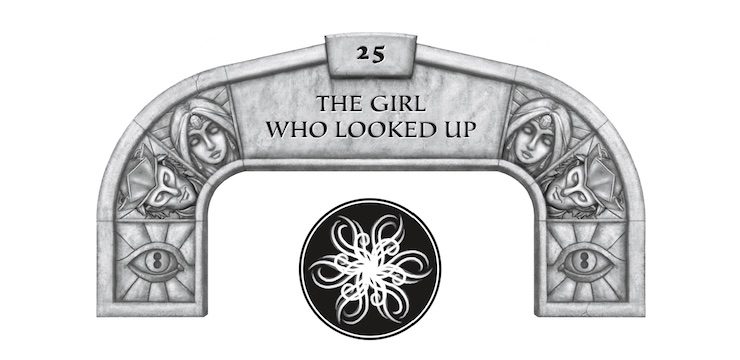
Title: The Girl Who Looked Up
L: It’s pretty self-explanatory where the title for this one came from.
Heralds
This chapter portrays two different characters, each shown twice. The first is Shalash, Patron of the Lightweavers, which is fitting seeing as how this is a Shallan chapter and our girl’s using quite a lot of her powers here. We can also draw a parallel to Shalash’s divine attribute of creativity, for the same reason.
The second isn’t a Herald—it’s a Mysterious Masked Character whom Alice tells me is the Joker—generally indicating some sort of Wild Card effect, or an appearance by Hoid.
R: I wonder if the Joker is here because of the creepy Midnight Mother murderspren or because of a thematic link to the reappearance of Shallan’s story later in the book, in the chapter “The Girl Who Stood Up”, which Very Definitely includes our buddy Hoid.
Icon
Pattern, indicating a Shallan POV chapter.
Epigraph
I will confess my murders before you. Most painfully, I have killed someone who loved me dearly.
–From Oathbringer, preface
L: I don’t really know what to say about this. It’s pretty straightforward. I suppose we could tie it into this particular chapter a little with the knowledge that both Shallan and Dalinar have the shared experience of having killed people they loved, a fact that Shallan is most certainly still struggling with here.
R: Question: How many murders are we talking about here? Just all the residents of Rathalas (plus Evi)? Or is there more pain buried in there?
L: It feels like more to me. I think Dalinar regrets all the lives he’s taken. I have literally no textual evidence to back this up, mind—just a feeling.
R: Sure, nothing will make you regret hordes of dead soldiers more than an epic worldwide battle-apocalypse.
Stories & Songs
“There was a girl,” Shallan said. “This was before storms, before memories, and before legends—but there was still a girl.”
L: I’ve gotta wonder if this is mostly just artful dialogue, or if there might be a seed of truth in it. The “before storms” bit is explained a little farther down (the wall blocks them out), but I find it hard to believe that there could be anything “before memories.” If that were true, how would the story have been passed along?
R: Plus, we have WoB that the highstorms (in some form) predate the arrival of Honor on Roshar. Methinks it’s artistic license. It actually reminds me of the way Rothfuss has his characters begin myths in Kingkiller. Whimsical, but with just enough information to catch a careful reader’s attention. It may just be a narrative signpost saying, “Here’s a myth, and myths Come From Somewhere. Pay attention.”
“The girl stared at those steps,” Shallan whispered, remembering, “and suddenly the gruesome statues on her side of the wall made sense. The spears. The way it cast everything into shadow. The wall did indeed hide something evil, something frightening. It was the people, like the girl and her village.”
L: From the end of the book, we know that this is allegory for the realization that the humans are the Voidbringers after all. They thought themselves the heroes, but in fact were the monsters, the villains, all along.
R: Who first told this story? Did it begin with the humans as a reminder that they’d been super naughty and ruined their last planet, so maybe they should try to back off on the dickishness 50% or so? Or was it told to the humans by the Listeners, for essentially the same reason?
L: That’s a really good question. Usually you can pinpoint who the initial storyteller was by who the villains are—history (and, often, myths) is written by the winners, after all. But it’s not quite so cut-and-dry in this story, is it?
R: Not by a long shot.
“She goes down and sees a perfect society lit by Stormlight. She steals some and brings it back.”
L: Echoes of Prometheus, here, stealing fire from Zeus to give to the mortals. Did the humans indeed “steal” the ability to utilize Stormlight from the Listeners? They must have… Stormlight couldn’t have existed on their planet, right? This is a really fascinating question (and one that I’m sure Alice would have had an answer for)—how exactly did the early humans learn to use Stormlight? I’m still so iffy on the ages-back-worldbuilding, it all gets mixed up in my head. Ross, do you know?
R: The humans brought Surgebinding with them, but that ancient Surgebinding probably wasn’t fueled by Honor’s Investiture, that’s true. It’s quite possible they were using Odium’s Voidlight before…
L: I wonder if one or the other is more powerful… the “original” Surgebinding via Odium’s power, or Stormlight?
R: We’ve seen some hints about differing potency, but those have also been muddied by human-versus-Listener usage. Venli might be a really good window into how the different forms of Investiture differ in the next book.
“The storms come as a punishment, tearing down the wall.”
L: Now here’s where I get more interested. How is the storm opening them up to a perfect society a punishment for them? If anything, this seems like it would be a punishment to the denizens of the other side of the wall, who have done nothing wrong and are now being exposed to the “monsters.” It’s possible that the analogy is just breaking down here as it has been told and retold over the ages, but… I wonder.
“It’s a lie, Pattern. A story. It doesn’t mean anything.”
L: Come on, Shallan. You’re smarter than that. You of all people should know that there are seeds of truth to every story, that they can reveal things about our natures and our societies that are deeper than the surface. Hoid would be so disappointed in you.
R: Pattern may be showing more maturity than Shallan here. As we’ll cover below, he’s already keyed in to the fact that stories mean something. If not about something historical, they tell a culture’s norms, and dreams, and fears.
Bruised & Broken
“I always imagined being up on one of these. When I was a child, becoming a player seemed the grandest job. To get away from home, travel to new places.” To not have to be myself for at least a brief time each day.
Too many memories of her father, and of her mother, who had loved telling her stories. She tried to banish those memories, but they wouldn’t go.
L: Simply taking note here of the reminders Sanderson’s dropping that Shallan is Most Certainly Not Healed.
R: Shallan really needs to take a page from Dalinar’s book (rimshot) and stop trying to dissociate from the fact that she totes stabbed Mommy Dearest through the heart with a magic intelligent teleporting sword. As Rosharan comic book character Chulley Quinn said, “Own that crem.” Only then will she be able to live with herself, long-term.
Squires & Sidekicks
“My name is Ishnah. I’m an excellent writer. I can take dictations. I have experience moving in the market underground.”
“You want to be my ward?”
“Ward?” The young woman laughed. “What are we, lighteyes? I want to join you.”
The Ghostbloods, of course. “We’re not recruiting.”
“Please.” She took Veil by the arm. “Please. The world is wrong now. Nothing makes sense. But you… your group… you know things. I don’t want to be blind anymore.”
R: Point 1 in Ishnah’s favor: she immediately recognized the Ghostblood symbol when she saw it.
L: Is that a GOOD point, though? We still know so little about the Ghostbloods and their motives. If someone today came up to me and said “Hey, I’ve heard about this group called the KKK, here’s their symbol” that wouldn’t exactly be a point in their favor.
She’s got some intelligence, yes. But whose side is she on? Does she know what the Ghostbloods are planning, and if she does, FOR HEAVEN’S SAKE let us in on it, won’t you, Ishnah? Are these the good guys or not? WHAT DO THEY KNOOOOOOOW?
R: I feel like the KKK is a touch less secretive than the Ghostbloods. And I imagine they know an awful lot! They’ve got a trophy case chock full of artifacts from other worlds, and are the best positioned, IMO, to be dealing in inter-Shardic politics (other than Hoid, the one-man secret organization of Dooooom).
L: But will they be using that knowledge for Good or Evil… that’s the big question.
R: Their symbol is triangles. Triangles are cool. (Having faith in things based on their shape is unlikely to lead to success anywhere except Sel, kids.) Also, come on. Ghostbloods? Whoever came up with that name wanted the group to sound badass, but didn’t have a lot of experience. Ghosts don’t have blood. These guys weren’t founded by a villain. My guess is they end up being sort of anti-heroish. Sometimes doing bad things for good reasons.
Places & Peoples
The tower of Urithiru was a skeleton, and these strata beneath Shallan’s fingers were veins that wrapped the bones, dividing and spreading across the entire body. But what did those veins carry? Not blood.
L: I’m actually kind of surprised that the idea of energy never even occurs to her. Shallan’s a smart one.
R: And they already have the concept of energy stored in gems. What happens if you Soulcast a long wire of gemstone and then infuse it?
L: Can… can they do that? Have we ever seen Soulcasters change gems into just… a different configuration of gem? Smoke, food, yes… but just changing the form from one thing to another? I wonder if that’s even possible. (Soulcasting reminds me in a lot of ways of alchemy, and now I’m wondering if there’s some sort of Equivalent Exchange thing going on in regards to the Soulcasters eventually turning into what they alter…)
R: Well, the Soulcasting properties of Diamond are “quartz, glass, crystal”, soooo maybe?
She walked around the edge of the circular room. The wall was scored by a series of deep slots that ran from floor to ceiling. She could feel air moving through them. What was the purpose of a room like this?
L: A delivery system, maybe? Like the tubes at the drive-thru at the bank? I suppose it could be as simple as ventilation, but you’d think Shallan would have picked up on that rather than thinking it all strange…
R: If you dropped an impeller in that round room and spun it, it would suck air from the center and force it out the slots.
L: So you think it’s a ventilation system then?
R: That seems like the simplest explanation. Which, considering Brandon’s thought process, could be utterly wrong.
Weighty Words
A dozen versions of herself, from drawings she’d done recently, split around her and dashed through the room. Shallan in her dress, Veil in her coat. Shallan as a child, Shallan as a youth. Shallan as a soldier, a happy wife, a mother. Leaner here, plumper there. Scarred. Bright with excitement. Bloodied in pain. They vanished after passing her, collapsing one after another into Stormlight that curled and twisted about itself before vanishing away.
L: At first I’d assumed that this was the Midnight Mother messing with her head, but the fact that they dissolve into Stormlight must mean that she’s making them herself. Is she deliberately creating a phantom army to confuse the enemy? Or is this subconscious, a sort of defense mechanism that she didn’t initially intend?
R: I can definitely see this as a precursor to the Lightwoven army at Thaylen City. Then, it was more on purpose, but this seems like a reflexive action meant to make her seem part of a crowd, instead of a lone girl.
A Scrupulous Study of Spren
“I could understand people… mmmm…. Through the lies they want to be told.”
L: This reminds me a little of Grand Admiral Thrawn in the old Star Wars Heir to the Empire novel (now sadly de-canon-ized, but still well worth a read if you haven’t checked it out before). He used a culture’s artwork to determine strategies by which to defeat and subjugate them. There’s something to be said about studying a culture’s fiction, artwork, and—yes, Pattern—their theater in order to understand them better.
R: I’d venture a guess that you’d learn more about folks from the lies they want to be told than by the truths they hold dearest, though there’s also rich cultural depth in how many of those truths are actually True, and how many have been shouted about by a majority until the opposition tired.
#PatternLovesFakeNews?
#Sorry
L: #notsorry
Creationspren had started to appear around her on the benches, in the form of old latches or doorknobs, rolling about or moving end over end.
L: I was curious about this, because I remembered creationspren being mentioned in WoK but I’d forgotten what they’d looked like, so I looked it up.
Creationspren were of medium size, as tall as one of her fingers, and they glowed with a faint silvery light. They transformed perpetually, taking new shapes. Usually the shapes were things they had seen recently. An urn, a person, a table, a wheel, a nail. Always of the same silvery color, always the same diminutive height. They imitated shapes exactly, but moved them in strange ways. A table would roll like a wheel, an urn would shatter and repair itself.
L: Interesting, then, that these ones chose to represent doorknobs. I wonder if there’s some significance to this… Why doorknobs, specifically? Representative of the doors opening (and unable to be closed) within her mind, perhaps? She did note that she’d seen some doors earlier, but I could have sworn that most of the doors in Urithiru were destroyed by the ravages of time.
R: Ummmm that’s a really good point. Shallan even notes the missing doors in this chapter. Is this an indication that the Midnightspren that was watching her entered the theater through a secret door?
“What happened?” Pattern said. “Shallan? I must know what happened. Did she turn back?”
L: I love how invested Pattern is in this story.
R: Cosmere Pun Police! You’re under arrest for not capitalizing the I in Invested.
L: Lock me up, copper.
R: Bahaha! You are forgiven.
A dark mass wriggled deep inside, squeezing between walls. Like goo, but with bits jutting out. Those were elbows, ribs, fingers splayed along one wall, each knuckle bending backward.
The thing twisted, head deforming in the tiny confines, and looked toward her. She saw eyes reflecting her light, twin spheres set in a mashed head, a distorted human visage.
L: The horror fan in me is thrilled by this. It’s amazingly horrific. It also reminds me a little of the mistwraiths from Mistborn.
R: Brandon has been building the Lovecraftian language to clue the reader in that Things Aren’t Right in every Shallan PoV so far, but yes, in this chapter, this description and the comparison of the tower to Pattern’s “impossible geometries” are a flashing neon sign that Our Heroes Might Be Vacationing In R’lyeh.
Alarming Artwork
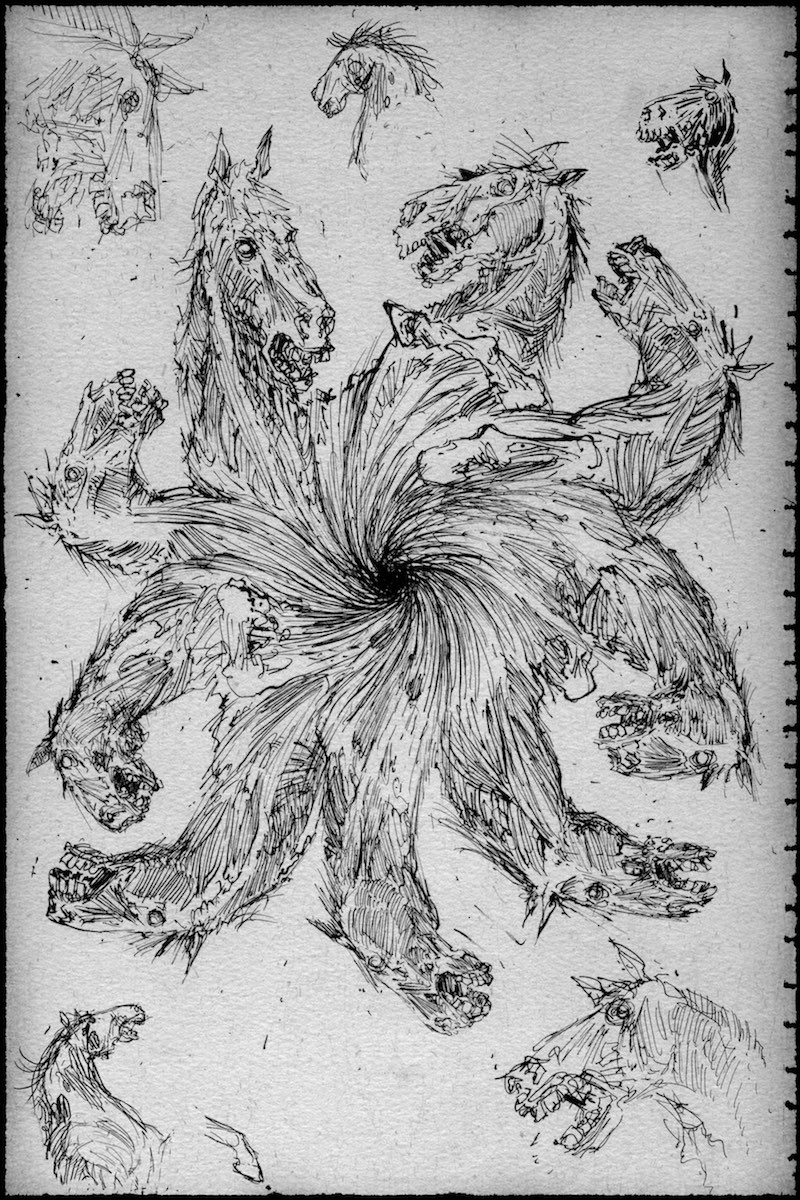
She had felt the wrongness Mraize spoke of. … Urithiru was like the impossible geometries of Pattern’s shape. Invisible, yet grating, like a discordant sound.
L: This sketch by Ben McSweeney is very disturbing. I included the quote here because the lines swirling down into the dark center also remind me of Pattern’s shape. These zombie-horses are terrifying in their own right, with their mouths open in silent screams (or snarling in some sort of primal rage), but the fact that they’re all connected and swirling down into a pinprick of darkness just makes them that much more menacing.
R: I’ve seen criticism of Shallan’s artwork in Part One, by folks who Weren’t Getting It, but I loved this piece from the beginning. And I loved it even more when I found out he’d had to revise these drawings a couple of times because they looked too polished!
R: Thanks for joining our discussion! Now, go hash out the details in the comments.
Next week, we’ll dive into Chapters 26 and 27, where you’ll find magic horsies, Dalinar killing hundreds of soldiers (including his own) indiscriminately, fighting a duel, and attracting a single shamespren, and Shallan delving deeper into the mystery of What Lurks Beneath Urithiru.
Ross is honestly just happy he got his part of this Reread done while supervising 31 children at Boy Scout summer camp. When not geeking out over Sanderson lore, he either develops software, writes his own stuff, or lives on Facebook.
Lyndsey is recovering from a busy weekend in which she met Jim Butcher at his signing in NYC, went on to walk in the Boston Pride parade as Yuri Katsuki the next day, and followed it all up with some ice skating practice (because clearly she has some sort of death wish and now can’t manage to pull herself off the couch). If you’re an aspiring author, a cosplayer, or just like geeky content, follow her work on Facebook or her website.

One problem with the soulcasting gems into wires plan is that it’s been established that you only change the substance, but not the shape when you cast. Hence why certain stone objects show the grain from the wood they used to be or thumbprints from the clay they used to be.
I have some good news about your Thrawn reference. Although Heir to the Empire and the rest are no longer canonical, Thrawn appears in the canonical animated series Star Wars Rebels and he still does the art thing there. It’s actually the focus of a couple of his episodes.
Yes, that drawing mesmerized me from the first look! To me it was the influence of the Dark Mother, but that swirl of black drawing the horses down…brrrrr.
@1, I’d heard that he shows back up in Rebels! So exciting! Guess I finally need to get caught up on that…
For Shallan and Pattern, a poem I wrote while acting in a college production of The Tempest:
The Actors
They fly on borrowed wings, in golden light,
Constructing universes out of words,
Lies in strange tongues, believed and understood
By those who watch in silence, in the dark.
They tell a story told a thousand times,
Give life to dreams once valued and preserved.
One step off stage, they are themselves again:
Folks chatting, crying, reading, playing cards,
Anxious about their entrances and lines.
One step on stage, and once more they transform
To beings bred long ago in someone’s brain.
Friends turn to foes and strangers fall in love.
They bare their minds as few would truly do,
Accept strange things, break into song on cue.
Desired in the dark by those who see
Only the splendor of their dreamed-up souls.
And when the tale is over, all too soon,
The friends and foes and lovers bow as one.
The watchers wake, and sigh to dream again.
And off the actors go, to other lives,
Discarding all they worked so hard to be.
Except in fleeting memories and jests,
The visions they embodied fade and die.
I think there is a WoB where at this time you cannot use soulcasting to make more gems to soulcast with. You could potentially make synthetic gems with science that can be used in soulcasting but not with soulcasting itself. Once I locate the WoB I will add it.
@3 It’s certainly worth watching. I don’t want this to turn into a digression about ranking Star Wars media relative to each other because those always end in bloodshed, so I’ll just say that it’s not as good as my favorite movies and is better than multiple of my least favorite movies.
It is not in this chapter, but I think it is a great time to pull up the artwork for the Midnight Essence spren-illusion-monster-thing going down the hole in this chapter. The artwork in this book is truly amazing. I mean how creepy is this?
So it looks like the soulcaster the fabrial is more limited, while a radiant with transformation could do a lot more. So perhaps changing the shape is possible, but only for a radiant. WoB below
https://wob.coppermind.net/events/181-stormlight-three-update-4/#e3824
here is the WoB that say synthetic gemstones would work
https://wob.coppermind.net/events/144-steel-ministry-report/#e2702
Unfortunately still having trouble locating the WoB about not being able to soulcast more soulcastable gemstones. Thing is i recall it perfectly. You could soulcast a gemstone, but it would not work for soulcasting. Guess I got more digging to do
@1, 3 – there’s actually even a new canon book, simply called Thrawn, which details his rise to power, written by Timothy Zahn, with a follow-up coming out soon (June 26th).
Intentionally rough / unpolished art as a depiction of Shallan’s fragile mental state and/or the Midnight Mother’s influence is a cool design choice, once you get it, but I was definitely taken aback the first time I saw one.
I can’t remember, but did Shallan learn how to use sound in-text or she figured it out off-text? Or she just spontaneously figured it out (which seems to be the way of surges)?
And that’s where investigation into the murder of Sadeas took an unexpected turn into supernatural horror genre! I really loved this chapter, though, it creates great atmosphere and, of course, Shallan’s story/play is deeply intriguing.
I’d particularly point out the huge steps leading down on the other side of the wall, which are described very similarly to a certain epigraph:
“Taking the Dawnshard, known to bind any creature voidish or mortal, he crawled up the steps crafted for Heralds, ten strides tall apiece, toward the grand temple above.”
–from The Poem of Ista. (Jasnah’s note: I have found no modern explanation of what these ‘Dawnshards’ are. They seem ignored by scholars, though talk of them was obviously prevalent among those recording the early mythologies.)
We think that “the light” stolen by the girl is stormlight, but could the story actually be about the Dawnshards instead or as well?
Another very curious thing is the Unmades’ and lesser Odium spren obssession with horses – here Re-Shepir’s influences inspires Shallan to draw this horrific sketch, voidspren tormenting little Gavinor were also showing dying/distorted horses and, finally, horses were a major part of Nergaoul’s presentation at the battle of Thaylenah. Yet, horses are such a minor part of life and battles on Roshar – could this be a clue towards extra-Rosharan origins of at least some of the Unmade? The Thrill being red already suggests corrupted investiture, rather than Odium-only provenance…
@@@@@ 4 AeronaGreenjoy: That poem is excellent.
I’ve been listening to the OBR audiobook. I’m on Ch. 76 now, and it’s truly a different experience. After Shallan tells the story, the reader imbues her voice with so much emotion I found myself tearing up for her. When I read the book, in my mind I heard her speaking somewhat hollowly and without inflection. But that’s probably because I have such a flat affect myself that it’s hard not to project it onto everybody I read. If I ever get an internet connection of my own, I hope to listen to the Audible versions of SA. I like reading / hearing these different interpretations of the same text.
This is also one of the easiest sections to visualize. Sometimes I picture SA in “live action” style, sometimes more anime-esque. This could easily be either.
The dynamics between the spren and his/her Knight is interesting. Often Wyndle is more in the role of parent to Lift. Pattern, on the other hand is more often than not in the role of child while Shallan is in the role of parent (for example, Shallan explaining to Pattern a chaperone’s role or what a play is. Syl takes on the role of an older sibling to Kaladin (and at times Kaladin thinks Sly takes her role too far and morphs into the role of a parent). From the little interaction we see between Jasnah and Ivory, their role seems to be one of equal partners.
Ross: I thought the Ghostblood’s symbol was three interlocking diamonds.
Could the slots in the theater be a way for sound to travel effectively throughout the room?
Thanks for reading my musings.
AndrewHB
aka the musespren
Moderators – this isn’t showing up on the Tor homepage, it still shows last week’s. At first I thought it wasn’t up yet. :)
@14 – That should be fixed now. Thanks!
Shallan already knew how to put sounds with her images. She forgot when she put mommy’s death behind a memory wall. I assume that when she gets her memory back she regains the ability she had in her childhood.
Re: Masked figure in Heading — Anytime we have an in-world story – the Joker figure shows up. Most of the time, because Hoid himself is telling the story. But here Shallan tells it herself. I love how “The Girl Who Looked Up” is retold later as “The Girl Who Stood Up.”
Her cast of dozens is a good preview of her cast of thousands army.
Re: Artwork – the horses were the one I both appreciated the most – and found the most disturbing. Yes, now is the best time to show it and talk about the art.
@@@@@7: I hate the Wall spren image the most. First I thought it was “the stick” coming back as a type of “in joke.” Even though we know what it is supposed to be, it’s still the drawing I wish was not included. It looks like screaming stick. Not even a good one, like Groot, but a jacked up version of a smiling one from a kids show.
@@@@@@.-@@@@@: Nice poem. Hoid would approve.
@@@@@ (someone) and 16: Shallan tied sound to Pattern in WoR, fairly early on.
@17 Braid Tug
That was Pattern mimicking the voices or sounds, not stormlight illusions. In the beginning Shallan had to make her voice deeper the ole fashioned way when pretending to be Veil. It was not until Oathbringer that we see Shallan actively creating different vocals and sounds with her illusions.
The storms themselves are the punishment for those not used to them because they make their life difficult.
The mysterious room reminds me of pneumatic tube post systems.
AeronaGreenjoy @@.-@, I, too, love your poem :)
The picture with the horses disturbs me more and more every time I look at it.
I remember the first time I read this chapter, I thought it might be a kandra (until other commentators were nice enough to point out that it could not have been. And now we also know the truth.)
I love this chapter; I think it is one of my favorites in the book, probably because I love legends and myths.
It drives home again how strange Urithuru is. I have a difficult time even picturing Urithuru to be honest; it is like my brain can’t form a good visual. I still wonder if all of wrongness she feels is related to the Midnight Mother or if there is something else, perhaps the Sibling sleeping? If the Sibling is tied closely to Urithuru, which one of the epigraphs suggested, that could explain why Urithuru feels so odd. It’s probably way off, but something about that comparison tickled my mind.
I also wish we had an idea of how much of Shallan’s abilities are truly new and how much she knew and repressed. For some reason, I felt like the level of ability she used for this play was something she had done and repressed. I don’t have any evidence, just a feeling. Poor Shallan.
Does anyone know the significance of the girl’s hair turning white?
re: Artwork
I think my problem with the artwork in the first part of the story was not necessarily realizing that it was Shallan’s art since it was so different from what appeared in the other books. Not just in the weirdness, but in the whole style.
re: Gemstone wire
How would this be created? I am not aware of any way to modify the shape of a gemstone. I do like the concept of the strata being something along the lines of fiber-optic cable and therefore able to transmit stormlight throughout the city as needed.
re: the origin of the name Ghostblood
It never occurred to me to wonder where the name came from. Now that you brought it up, I’m thinking it refers to Investiture. Since Investiture comes from a Shard and contains a bit of their essence, it could metaphorically be considered blood (or a part of their lifeblood). For that matter, the same metaphor could be extended between Adonalsium and the Shards themselves.
@11, re: “We think that “the light” stolen by the girl is stormlight, but could the story actually be about the Dawnshards instead or as well?”
Oh. OOOOHHHHHH. Now that’s a good theory. I’ll have to ponder on that one.
@18
I think with the saying of her 4th Truth, Shallan regained all the abilities she lost in her childhood, including the ability to add sound to her images. If she was able to fully accept her Truths she’d probably have her Plate already too.
Unrelated note, any speculation on the Colors associated with the Shards? Odium’s is gold, an odd color for hatred (I would have assumed Red). Odium sees himself as Passion, could he have changed his Shard Color to reflect his preference?
@12, 17, 20: Thank you.
@21: I also wonder about the girl’s hair color change, which reminds me of the royal locks of Idris.
#25, and we know the “humans” of Roshar are aliens. Maybe there were descendants of a Returned among them, like the Idris royals?
I am late to comment, but I actually liked this chapter. I thought the story Shallan told was both mesmerizing, fascinating and oddly, very personal. My first interpretation of the story was metaphorical. The wall was there to keep everything Shallan didn’t want to tell inside, to protect the outside from the truth about herself. The girl was the metaphorical version of herself who tries to see what there is beyond the wall and she sees the world is a much bigger place then she was left to believe. Granted, I don’t think this is how I was meant to read it, but this is how I ended up viewing it. I thought it fit.
On the side notes, I noted the passage where Shallan is in awe of actors, saying how blessed they are to be able to change skin, to be anyone they want, to play roles as opposed of being themselves. This passage got to me because I have just finished reading the “food heist” chapter which, I’ll admit, was one of my most disliked chapter upon my first read. It felt pointless, at the time. Upon re-read I however stumbled onto something I thought was of interest, something I think is relevant to this week’s chapter.
When Shallan pretends to be the lighteyed lady of the household (I already forget her name Nananan or something along those lines), she sinks into the role. She starts to behave like her, to think like her, to be her. This lady is not someone Shallan wants to be. She is no Veil. Worst, she is someone she despised and yet, when she puts on the illusion, she becomes this woman. I thought this was interesting clue to what is really happening with Shallan, how magical it is as opposed to anything else. My perception, after this chapter, is Shallan’s powers allow her to be the people she transform herself into or, at the very least, to map her mind on them so closely, she essentially starts to think/behave like them. Lightweaving now seems like it doesn’t just affect how others perceive you, it isn’t just a mere disguise, it also affects your mind. I don’t know how to explain it differently.
If I am right, then it very well explains Shallan’s issues with Veil. Veil is not real, she is a fabrication of Shallan’s mind, but the more background she puts into Veil, the more thoughts she pushes into the persona, the more real Veil becomes. Hence, when Shallan disguises herself as Veil, her brain maps itself to the one she made up with Veil. And so start her problems because she doesn’t realize what she is doing and because she likes being Veil. She loves Veil. She wants to be Veil. So she puts disguises on top of Veil as if Veil were real and the more time she spends with her brain mapped to the “make-belief” brain she created for Veil, the more independent Veil becomes, the more capable of having her own thoughts. It explains why Veil crushes on Kaladin while Shallan doesn’t. It also explains why Veil wants Shallan to be gone forever. She ends up believing she can be real.
And all of this I think comes from lightweaving and not having anyone more senior to warn Shallan on the danger of her powers.
@Gepeto, I think this is what the Cosmere calls “Connection” in a specific application. Dalinar can Connect to someone and speak like them (and Southern Continent Scadrians have the same trick via the amulets). Shallan can Connect to someone and act and seem like them in a more general way.
One suspects that Vasher and Vivenna are doing the same thing to speak to the Alethi. I wonder if Vasher could speak in Makabaki or something if he wanted to.
@28: I now suspect you are right or close to being right.
In Part 3, Shallan worries over not having thought of putting a face on top of Veil as she refuses to lose Veil’s persona. She wants to be her, she bluntly says so to Wit. She wants to be Veil and each she puts on Veil’s disguise, she has to forces herself to think like Veil. Clues are she is doing it with everyone of her disguise: she ends up thinking like them. The problem with Veil is she ended up being a persona Shallan preferred over being herself and the more time Shallan spends within “Veil’s made-up brain”, the more independent of thought Veil becomes, up until Shallan realizes Veil is just another disguise. She can’t fake experience she doesn’t have. Veil is a lie, but for a while, Shallan believed the lie was reality.
Probably why Lightweavers deal in Truth instead of Oaths. Given the mechanics of the magic it’s easier to live a lie. The truth keeps the user grounded in reality.
Another way Brandon could have gone/could go: have Veil be a real person, an actual Ghostblood that Shallan has met (while Veil herself was in disguise). Shallan is unconsciously assuming Veil’s real identity but without absorbing Veil’s knowledge, just her personality and mannerisms.
Think how Mraize is reacting now, understanding Shallan’s powers better than she herself does! He would know the real Veil. Of course, I don’t actually think this is Brandon’s plan, but wouldn’t it be a cool Sanderson twist?
Now that I just wrote it down I want that to be the plot, dagnabbit!
It just seems like Shallan’s power was too much too early. I just don’t see how she was at forth level so young. Her mother wanted her dead because of it but her own brothers don’t seem to have seen it. She had a Shard blade and nearly full powers of illusion if she already controlled sound. There still has to be something special about how she gained her abilities. Whether that is something that will still affect the plot, I can’t guess, but it feels like it should be explained.
About the story told by Shallan and later Hoid, I think it was also theorized that it talks about the human population of Roshar was still limited to relatively high storm free Shinovar. (Also look at the voidspren Shin eyes discussion of the previous chapter.) The people might have lived with the relative dark void-light fueled surgebinding.
Might it be true that void-light investiture from Odium is harder to come by than the stormlight which is replenished every highstorm? The wall (Shin mountain range) was keeping the humans from the stromlight invested rest of Roshar. Humans ,having fled their world which was destroyed by surgebinding (so world destroying monsters/ voidbringers), needed to be kept away from the stormlight. The peaceful Listener society on the other side of the wall will be disrupted by the humans/real voidbringers becoming able to steal/use stormlight indeed.
@30: This is exactly what I believe. Ligthweavers powers make it easy for them to live a life of lies, to be whoever they want to be and to completely forget who they initially were. To live a hundred live as a hundred persons none of them being you.
I think, the truths are meant to prevent what happened to Shallan in OB. Her inexperience, her lack of mentors and her past created the perfect situation where she ends up preferring living the life she made up for one of her persona as opposed to her own. The discussion with Wit pretty much nails it down: her personas are being too attractive to her because she does not like herself.
Hence, I am not really sure she believes her lies, but she wants to believe as long as she puts on Veil’s costume, she is Veil. Up until the reality of her lies crashes down onto her: she can’t fake experience she never had. She can’t pretend to have knowledge she never possessed. It doesn’t matter how “real” Veil looks or sounds, she remains a lie. A lie Shallan ended up depending on.
I will admit I am slightly worried over her needing to be “Veil” with Adolin to go out drinking with him… This is the one part which does bother me very much.
I so hate Veil. I honestly want Shallan to lose this disguise forever and to work on new ones which won’t take over like Veil did.
@31: That’s pretty neat, but the narrative does have Shallan create Veil out of thin air. Well, not exactly. Veil is supposed to mimic Tyn. Radiant is made to mimic Jasnah.
@21 Evelina
I agree the play is a level of proficiency Shallan once held but repressed. We do see her in some situations (when she meets Hoid the first time around her father when she is younger) change the landscape instinctively with an illusion and again when Pattern shows her a room to face the truth that she killed her mother. The first she pushed down, the second she couldn’t. So I do feel she was well along in her radiant progression when her mother attempted to kill her.
@24 EvilMonkey
I agree on Shallan’s progression
Regarding color associated with shards I do not believe there is a one to one. For instance Preservation was whiteish, while Ruin was black, yet nightblood leaks black smoke and Sanderson said that was the color of corrupted investiture. A later WoB asks his to clarify about corrupted investiture, and he explained it was a mixture of two or more shards. Yet in another WoB he states the red we have been seeing is co-opted investiture. So I take this all to mean colors are not necessarily associated with a particular shard over another.
Carl @26:
White hair isn’t just a trait of Idrian royals when in the grips of terror – Nathanatans have white hair normally, for instance, as seen in WoK. And also, there would be a problem with chronology if the story of “The Girl Who Looked Up” is supposed to be ancient, because Vo, the First Reurned and the ancestor of the Idrian royals lived only about 600 years prior to Warbreaker, i.e. closer to the Sunmaker’s time and a few thousand years _after_ the theorised exodus of humans from Shinovar.
Gepeto:
Absolutely! We have, indeed, seen Shallan somewhat involuntarily assuming the persona of that noblewoman because she couldn’t stop at just skin-deep impersonation at that point – but, like certain native qualities of Shallan included in Veil, it was, I feel, excessively exaggerated. Not only do her disguises tend to assume lives of their own, but they also gear towards extremes.
And yes, I also dsilike Veil, because in her Shallan’s traits that I find most interesting – her artistic sensibilities, inspiration and curiosity are completely supressed, while her boldness, sass, tendency to takes risks, etc., are taken to 11, where they are no longer attractive or helpful.
And yes, spiritual connections are likely at play, as we know per WoB that the Lightweavers are pretty close to the Spiritual Realm and Connection seems to be a function of it. Shallan is probably really lucky that she didn’t have to do any Transformations in her confused state, because I can’t help but think that it might have gone both ways if she did – like what happens to device-using Soulcasters, but on steroids.
Goddessimho @32:
I doubt that young Shallan was at her 4th Truth – IMHO, her previous problems with sound manipulation had more to do with psychological blocks that with her progression as a Radiant. It wouldn’t surprise me if we eventually find out that her mother discovered her due to such an aural illusion.
TeitsjP @33:
But there is no reason to think that there is no stormlight in Shinovar – the storms may be weakened to mere rains there, but they and the Stormfather must pass over that territory in order to circumnavigate the world, as they do. Which means that Honor’s perpendicularity also passes there. According to Szeth’s PoVs in WoK it is blasphemous to for the Shin to use stormlight for mere illumination – not impossible. And, of course, Dalinar demonstrated in OB that Honor’s Perpendicularity doesn’t need storms to dispense stormlight – it is just that it is normally attached to the Stormfather and travels with him.
What is more, we know that access to stormlight doesn’t by itself let people surge-bind, only a bond with Nahel spren allows for that and that came significantly later than the exodus of humans from Shinovar – if that’s what happened. Personally, I suspect that a migration of non-Ashyn humans to Roshar may have played a role in whatever sparked the initial quarrel and war between the humans and the singers.
As to void-binding, we have no idea how it was accomplished, so we don’t even know if it was ever practiced in Shinovar. I find it unlikely that Honor and Cultivation would have willingly welcomed the followers of Odium onto their world, though some may have slipped through, of course.
Isilel & Gepeto above: I like the Veil personna. It does not grate on me as it does seems to do for you. To each their own, I guess. I see Veil as that part of her personality which represents the type of person that Vorin culture does not allow a noble woman to be. At her core, Shallan is still a teenager who is trying to find her role in the world. A form of rebelling. Remember the quote that Shallan reads from Jasnah’s book in one of Shallan’s flashback chapters in WoR. I believe as Shallan grows older and comes to accept her place in Vorin society, she will have less and less need for Veil.
Thanks for reading my musings.
AndrewHB
aka the musespren
@36 Isilel
Could you post the WoB about lightweavers being close to Spiritual Realm? Not saying they don’t, just always like learning more, so would love to see that WoB. Thanks!
totally missed this week’s re-read. Posting to put this in my conversation for me to come back and read. I can binge!!!
@36 Isilel: After re-reading the food heist chapter, my thoughts are definitely leaning towards Lightweaving being more than “putting on a physical disguise”: it is much more powerful. Her experience with the noblewoman shows Shallan trying to impersonate someone is more than her just changing her physical appearance, it alters how she thinks and acts.
As such, I do think a lot of this happens with Veil (and also Radiant though to a lesser extend). I am however not ready to state Veil represents one side of Shallan’s personality: Veil was made to resemble Tyn in order to infiltrate the Ghostbloods. Shallan created a persona, modeled of Tyn, which she believed could act the part. Of course, some of it comes from her as all actresses will infuse some of themselves into roles to make them feel more realistic, but the bulk of Veil most definitely isn’t Shallan. It is just like Radiant was made to mimic Jasnah: Shallan has little in common with Radiant, but Radiant is whom she believes she ought to be.
I also hated how Veil discarded Shallan’s artistic abilities and sensitivities as useless and a waste of time. I too much prefer Shallan as the scholarly artist with a streak for adventure to the manipulative fake Veil which Shallan ends up thinking it so cool, she might as well become her.
@37: The reason I hate Veil is I find her to be a mean individual. She is outright dismissive towards Shallan. She believes she is so cool, so sassy, so amazing everything will take to her immediately. She is horribly arrogant and she acts like a know it all when, in reality, she is as clueless as a babe. She manipulates this poor Grund to give her information with her bags of food while pretending she is doing a good action when in reality, she is gathering information.
More importantly, I hate the fact the narrative is suggesting I should find Veil “cool” and “sassy”, so she just robbed me off the wrong way. Ah and there is also the fact Veil is not a real person. She is fabrication, everything about her is a lie, a self-inflated lie who thinks she is worth more than creative, bold but sensitive Shallan.
My personal hopes are Shallan will completely discard the Veil persona because she is too dangerous and instead choose to work with less inviting personas or, at the very least, ones she hasn’t developed such a personal connection with.
Hmm I suppose it shouldn’t surprise me I like Veil – given my differing philosophies to the majority of the people here on the site – my push toward science as opposed to art for example. Veil’s ability and desire to get things done rather than sit and ruminate (like Hamlet) I find much more attractive. Sanderson did a great job here though showing how one of multiple personalities can “take over” and how when dealing with people with multiple personality disorder assuming the dominant personality is the “Real” one (assuming of course a “Real” personality exists which is certainly questionable – we all put on Masks depending on who we are dealing with).
I would say the same is true about Truth. Which this used to be something the “left” used to argue, especially against the more religious “right”. It is so very strange living long enough to see each political side adopt arguments of the other.
Veil is a part of Shallan’s personality profile. She’s faking the experience portion but being bold and sassy? The plan that brought her into the main cast, the theft of a soulcaster, was ballsy. Walking into a meeting with highprinces and enlisting Sebarial as her uncle based off observations alone was bold. The jokes, her back and forth snark fest with Kaladin is sassy. Veil is the part of her personality she had to suppress in childhood, the part she gets to express now that she’s free. It’s unlikable only because she goes off the rails with it by suppressing, even burying personality traits she associates with weakness, the personality traits she had to assume to survive House Davar. To fix herself she has to use the persona instead of letting it use her. Take lessons from Veil without letting Veil consume her.
@41: Brandon said Shallan did not have a personality disorder. There are clues in the book her personas happen because of her magic, not her mental state. What her trauma has caused though is a situation where her made-up persona have become more attractive then her own self. She hates herself so she wants to become someone else. Luckily or unluckily for her, she happens to have exactly the right kind of magic to make it happen. Without magic though, there would be no Veil nor Radiant, just Shallan, but she would have probably never recovered her memories.
@42: But Shallan is never as obnoxious as Veil nor is she a tavern wench casually drinking with ruffians. Yes, Shallan can be bold, when the situation requires it, but she isn’t openly manipulative like Veil nor does she parade into her outlier outfit standing out like a beacon of light.
And I do not think we can discard the fact Veil was created out of a need to have a persona to infiltrate the Ghostbloods nor can we ignore Veil was made to resemble Tyn. Veil is not someone Shallan has repressed, she isn’t the inner Shallan: Veil is a persona Shallan created and started over-using as a mean to cope with reality. Then, she starts to mold Veil to be someone she believe she wants to be: what Veil became is Shallan’s dream girl. Yes, some of her traits are plain exaggeration of some of Shallan’s traits, but this is what they are, plain exaggeration and yeah they are traits Shallan values over her other, often stronger, traits.
Thus I don’t think we can say Veil is Shallan or is a part of Shallan. Veil is nothing. She’s a disguise and I think part of Shallan’s progression will be to drop Veil. To drop the need for Veil, to discard this persona because this is what she is, a persona. And Shallan can make an infinity of those, but only Veil really threatened to take over.
Hence, if I am reading this right, Shallan will need to start viewing Veil no differently than her Lyn costume as a mere disguise and/or to just completely discard her. She thinks she may need to do it, in OB, and she frets over the idea. My thoughts are this is where she will need to go: destroy Veil because Veil was never real.
Just a thought, Wit seems to think Veil is a part of shallan as the illusion he helps her create has aspects of veil present when advising her on how to handle her pain
One thing about “The Girl Who Looked Up.” Yes, it’s a story that hints at the humans true status as the Voidbringers. But, that’s not all it does. The humans from whatever place Odium controlled escaped. When given a chance to serve different gods, they did.
The heart of that seems to still be in their religion. While they’ve created a lot of rules around their society, everyone is supposed to find out what it is they want to dedicate their lives to. It may have been incorporated into service to one, particular faith, but that core element of choosing is still there.
So, this is a world where the Orcs escaped Melkor or Sauron, decided the Valar looked like much better masters, befriended the Elves, got into wars with the Elves, some of the Elves went over and served the Dark Lord . . . and, now, the Orcs think they’re the Elves and the Elves have always served the Orcs’ old boss.
#45, the “humans” of Roshar come from Ashyn, another inhabited planet in the Roshar system. Ashyn was hideously damaged by Surgebinders, but there are still humans there, and Brandon has said that some of the action in the Stormlight Archive will take place on Ashyn.
Ashyn is remembered in Vorinism as the Tranquiline Halls, but of course it wasn’t really a perfect Paradise, just as the pre-Classical Greeks really didn’t remember a literal Golden Age.
Scath @38:
Quick search revealed this WoB:
DWcole @41:But Veil doesn’t have any scientific curiosity either! She is just a fake rogue with extreme tendencies and very limited perspective. Personally, I find the “Renaissance Personality” Shallan who is scientifically curious and creative and applies those qualities towards understanding and solving the monumental problems that their civilizations currently face, like she did in WoR, to be much more interesting. Also, rogues are a dime a dozen in fantasy. Shallan was very proactive and got things done since her introduction – she didn’t need the Veil persona for that.
@40 Gepeto: you’ve talked before about not living in the U.S., so I feel like I should tell you that in colloquial English in the U.S. (I think also the U.K.) the phrase “rubbed me the wrong way” means what you seemed to be getting at, but “rubbed me off” is a sexual euphemism.
@44: Wit also says Shallan’s personas are too inviting for her because she hates herself and as long as is not going to accept herself, she will be tempted to sink into being someone else. He also speaks of Veil as something which is external to Shallan and yet belongs to Shallan as she made her up from scratch.
Hence, I really do not believe Veil is “real” and, as I said above, if Shallan did use some of herself to make Veil up (again actresses do this all the time, there is nothing special into drawing into your own personality and life experience to better play a part), the end result is most definitely not Shallan. As @47 Isilel has pointed out, Veil is fundamentally very different than Shallan and even the traits she may have in common aren’t used in the same way nor do they express themselves in similar ways as within Shallan. Veil literally spat on Shallan’s artistic sensitivity.
@47: Yes. I agree to everything you say. Veil is a fake rogue with a fake background and, when I read her, I was very aware of how fake everything she was doing was. The part where she pretends she understands urchins made the hair on my arms crawl.
I would add Veil is Shallan’s dream girl: she is who she wish she were. She is someone she believes would be preferable being because Veil doesn’t have any of the defaults Shallan sees in herself. But this happens because Shallan hates herself: everything she is, she hates it. Hence, she plays at being someone else and, because of her magic, the someone else earn an independence of her own and stated bashing Shallan thus reinforcing the feeling of how undeserving she feels.
To push it further, Veil is the “grass is greener on the other side of the fence” persona up until you end realizing you don’t want to live on that grass. It is why I think Shallan will need to discard Veil, to treat her for what she is: a disguise, not a real person. As long as she will use Veil as someone “real”, she will relapse. Those are my two cents anyway.
@48: Oh… I thought it meant “disagreed with me” or “didn’t flow down well with me”. Apologies. I had no idea. I meant to say Veil got on the bad side of me not in a way where I felt the character is poorly written, just in the way of myself really not liking her.
@47 Isilel
Thanks for the WoB!
@49 Gepeto
I never said Veil was “real”. Just that aspects of Veil are parts of Shallan, which does show in the two illusions Wit creates and uses to help Shallan. Also what Wit actually said was
She nodded toward the illusion of herself still standing “I can’t be her. She’s just another fabrication.”
Both illusions vanished. “I see only one woman here” Wit said “And its the one who is standing up. Shallan, that has always been you. You just have to admit it. Allow it“
I guess where I am getting confused by what you are saying is I feel one second you say Veil isn’t real, the next you say she has aspects of Shallan, and then another you say she has absolutely no connection to Shallan. All I am saying is Veil is a mask that Shallan wears that does have aspects and traits of Shallan in it. Same with Radiant. Shallan drinks as we see in Words of Radiance. Shallan is resourceful and pushes against her upbringing. Those are traits we see in Veil. Shallan can be confident, and assume command. Those are traits we see in Radiant. Shallan just hates herself and feels she does not have these traits because in her mind if she had, then she wouldn’t have lost her family the way she did. “Shallan” is the cause of all the tragedy in her family because she was “weak” in her mind. Radiant and Veil are strong in all the ways she doesn’t think she is. Wit is trying to tell her she is strong in all those ways. That she has to learn not to blame herself for the hurt. To as he said “Accept the pain, but don’t accept that you deserve it”.
At least that is my reading of the character. Everyone is perfectly entitled to either dislike or like Veil as it suits them of course.
@49 Yeah, as long as you leave out the word “off” it means exactly what you meant.
As long as we’re talking about American English expressions,“didn’t flow down well with me” is not quite the colloquialism. It’s “didn’t go down well.” It’s a reference to drinking something. If it “goes down well” it’s pleasant to drink. Something that doesn’t go down well would be something you choke on.
Standard English doesn’t use “flow” when referring to drinking, except when being either humorous or really, really technical.
Wait, let me turn off my pedantic side. Sorry.
A bunch of people have beaten me to it, but Thrawn does return :) I would definitely recommend checking out Rebels (as well as the latter seasons of Clone Wars which sets up a few things that will get picked up/resolved in Rebels). I haven’t read Zahn’s new books yet (I’m still plugging away at the last of the old EU that I never finished) but I’m looking forward to it.
Regarding OB: Again, I’ve enjoyed all the commentery here, especially on Shallan/Veil. In this case I think my preferences align more with Gepeto, et al. I don’t care for Veil all that much and I think that while personas are one thing (even personas that may represent the opposite of what we are) there’s a big danger in that Shallan relies on the personas so much because of her own self-loathing. It’s one thing to have personas when you are secure in and comfortable with your own identity. It’s another to have them when that is not the case. The personas themselves are not the mental illness (Gepeto’s description of it actually reminds me a lot of Soulstamping in the Emperor’s Soul novella, which takes place on Sel) but I do think Shallan’s mental illness makes her susceptible to some dangers from that magic.