







Welcome back to the Oathbringer reread, as we return to Urithiru for disturbing drawings, cooperative cartography, international intrigue, and mystifying murder in Chapters 8 and 9.
Reminder: we’ll potentially be discussing spoilers for the ENTIRE NOVEL in each reread. This week, there are no Cosmere spoilers in the article, though we make no promises about the discussion in the comments. But if you haven’t read ALL of Oathbringer, best to wait to join us until you’re done.
Chapter Recap
WHO: Shallan Davar
WHERE: Urithiru
WHEN: 1174.1.2.2 (The same day as the preceding Kaladin chapters)
We start off Shallan’s first chapter in the book with drawing. She’s having trouble depicting the city—for some reason, her drawings are coming out surrealistic. She’s also actively trying not to think about the revelation of the truth she spoke in the last book regarding her parents’ deaths. A scout arrives and brings her to a meeting with Dalinar, Navani, Adolin, and Renarin. After establishing that Shallan knows next to nothing about world politics, Dalinar goes on to list off the locations of the ten Oathgates and decides that their next step should be trying to secure alliances with the cities which contain them. However, their meeting is interrupted by the news that there’s been another murder.
Our heroes hurry to the site of the murder, where Bridge Four is waiting. Adolin is shaken by the fact that this man has been murdered in exactly the same way as he’d killed Sadeas, and then is shaken further then Dalinar orders him to investigate the murders.
Threshold of the storm
Titles
Chapter 8: “A Powerful Lie” is taken from Pattern’s commentary:
“It’s all right,” Shallan said in a hushed voice as the wind died down. “Just … just let me draw.”
“Mmm…” Pattern said. “A powerful lie…”
A: The subject lie is, presumably, Shallan’s claim that it was all right, or would be if she could just draw. Because clearly things are not all right, and even drawing will not be enough distraction to make it so. The theme of “powerful lies” carries through the rest of the chapter in Shallan’s pretenses and illusions, what with “power is an illusion of perception,” her disguise as an Elsecaller, and the map she creates with Dalinar.
Chapter 9: “The Threads of a Screw” comes from Shallan’s thought about the strata patterns in the walls as they run toward the scene of the crime:
The strata here spiraled, twisting around the floor, ceiling, and walls like the threads of a screw.
That’s the obvious part, but there’s so much twisting around in this chapter that it’s very appropriate thematically as well—especially that bit with the copycat murder that everyone (except Adolin) assumes is a serial murder.
Heralds
Chapter 8 shows Shalash (Artist, Creative/Honest, Lightweaver) in all four spots, which I assume is due to Shallan’s drawing and Lightweaving throughout the chapter. Chapter 9, though, has Battar in all four, which is very unusual for a Shallan chapter. Battar is associated with Counsellor, Wise/Careful, and Elsecallers, so she would be expected if Jasnah were around. Since she’s not, I suppose it could be “Shallan pretends to be an Elsecaller,” but I think it’s more associated with Dalinar’s wish that Jasnah could be there to give counsel, and the inversion of the role as Adolin attempts to hide what he knows.
L: Well, an argument could also be made that Dalinar is the main character of these chapters for the most part, despite them being from Shallan’s POV. All of the action is coming from him, with Shallan as a simple observer. With this in mind, Dalinar is being very wise and careful in chapter 9 by setting Adolin as his investigator. Honestly I could see it even better if it had been the previous chapter that had Battar, but Dalinar’s still in wise-councilor mode here too.
Icon
With Shallan as the sole POV in these two chapters, naturally Pattern is the icon for both.
Epigraphs
That moment notwithstanding, I can honestly say this book has been brewing in me since my youth.
The sum of my experiences has pointed at this moment.
This decision.
—From Oathbringer, preface
A: Even having finished all the flashbacks, I’m a little baffled by this first sentence. Is he referring to “his youth” as the early days of the campaign to unify Alethkar, back when he was the blood-thirsty kid who would do almost anything to activate the Thrill? That’s the only way I can make sense out of it; he’s thinking back to his first experiences with Nergaoul, and the entire process that led to his ability to embrace it and tempt it into that gemstone.
Stories & Songs
She glanced at a soldier who wore the gold and red of Hatham’s army. He immediately looked down and rubbed at the glyphward prayer tied around his upper right arm. Dalinar was determined to recover the reputation of the Radiants, but storms, you couldn’t change an entire nation’s perspective in a matter of a few months. The ancient Knights Radiant had betrayed humankind; while many Alethi seemed willing to give the orders a fresh start, others weren’t so charitable.
A: Sanderson is going to keep reminding us that the whole world knows the old Knights Radiant had betrayed humanity, and willingness to trust the new ones is far from universal. It might get irritating, but as readers I think we need to bear it in mind; as “outsiders” to this world, and “insiders” to the minds of the new Radiants, we know they’re the good guys, or at least they mean well. The mistrust of the rest of the world needs to be part of our assessment all the time, if we’re to understand future events and reactions.
Relationships & Romances
Curiously, it was Renarin who stood up, setting aside his blanket and cup, then walked over to put his hand on his father’s shoulder. The youth looked even more spindly than normal when standing beside Dalinar, and though his hair wasn’t as blond as Adolin’s, it was still patched with yellow. He seemed such a strange contrast to Dalinar, cut from almost entirely different cloth.
“It’s just so big, son,” Dalinar said, looking at the map. “How can I unite all of Roshar when I’ve never even visited many of these kingdoms? Young Shallan spoke wisdom, though she might not have recognized it. We don’t know these people. Now I’m expected to be responsible for them? I wish I could see it all.…”
A: This really is unexpected, though more to Shallan than to the reader (at least, the reader who has been discussing Kholin family behavior to the point of exhaustion). Later, we’ll see that it’s happened before—Renarin is sometimes the one who sees a need within his father and finds a way to reach out and give support. All the same, it’s almost painful to see Dalinar looking overwhelmed by the task at hand.
L: I really love that Renarin is the one to realize that these words may have hit a little too close to home. The boys may not know the extent of their father’s damage (hell, Dalinar himself doesn’t yet), but they clearly remember at least a little of what he was like before the Shattered Plains.
Ahead of her, Adolin stopped and looked back. He danced for a moment, as if impatient, then hurried to her instead of running ahead.
L: Awww. Adolin’s just too adorable. He’s thinking of her well-being over his own curiosity. I love his chivalry.
A: I’m also glad he waited for her, so that we could get her reaction to his reactions!
Bruised & Broken
“I understand why you hate me, Shallan. I did not mean to help you kill your mother, but it is what I did.”
…
It meant she had to summon her Blade each time. The Blade she’d used to kill her mother. A truth she’d spoken as an Ideal of her order of Radiants.
A truth that she could no longer, therefore, stuff into the back of her mind and forget.
…
“The sword isn’t you. The sword is me, my father, the life we led, and the way it got twisted all about.”
L: Hoo boy, here we go. Shallan’s arc in this book is pretty bad, in the respect that she’s just… so very broken. So so broken. This is only the beginning. The realization of what she’d done cracked her wide open, and a slew of personalities just comes spilling out.
A: This was the beginning of a surprise to a lot of readers. At the end of Words of Radiance, it appeared that Shallan had faced her past actions and resolved her issues; now, when we finally get back in her head, it turns out that her head is a very messy place. As we proceed, we’ll see that her issues are so far from “resolved” that the two words shouldn’t be on the same page. For some readers, this was frustrating, as they’d hoped to be done with watching Shallan hide from her memories. For others, it was a mark of brilliant characterization, because the simple fact is, her issues are not simple; to resolve the whole thing in one Moment Of Realization would be cheap and unrealistic.
[Renarin] wore his Bridge Four uniform, but had a blanket around his shoulders and was holding a cup of steaming tea, though the room wasn’t particularly cold.
L: Interesting that Sanderson called this out. There must be some deeper meaning to it. Any thoughts, Alice?
A: I don’t have anything solid, but I agree—there’s supposed to be some significance there. The absolutely only thing I can think of is that when we see his spren at the end of the book, it looks like a snowflake; could Glys have the effect of making him cold? Maybe he’s feeling the presence of the Unmade, too; Shallan draws weird surreal pictures as her reaction, and Renarin gets cold? I don’t think he’s trying to hide Glys, because he doesn’t hesitate to set the blanket aside later. Now I want to watch for other instances of Renarin being cold when others aren’t!
(For your entertainment… I went back and looked at the beta, and it turns out I asked this exact question. The only suggestion, from Sarah, was that perhaps it was more about comfort in an overwhelming situation, which I could totally see.)
Diagrams & Dastardly Designs
L: Okay so, I’m going to put this stuff about the strata in Urithiru in this section even though this isn’t exactly what this section was meant for. Patterns and Designs are pretty close, right?
Couldn’t they distinguish the pattern here of wide reddish strata alternating with smaller yellow ones?
L: It makes total sense that Shallan, with her training as an artist, would be more keyed in to the varied designs and alterations of color than a normal person. I wonder if the colors have any special significance, though? If we’re going to go with the widely accepted theory that this city is supposed to be powered by Stormlight, these could be conduits of some sort. Are the different colors significant to different types of energy?
A: The descriptions of “strata” in the walls of Urithiru are really bizarre. During the beta read, I noted that actual rock strata don’t behave in the ways they were sometimes described. Since the term “strata” remains in the text, now I’m watching to see if the descriptions change. If they continue to do weird and unnatural patterns, I will assume that they were shaped by the construction process rather than being naturally formed. Yes, I’m going somewhere with this…
In the meantime, though, I’m pretty sure that some of the strata carry Stormlight, anyway. It’s too obvious a way to channel it around, right?
L: Right, and there’s also something to be said for the fact that if gems can hold Stormlight, why couldn’t certain types of stone?
Squires & Sidekicks
“How does it work? Being a Radiant? You have a Shardblade?”
So that was where this was going. “I assure you,” Shallan said, “it is quite possible to remain properly feminine while fulfilling my duties as a knight.”
“Oh,” the scout said. Oddly, she seemed disappointed by that response.
L: I love the fact that Shallan completely misses the point of what Lyn was getting at here. As we see later, Lyn doesn’t much seem to care about femininity. She wants to fight with Bridge 4, not be constrained to traditional Alethi societal norms. I won’t be speaking too much about how this character is based on me in this reread, and how her characteristics may or may not line up with my own personality (if you ever run into me at a con or at a signing you can feel free to ask me in person), but I will say that I really love this about her character. As nice as it is to see female characters like Shallan and Jasnah who don’t hold to the typical archetypes of “warrior-woman,” “mother,” or “seductress,” it’s also nice to see women actively struggling against the inherent sexism of their culture.
A: One thing I’ve noticed in WoR and OB is the roles women play when they aren’t wealthy, or the wives of officers, etc. In WoR, we saw that a number of the Kholin grooms were women; since that occupation isn’t specifically mentioned in Arts and Majesty, it’s open equally to men and women. The ardentia, of course, is likewise equally open. We’ll see in Oathbringer that, while there are certainly far more men than women scouts, Lyn is hardly the only woman in the group. We’ll also see a number of shopkeepers, etc., if I remember correctly, as well as various scribes keeping things orderly. So it seems that there are avenues other than marriage or the ardentia open to women (both light- and darkeyes), but it probably depends a lot on the opportunities they find. Sort of like real life, come to think of it…
On that subject, I have to throw in one more quotation, mostly because it makes me laugh at the same time that it reminds me that every culture has different expectations:
Nobody tried to shelter Navani from the sight—as if it were completely proper for the king’s mother to be poking at a corpse. Who knew? Maybe in Alethkar, ladies were expected to do this sort of thing. It was still odd to Shallan how temerarious the Alethi were about towing their women into battle to act as scribes, runners, and scouts.
L: Peet! Lopen! Rlain! Oh, how I’d missed these guys. We don’t see much of them yet, but there’s one part I did want to point out.
[Rlain] drew attention from the other soldiers, several of whom positioned themselves subtly to protect Dalinar from the Parshendi. They considered him a danger, regardless of which uniform he wore.
L: As sad as this makes me (I love Rlain), I can’t say that I blame them at this point in time. No one knows how the transformation into “Voidbringers” works. All they know is that when the Everstorm swept over them, the parshmen changed. Who’s to say, to these soldiers, that Rlain might not suddenly turn evil?
A: As far as I know, the only thing keeping Rlain from going Voidbringer is his own determination not to change, though he might receive some additional protection from Kaladin’s squire effect. I agree on all points, Lyndsey; as much as it makes me sad to see him so thoroughly mistrusted, there is a valid reason for people to worry.
Places & Peoples
A: This chapter provides a great overview of the cultures we’re going to meet soon. Prior to this, we saw them only by reference or in Interludes; the action centered on the Shattered Plains, with bits in Kharbranth, Jah Keved, and Alethkar. Oathbringer has Our Heros conversing and meeting with people from these other nations, and sometimes traveling to them as well.
“They’re Azish,” Adolin said. “How can they not be predictable? Doesn’t their government mandate how to peel your fruit?”
L: A reminder here (for those with poor memories like me) that Azir is where we first met Lift. Their society is tightly structured around rules and laws, and requires a ton of paperwork for just about everything. Renarin might insist that Adolin is stereotyping, but I wouldn’t be in the least bit surprised if Adolin’s tongue-in-cheek comment doesn’t have a shred of truth in it.
A: Hey, stereotypes exist for a reason!
“There’s that warlord in Tukar. What’s his name?”
“Tezim,” Navani said. “Claims he’s an aspect of the Almighty.”
L: For some reason I’m getting shades of the False Dragons from Wheel of Time here.
A: Hah! He does sound a lot like those… but, from a certain perspective, he’s not entirely wrong.
“Azimir, capital of Azir,” Dalinar said, stepping from Urithiru to the center of Azir to the west, “is home to an Oathgate. We need to open it and gain the trust of the Azish. They will be important to our cause.”
He stepped farther to the west. “There’s an Oathgate hidden in Shinovar. Another in the capital of Babatharnam, and a fourth in far-off Rall Elorim, City of Shadows.”
L: (Which is such a cool name for a city, just sayin’.)
A: (I know, right? So intriguing! Unfortunately, I suspect that we’ll have to wait for Lift’s flashbacks to learn much more about it. ::pouts::)
“Another in Rira,” Navani said, joining him. “Jasnah thought it was in Kurth. A sixth was lost in Aimia, the island that was destroyed.”
A: Keep this in mind for later Interlude discussions!
Dalinar grunted, then turned toward the map’s eastern section. “Vedenar makes seven,” he said, stepping into Shallan’s homeland. “Thaylen City is eight. Then the Shattered Plains, which we hold.”
“And the last one is in Kholinar,” Adolin said softly. “Our home.”
A: I haz a sad. Adolin doesn’t know much yet; there are indications that something is not right in Kholinar, but all they have to go on is that the spanreeds in the city aren’t working, plus what little intel they received from Kaladin. They don’t talk about it much, focused as they are on the immediate issues of creating a functional society in Urithiru, warning other nations of the Desolation, and forming a coalition to save humanity. So this one soft remark stands out—it’s one of the few times someone verbally acknowledges the very real concern for their home.
While we’re on the subject… in the next couple of paragraphs, Dalinar outlines the plan to focus on Azir for its organization, Thaylenah for its shipping, and Jah Keved for its manpower.
“And Kholinar?” Adolin asked.
Dalinar doesn’t get a chance to respond before the scout comes in, but the question is left hanging. What about Kholinar? Strategically, it’s not terribly important; the Alethi are known primarily for military prowess, but most of those resources—the good ones, anyway—are already gathered at the Shattered Plains or Urithiru. From that standpoint, Kholinar is no more vital to the coalition than Shinovar or Babatharnam. But it’s home. ::sniff::
Well, anyway, there’s the run-down of all the important places on Roshar.
Tight Butts and Coconuts
Maybe when Brightlord Brooding-Eyes returned, he could fly her to another peak along the mountain chain.
L: I will never not laugh at “Brightlord Brooding-Eyes.”
A: ::gigglesnort::
“Brightness Shallan,” he said. “How would you deal with the Makabaki kingdoms? … Azir is the most important, but just faced a succession crisis. Emul and Tukar are, of course, at war, as Navani noted. We could certainly use Tashikk’s information networks, but they’re so isolationist. That leaves Yezier and Liafor….”
“Yes, yes…” Shallan said, thoughtful. “I have heard of several of those places.”
L: You know, a lot of Shallan’s quips fall flat for me—she reads as if she thinks she’s just soooo much smarter than everyone else and has a tendency to make others feel a little stupid, I think. In real life, I don’t much like that type of humor, so often times I don’t find myself amused by her comments. But this line worked perfectly for me, possibly because she’s admitting to a fault of her own rather than touting her own wit.
“And to be frank, Brightlord, I think [Pattern]’s scared of you.”
“Well, he’s obviously not a fool,” Adolin noted.
Dalinar shot his son a glance.
“Don’t be like that, Father,” Adolin said. “If anyone would be able to go about intimidating forces of nature, it would be you.”
L: Adolin’s flippant little quip here made me chuckle.
A: Every time I read that line from Adolin, I snicker again. It’s perfect. The funniest part is, Dalinar just recently bonded the cognitive aspect of the dominant force of nature on the planet, right? So, yeah, “intimidating the forces of nature” is sort of what Dalinar does these days.
“Any number of people could have wanted him dead, right?”
L: Right, Adolin. Any number of people! It could have been ANYONE! But certainly not you.
Weighty Words
“I couldn’t have created this, Brightlord. I don’t have the knowledge.”
“Well, I didn’t do it,” Renarin said. “The Stormlight clearly came from you, Brightness.”
“Yes, well, your father was tugging on me at the time.”
“Tugging?” Adolin asked.
“The Stormfather,” Dalinar said. “This is his influence—this is what he sees each time a storm blows across Roshar. It wasn’t me or you, but us. Somehow.”
L: One of our first depictions of Dalinar’s interesting powers, here.
A: So is this Tension (soft axial interconnection), Adhesion (pressure and vacuum), or a resonance peculiar to Bondsmiths? The Stormfather later mentions what he calls “Spiritual Adhesion” with which Dalinar can make a Connection and learn other languages. My best guess is that this is another form, except that in this case it gave the Connection to Shallan. Maybe?
L: Hell if I know. I’m still confused more often than not by the mechanics of Windrunning, nevermind this, whatever it is. I love Sanderson’s depth of detail in his magic system, I appreciate the heck out of it, but I can’t analyze it. I was an English Major. Physics and science are not my fortes.
A: I just get a total kick out of the way he makes this all “physics and science” on the surface, and then suddenly he turns and applies the concepts of the physical forces to cognitive and spiritual abstractions instead of physical objects, and now everything is inside out and upside down. And it still makes sense. Sort of.
“I’ve seen the enemy’s champion—a creature in black armor, with red eyes. A parshman perhaps. It had nine shadows.”
Nearby, Renarin had turned towards his father, eyes wide, jaw dropping.
L: RENARIN. What do you know?! I’d kill for his POV of this scene.
A: I have to assume he’s seen this nine-shadowed champion in vision by now, though probably not yet with identity attached. Why else would he react this way?
L: And since we’re talking about Renarin…
As they moved, Shallan felt something prickle at the back of her neck. She shivered, and couldn’t help glancing back over her shoulder, hating how this unfathomable building made her feel.
Renarin was standing right behind her. She jumped, letting out a pathetic squeak. Then she blushed furiously; she’d forgotten he was even with them. A few shamespren faded into view around her, floating white and red flower petals.
“Sorry,” Renarin said. “Didn’t mean to sneak up on you.”
L: So… is Shallan just feeling the Unmade who’s taken up residence here, and Renarin’s presence is a coincidence, or…
A: … or is she feeling the presence of a corrupted spren, much like she feels the presence of the Unmade?
“You did well investigating the incident with the king’s saddle, even if that turned out to be something of a wind chase.”
L: I like this little in-world term.
A: Mmmm, good lies.
Mendacious Motivations
She looked to Adolin to get his read on the situation, and found him staring, aghast, mouth open and eyes wide. “Adolin?” Shallan asked. “Did you know him?”
He didn’t seem to hear her. “This is impossible,” he muttered. “Impossible.”
A: Poor Adolin. What a horrible shock this would have been!
“I’ll need to leave [the murder investigation] to you, son.”
“Me?” Adolin said. “You want me … to investigate who killed Sadeas.”
L: Well. That’s awkward.
A: Also hilarious.
Adolin swallowed. “I understand.”
Shallan narrowed her eyes. What had gotten into him? She glanced toward Renarin, who still stood up above, on the walkway around the empty pool. He watched Adolin with unblinking sapphire eyes. He was always a little strange, but he seemed to know something she didn’t.
A: It’s hard to know whether Renarin has seen a vision involving this, or whether he just knows his brother so well that he’s figured something out. Either way, it seems like only Shallan and Renarin notice how strange Adolin is acting, and Shallan dismisses it by thinking that Adolin isn’t remotely deceitful enough for her to be suspicious of him. Still, Adolin’s final comment just destroys me:
“I have no idea who did this, Shallan. But I am going to find out.”
Not worried that someone saw you kill Sadeas, by any chance?
A Scrupulous Study of Spren
We’ve already discussed most of the Pattern issues elsewhere, so we don’t need to talk about him here. There aren’t many others in these chapters.
…coldspren growing up like spikes around her.
…a windspren passing and troubling the pages.
A few shamespren faded into view around her, floating white and red flower petals. She’d rarely attracted those, which was a wonder. She’d have thought they would take up permanent residence nearby.
A: Aside from the snicker this always elicits, are shamespren like gloomspren—a common emotion, but uncommon spren? Never enough of them to go around?
Arresting Artwork
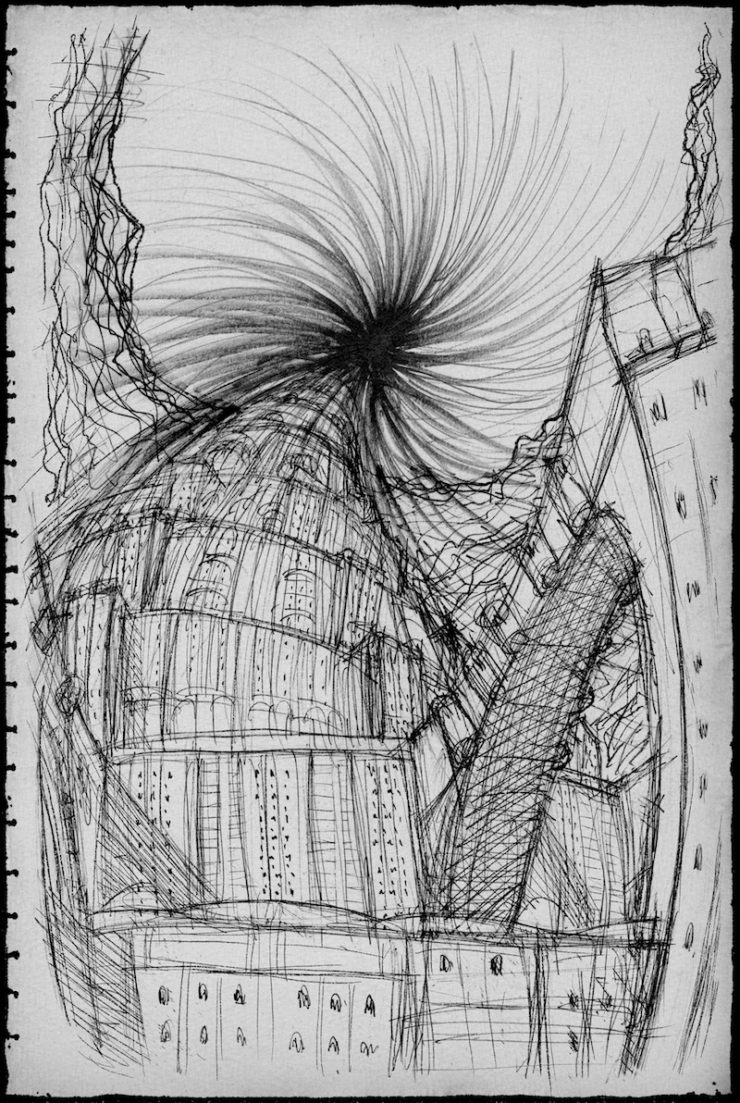
She couldn’t get an angle from which to view the entire tower, so she kept fixating on the little things. The balconies, the shapes of the fields, the cavernous openings—maws to engulf, consume, overwhelm.
L: I absolutely love what Ben McSweeney did with these surrealistic, creepy images of Shallan’s. Not only does it reflect her growing unease of what’s lurking in Urithiru, but it’s an interesting window into her mind, as well. She’s fracturing, breaking apart—and her artwork reflects this. In my experience, when I have suffered from depression, I find it very difficult to write or work on any sort of crafts. The inspiration doesn’t come, and when I do manage to get something accomplished, there’s just something off about it. So I relate to this artwork of hers a lot.
A: I seem to remember reading complaints somewhere about the artwork in Oathbringer having “gone downhill.” I think it was someone flipping through the book before they’d read it, maybe, and they were really disappointed. And the beta readers were all going, “No, no, it’s all good, it all belongs, same artist, just RAFO…” As I recall, there was also a story about how hard Ben had to work to get these Part 1 illustrations bad enough to suit Brandon.
Quality Quotations
- Though the place was stuffed with rugs and plush furniture, the finery fit this bleak chamber like a lady’s havah fit a pig.
- Storms. He always seemed so … large. Bigger than any room he was in, brow perpetually furrowed by the deepest of thoughts. Dalinar Kholin could make choosing what to have for breakfast look like the most important decision in all of Roshar.
And that’s all for today, even though I’m pretty sure we left out some interesting stuff! We can pick up the rest in the comments, eh? Be sure to come back next week, when Paige will join Alice to talk about Chapter 10. We’ll check in on Kaladin’s progress, and enjoy our second Adolin POV.
Alice has nothing much to say about herself this week. Lame, isn’t she? But hey, did you see the announcement of the new Legion book? It’s really good, if somewhat weird and unexpected.
Lyndsey probably won’t be able to make it next week. Between learning stage combat choreography, auditioning for her local Renn Faire, practicing modern dance choreography for an event, running the Anime Boston Masquerade at the end of the month, and finishing up her cosplays, she’s going to be just a smidge busy. If you’re an aspiring author, a cosplayer, or just like geeky content, follow her work on Facebook or her website.


Good pull on the pig in a havah quote. Now that’s something I’d like to see fanart for. (To Google!)
Since Renarin is autistic, the blanket could be there primarily for the extra weight. Many autistic people find weighted clothes or just a heavy blanket very comforting. The hot tea might be a similar sensory thing, or I could be totally off base and it’s a magic thing.
soursavior @1 – Ack. That thought about the weighted blanket effect was tickling around in the back of my mind, and I couldn’t get hold of it. Thank you.
I like how when Lyn started flipping through Shallan’s sketch book, Shallan tries to shrug it off us using a different type of artistic style: RL surrealism. Another interesting thing. In Roshar, surrealism is a long ago style that virtually no present day artist uses. In RL, it was a recent artistic style (20th century) and that in RL it has influences in other parts of society.
I think Shallan’s difficulties drawing the Tower is somehow due to the presence of Re-Shephir. After Shallan’s encounter with Re-Shepir at the end of part 1, I do not believe my opinion in the prior sentence is very controversial. Later, we learn that the creation and continuation of her alternative personas (Veil and Brightness Radiant) sometimes bleed into her artistic drawings. Sometimes, when she is drawing, Veil or Brightness Radiant take over. Between Shallan’s different personas mixing with the core of herself and the effects Re-Shephir has on Shallan’s drawing, it is remarkable that Shallan is able to draw at all.
Lyndsey. I agree with you about Shallan’s humor re her lack of knowledge. I like it when characters have self-deprecating humor. It shows that they have a certain level of humility.
Thanks for reading my musings.
AndrewHB
aka the musespren
Lyndsey, is Lyn based on you or named after you?
@2 WetlanderNW I have a sibling who is both autistic and very outspoken about autism, so that sort of thing is often on my radar these days.
If Brandon ever makes it out to New England again maybe I’ll try to ask him whether it’s magic or comfort.
Reading these chapters for a second or third time, I am seeing the beginning of her breaking into Veil and Radiant just a bit. She treats Lyn very Jasnah-esque just before the whole ladylike with a shardblade comment. The deprecating self humor is more reminiscent of Veil than it is of Shallan. And then she’s stuck being the slow short Veden girl without Stormlight when the long-legged Alethi run to see the body. I was one who didn’t like seeing her all in pieces through the whole book again, but I did like how she’s getting it back together by the end.
I have a sort-of theory about the oaths. It seems like Shallan can give her truths before she deals with them cognitively/psychologically. That may be what helped her get a shardblade as a child. Kaladin, conversely, has to face up to the heavy stuff before he can say his oaths. As an example, we know that Shallan has done her 4th ideal but didn’t immediately get her shardplate, whereas it seemed like if Kal had said the words there in Shadesmar he would have had it right then. Maybe to fully ‘level up’ you have to do both the words and deal with their impact, but different orders deal with that differently? I tried to see how Szeth dealt with it, but I think by the time he does the oaths he’s already so there mentally that it’s different for him. Or just the way Skybreakers are different from other orders. Wow this is getting long. Sorry!
“I have to assume he’s seen this nine-shadowed champion in vision by now”
Yes, Dalinar saw the nine-shadowed champion in chapter 1 when he stayed past the normal ending of the vision of destroyed Kholinar.
OB, Ch 1.: “A golden light, brilliant yet terrible. Standing before it, a dark figure in black Shardplate. The figure had nine shadows, each spreading in a different direction, and its eyes glowed a brilliant red.”
@7 – She’s referring to Renarin’s visions, not Dalinar’s.
After viewing the Shallan’s picture of the tower i feel there is almost a hint on what she is about to face. if you imagine the tower as the abdomen of a spider, with the bottom being the face, with the pillars coming out the sides as legs, and then the swirls are like a web. Just thought that imagery was cool
WinespringBrother @7 Was she talking about Dalinar or the fact that Renarin’s jaw dropped. Has Renarin seen the Champion of Ordens in a vision?
Alice and Lyndsey, I’ve been curious about the back-and forth exchanges you have in these reread articles. At some point could you talk about your process for generating these collaboratively?
Thought: Shallan seems to get the benefit of her order’s equivalent of the Third Oath (Shardblade) before speaking it, but then doesn’t get the benefit of the Fourth after speaking the Words.
Maybe this relates to how the Spiritual Realm is outside of time? Maybe the different orders, or just different Radiants, have different levels of connection that Realm?
On another subject: rereading Chapter 8 made me think about the name “Urithuru”, which I suspect is at least partly derived from the Mesopotamian city of Ur. The reason: what Shallan describes is a very, very large ziggurat, the Mesopotamian temple architecture. Is Urithuru meant to recall Babel, I wonder?
“Interesting that Sanderson called this out. There must be some deeper meaning to it. Any thoughts, Alice?”
Not Alice, but I think you might be reading too much into it. The blanket in mild weather thing and a warm beverage (especially since the only cold stimulating drink we’ve seen was treated as a novelty) isn’t too unnatural for higher-functioning autism. I could see the real-life influence for Renarin (if there is one) easily behaving similarly. My brother walks around the house draped in a blanket even in the Alabama summers.
Hm, I may be seeing things too straightforwardly, but I thought that Renarin was cold because he had been doing something outside with Bridge 4 before he was called to the meeting, and unlike Shallan he didn’t indulge in wasting stormlight to make himself more comfortable. OTOH, he also later admits that he too could sense Re-Shepir, but just ascribed it to his own strangeness, so this may be affecting him too. And yes, it is obvious by Renarin’s reaction that he had seen the vision of Odium’s champion, though it remains unclear whether he recognized his identity at this point.
Female scouts – makes me wonder if they also used to jump the chasms with poles or if they were sort of the second echelon and had to wait for mobile bridges and such. After all, they are the ones who make professional maps and document the findings. If they did jump, then they probably have a bit of a head-start with their Windrunning, as the mindset would be somewhat similar. It also seems to me that it is an occupation for young women and that they have to transition to something else after a few years. Marriage to non-coms, perhaps, or scribe-work, though this niche seems to be mostly occupied by light-eyed women. Maybe trade?
But we have seen other occupation options – for instance, some of the surgeons are female – though I have always wondered how they deal with keeping left-hand gloves from becoming a source of infection, etc. Much easier to wash hands than to keep a glove clean/sterile in pre-industrial conditions. Intelligence gatherers/brokers and spies like Ishnah also are traditionally female. And IIRC, when civilian men from Dalinar’s camp stepped up to volonteer for the army after the disaster at the Tower, it was mentioned that the women were taking up the slack, so it looks like there is a lot of leeway in the crafts and trade. Adolin’s tailor is a woman. We have also seen the traditional servers, seamstresses, cooks, etc. and washerwomen. Concerning those last – how? Do they use enclosures so that they can remove their gloves without impropriety? IMHO, it was really a missed opportunity for Sanderson to remain true to his worldbuilding and make his professional launderers male, like they used to be in Ancient Rome.
Speaking of Shallan’s response to Lyn – it is ironical that Jasnah, who told Shallan that being a Radiant could be properly ladylike and wouldn’t require her to swing a sword… fights quite competently with her shardblade at the end of OB. I am really curious when and how she learned her swordsmanship. And Shallan was also somewhat disappointed to hear Jasnah’s assurances at the time, and now she disappointed another hopeful in her own turn.
Concerning Rlain – I have been waiting for the whole book for somebody to question him about his people’s lore re: the Unmade, Odium, voidforms, etc. Annoyingly and somewhat unbelievably, nobody did. I know that it is being saved for book 4 where the Listeners will necessarily be a large focus, but still.
I like Lyn’s response to Shallan’s art: “It makes my eyes make my brain think it forgot to wake up.”
Adolin being assigned to find the murderer made me think of The Departed, when Matt Damon is assigned to find the rat in the Boston Police Department. He tells Jack Nicholson, “They want me to find myself.”
Dalinar loomed over the table, his piercing gaze tracking from one target to the next.
“Bacon and eggs, or shall I have a bagel?” His deep voice carried surprisingly well for how quietly he spoke. Anticipationspren hovered around the cooks as they awaited his decision.
“I think pancakes would make for a nice change,” interjected Navani.
“Hmm. You may be right.” Dalinar stroked his chin as he considered his options. “Very well. Pancakes it will be.” The cooks immediately leapt into action.
Re: Bondsmith powers, my guess is that they have an inherent Connection to the other Radiants, so that any nearby Radiant can instinctively use their own Surges however the Bondsmith needs them to. They become more powerful together than they were apart.
Pancakes!!
Anyway, the strata in the halls seemed very significant to me and yet only Shallan ever mentions them. The others talked mostly about the vents and the lifts.I also don’t get how Dalinar wasn’t feeling the “dread” that Shallan and maybe Renarin picked up on.
The bottom line for Dalinar: that man has gravitas.
On Rlaine’s ability to stay in Warrior form and not go void. I don’t think he is anything special. Don’t the Listeners need to go out into the storm and invite the change?
Kaladin made big strides forward in The Way of Kings, but then struggled with the implications and fell pretty far back (even “killing” Syl) in Words of Radiance before finally coming to terms with what he needed to do and saying the Oaths to get his Shardblade. The same thing happens with Shallan. She made a lot of progress in Words of Radiance but spends most of Oathbringer trying to get herself back together and move forward with what she’s experienced. In both cases, I think it’s brilliant character development. Progress and growth is never a straight line.
@21 Benjamin
Honorspren care more about their agreements than about the well-being of actual people. There’s a big difference between “keeping your word” and “doing what’s right”.
In Oathbringer, Kaladin recognizes that Parshendi lives are just as valuable as human lives, while Syl remains focused on him protecting the people he swore to protect. Oaths are not a substitute for morality, and Kaladin isn’t going to give up his own sense of right and wrong so that he can become Syl’s idea of a “proper” Radiant.
@22 *cough* Aral *cough*
/re-read thread cross-over
@@@@@ Alice and Lyndsey, how do we know the ‘When’ of these chapters? I don’t recall seeing any of that on my read through, and just wondering if I’m missing something hidden in here. Or I could just simply be an ignore-a-moose :)
With regard to the blanket thing: If I remember correctly, one of the symptoms of shock or stress can be feeling cold even when the temperature should be warm. So maybe Renarin is just having trouble coping.
Chris @11 – It varies a little in actual practice, but the process goes something like this: We have a template in google docs with all of the units and placeholders that we use each week. One of us will create a new document from that template in a shared folder, and start populating it with quotations and initial thoughts. Over the course of a couple of days, we both get in and make comments on things that caught our attention, and react to whatever the other has already said. We also make side comments when there’s something we need to decide how to handle, like whether something needs to be addressed or which unit a particular discussion fits best. When things work right, we spend a chunk of Tuesday where we can both be in the document at the same time, and we use a combination of document editing and side commenting to have fun and do real-time conversations. When that doesn’t work out, we just respond back and forth when we can, sometimes inserting comments that will make it sound like a conversation instead of a declamation. We’ve worked together enough that we can make it sound like real-time even when it’s not, to some extent. In any case, we alternate taking point on the final review, edit, and upload, which we try to have in by noon Wednesday so the front-page people at Tor have time to put in the artwork and make everything pretty before they schedule it for publication. Does that answer the question?
Porphyrogenitus @17 – ROFL!! I love it. That’s my kind of fanfic. :D
zeldune @24 – As beta readers, we have access to some stuff that never gets published. For the WoR reread, I begged for – and got – Karen’s timeline, which I was given permission to reference. For OB, Karen put the timeline in the beta spreadsheets so that we could help make notes on timing relationships, and then put it in the gamma so we could reference it as needed. It’s unpublished, but not a deep dark secret, so I refer to that when I give dates.
A: Poor Adolin. What a horrible shock this would have been!
…
Not worried that someone saw you kill Sadeas, by any chance?
Snif.
Those amazing commentaries just reminded me how great the early chapters of OB were. The shock, the tension, the drama: introducing the copy-cat murders was a streak of genius and it was so interesting. I however cannot say how the narrative ultimately became about Shallan hunting Re-Shephir actually was an interesting turn-over.
Sigh.
As a reader, not capitalizing on the tension, the angst, the shock those few scenes introduced just made the rest of this narrative arc turn sour. So yeah, what are you thinking Adolin? Why haven’t we gotten at least one chapter revolving around the investigation? What happened to the scratch mark on the wall Adolin made to erase the mark he made as he scouted? How come weeks of investigation didn’t have anyone notice this? Even if nothing was noticed, why isn’t Adolin worried about being uncovered? Has he hidden clues leading to himself?
IMHO, this narrative was never tied on in a satisfying manner, so for now, I’ll relax and enjoy these early chapters where everything was still possible, when I thought the Sadeas arc would be…amazing.
On Shallan, I am one of those readers who find Brandon went too far with the character. So while I agree inner problems cannot vanish on a whim, as a reader of this book, I personally felt another 1000 pages of Shallan refusing to face her past was…. 800 pages too much for this arc. It seems to me as if Shallan’s entire arc was more or less pointless in this book. I am not saying this because I believe characters should always progress, I am perfectly fine with Kaladin’s lack of progression in OB, it is more the fact her character has been hung up over the same narrative for three books now. It it were realistic to have it play this way, I do find the intense focus on the character and this specific problem made up for a narrative I didn’t particularly enjoy reading.
About Renarin, I too, with my focus on blankets, notices his need to be cuddled and fed warm tea. I however do not have an explanation for it, so it is anyone’s guess at this point in time. I must however state I found it interesting to read how Renarin is the one to pick up on his father’s distressed and needs whereas Adolin is usually blinded by his hero-worship complex to see much pass it, in a general manner. I love how this week’s commentary is tying this moment to a later moment within Dalinar’s flashbacks.
Oh and I love how Adolin was worried about home… but I wish Brandon had taken the time to write out how worried he actually was while they were there as opposed to have him wear ugly suits. On a side note, I personally felt Brandon literally giggled as he thought of about the worst, most ugly, most ridiculous outfit according to our modern days to put Adolin in. I automatically made the link with Jason Bigg’s blue powder suit in American Pie… so yeah, I guess it was funny, but a few inner thoughts on the Kholinar situation would have linked with this chapter neatly.
I’m pretty sure I had a thought for a comment, but it went on a wind chase while I was laughing at Porphyrogenitus’s brilliant breakfast scene … (I wonder if they did the pancakes Yeddaw’s style)
I rather think Lift is the one whose meal orders should strike trepidation into the hearts of all. Though it wouldn’t so much be a matter of awaiting her choice as being ordered to make all of the options.
For me, the correct answer in that scenario would always be eggs and a bagel.
One thing that occurred to me about Shallan: I wonder whether Lightweaving can have an effect on people’s souls. In The Way of Kings, didn’t Shallan draw the bandits she recruited? And the bandits became more like her drawings. It could be that her problems with identity later in the book are partly magical.
Here we go with Shallan’s arc….
I found it exhausting, especially when they got to Kholinar and shes walking around the streets being everybody. I was one of those who thought she’d gotten her head together by the end of WoR. It does make logical sense that she’d need one book to undo her memory blocks, and the next book to deal with those rediscovered memories. Kaladin also took two books to deal with his own issues. But for some reason I disliked Shallan’s arc a lot more, and its only going to continue in book 4 because Veil and Radiant are still running around.
I really liked how Shallan’s inability to draw Urithiru foreshadowed that there was something wrong with the place, specifically Re-Shephir.
Do we know if Renarin is getting a POV book? Between his unexplored powers, his personality, and how hes different from everyone yet is capable of real empathy, he’s now the most intriguing character for me, especially now that we know he’s the wild card that Odium can’t see.
Mentioning the Oathgates in parts of Roshar that we haven’t been to (or only in flashbacks or interludes) just makes the wait for the next book that much harder.
Gaz @31 – Yes, we’re slated to get Renarin’s book in the back five. (Second SA arc, books 6-10). Also, there’s a 1-year gap between OB and the next book, so maybe Shallan will get Veil and Radiant on a shorter leash by then.
One thing I notices about the ‘strata’ thing is that a lof of the time at least one of the layers mentioned is a conductive metal, like copper of gold. It reminded me of the metal inlays on the ship Shallan and her Pretties ride on in Shadesmar, where the spren seem to communicate with each other by keeping in contact with the metal. Perhaps there’s a connection?
@21 That’s very insightful. But if the pattern continues, that means while Dalinar has made a lot of progress in Oathbringer, we’ll see him struggle a lot more in the next book, while the next character (Szeth?) grows stronger.
@Gepeto: since we’ve disagreed in the past, let me say that I think we agree on one thing: Brandon Sanderson’s weakness as a writer (for me) is that he spends about twice as much space as necessary (again, for me) having characters sit around and agonize, while not doing anything about their situation. I prefer protagonists to act. Kaladin and Shallan in the Stormlight Archive give this impression, although oddly Shallan is doing stuff. It’s her constant whining that makes her feel ineffectual. Hmm … in fact, one reason I think the original Mistborn trilogy is actually the weakest of the published Cosmere works is how much time Sazed, and to a lesser extent Vin and Elend, spend whining and dithering.
Now that I write that, maybe it’s whining protagonists that get under my skin.
@30, David_Goldfarb:
We know that Lightweaving can affect the audience, pre-Recreance they were famous for being inspirational. I hadn’t considered that it might be a two-way street. Interesting.
@34 – I can definitely see Book 4 as being rough on Dalinar – especially if the 1 year gap between OB and Book 4 is the time it takes for Dalinar to write and publish the in-world Oathbringer. There’s going to be severe backlash from Roshar to the reveal of what really happened at the Rift – not to mention how Adolin and Renarin might react to the truth of how their mother died. I can’t imagine Dalinar won’t tell them the truth before the book is published and instead wait for them to read it, but that is going to be an excruciating conversation.
@35 – I agree that Shallan is doing stuff, but her doing stuff IS the agonising. She’s doing stuff, but as Veil and Radiant instead of as Shallan, to run from the truth. She’s acting, but in a way that goes in the opposite direction to resolving her situation. It’s only when she stops doing anything, and talks with Wit, that some resolution takes place.
@35: I do not mind some amount of internal antagonizing, but ultimately I prefer when it pans out into action. With Shallan, her entire “fake personalities” arc pans out into… nothing. She creates them out of a need to find a way to not deal with the truth she has spoken and she ends the book none the smarter, not really wanting to face it. So while I understand not all character arcs can show progression, with Shallan, I feel we haven’t been going anywhere in three books.
Hence I do feel the “I will not face my memories and I will run away from my issues” arc has extended its welcome. What gives me hope if the fact Shallan seems to be going within the right direction towards the end of the book, but it does not make me appreciate the arc better.
Couple of questions:
1. Why are people saying Renarin is Autistic? Was this WoB or just people’s assumption? As for him having a blanket, they are sitting in a room that is above the clouds and the heating system isn’t working well (Dalinar comments on the need for the new heating fabrials and how he prefers wood fires). It never occurred to me that there was more to it than that.
2. When did Shallan speak the 4th Oath? The only one I can remember her speaking was the truth about killing her parents. What were the others?
@14 re; gloves
Maybe surgeons use leather gloves, they wouldn’t be too hard to disinfect. And I always assumed that Vorin laundresses just dealt with getting their gloves wet. I mean, at least their gloves will be super clean?
Re Renarin: Autism runs in my family so I read the blanket and tea as an autist thing. But it could be magic, or just regular garden variety cold.
Seems like a good place to ask this: Do we know if Brandon’s “strata” in Urithuru were inspired, appearance-wise, by the Wave rock formation in Arizona (https://en.wikipedia.org/wiki/The_Wave,_Arizona)? I’ve never read anything to that effect, but sadly I don’t have enough free time to scout out every WOB.
I too have a (very cool!) theory about Urithuru’s construction, but like Alice I’m keeping mum on it for now.
Re: Shallan’s personality “splitting” – there have been several posts over on the 17th Shard by people in the psychology field that say her symptoms do not align with Multiple Personality Disorder. From what I know about MPD, I had always thought that – to me, she seems more like a stage actor who gets “lost” in the characters he plays because it helps him deal with unpleasant realities. Brandon is so good about research – if he were trying to depict MPD, I think he would have been more accurate to the science/medicine of it, not take his cues from folklore and old B-movies. But maybe I’m wrong.
Finally, I think (I hope!) that there’s serious foreshadowing in this quote: “Storms. He [Dalinar] always seemed so … large. Bigger than any room he was in…”
Thanks Alice & Lyndsey for another terrific installment! :-)
Roger @38 – We got Renarin’s autism from a WoB (or two), though from what I can find, Brandon hasn’t necessarily settled on exactly how much of his issues are related to autism, or to other things. He also has anxiety, for example. The little box he used to fiddle with all the time was to show him stimming (cluing us in to the autism), though some people thought it was actually his spren.
As for Shallan’s Ideals… I’m not at all confident that we can say definitively what “level” she’s on. She has progressed and regressed so much that it’s really not clear, especially since Lightweavers don’t have specific Ideals for the order. The idea of “speaking truths as an approach to a threshold of self-awareness” seems like something Shallan is seriously struggling with, so she may have leveled up and then leveled back down several times.
@39, E S Lavall: actually, if you assume Roshari diseases are caused by Earthlike pathogens (bacteria, viruses, fungi) it’s essentially impossible to non-magically disinfect leather gloves. Boiling water stiffens leather.
Thank you for the process description.
I see a lot of comments about how Shallan’s arc was frustrating or unsatisfying for people. I can definitely see why that would be, but I want to say that Shallan’s fracturing mental state was absolutely my favorite part of the book and provided some of the driving tension for the whole experience.
I loved watching her dig herself deeper and deeper into trouble, all the time thinking to herself that she was handling it and getting better. I loved her sudden panic in part 1 when she wonders if she killed her brothers too and just repressed that memory. Her mental strain kept building and I was watching it closely to see what would break first and when.
And I think it’s a strength of the story that her issues don’t align with multiple personality or dissociative identity disorders. Shallan is using her magic to facilitate her own escape from reality, causing her own problems. Each actual step she’s taken in the right direction has involved owning responsibility for how she got to her current situation, and I believe the eventual resolution of her story will follow that same theme. That’s a powerful theme but not necessarily one you want to apply to real world mental health issues.
As far as her radiant progression, her oaths/truths so far have been “life before death,” “I’m terrified,” “I killed me father,” and “I killed my mother.” That puts her at 4. Some of these at least were to renew her truths said as a child, when she was at least at level 3 since she was able to summon a blade.
@40: There is a WoB by Brandon which does confirm he wasn’t trying to depict any personality disorder with Shallan. He also confirms what she does, really, is putting on masks, as many people naturally do, but since she has magic, she actually becomes those people. I have personally read it as her being an actress acting the roles of Veil/Radiant as she defined them. There is some of her into the roles, just as good actors will infuse some of themselves into their roles, but Veil most certainly is not Shallan. She is a creation of Shallan with a backstory which doesn’t align at all with Shallan. When Shallan is Veil, I read it as she acts as she thinks Veil would act, but she is either cocky enough or disturbed enough to believe this is the same as “knowing”.
In any cases, Veil/Radiant allows Shallan to wiggle out of her truths because the truths she spoke do not apply to them. It is why, the way I read it, Pattern raises the red flag when she does it and it’s also why it ends up being a problem. Had she keep Veil as a useful “disguise” to investigate, then nothing would have happened, but she played at being Veil, she wanted to become Veil to stop being Shallan except she can’t. You can’t be anyone else but yourself.
It is one aspect of Shallan’s arc I disliked, the fact she constantly run away from her challenges and hardships. After three books, I thought it was more than time she starts actually facing her hardships, even if difficult. So when Brandon wrote a narrative where all she does is escape, I felt it was pushing the narrative too far on one side to remain interesting.
Overall, this arc was either a hit or a miss with readers: some loved it, some hated it. I think the whole of OB was pretty much this way for readers: some loved it, some were disappointed with it for various reasons, Shallan is sometimes one of those.
@14 Isilel
So here is my theory about Jasnah and sword fighting. In my opinion we don’t really see her using any particular proficiency with the blade. We do not see her fight toe to toe with the enemy with a clash of blades. What we do see however is her casually swipe through like two or three individuals with the shardblade with little to no resistance. On the other hand we see her employ her transformation to constant, effective, and lethal skill. She even uses partially seeing into shadesmar to predict her enemies arrival/movement in order to act. So personally I do not believe she received any training regarding wielding a shardblade, or at least no where near the training of a soldier or fighter. Soulcasting on the other hand I feel she practiced extensively and that shows. Though it could be suggested that considering Ivory has a sword and is seemingly martial himself despite being a spren of scholars, he could be the source of any weapons training if any training did in fact take place.
Regarding cover safehands during surgery, i could see using curtains to partition surgery rooms, or raising covered right around the wound like we do in modern ages, just for different reasons. Also why not disposable gloves for surgery or laundry?
@20 adjbaker
So Sanderson has answered this. Basically a listener could be near a window, or a thin wall and if they wanted the change, they could change. Just like a listener could be out in the everstorm and if they didn’t want to change, they wouldn’t.
@21 Benjamin
I agree. I feel like Sanderson has set up a system where swearing further oaths is quite clearly harder for each subsequent oath sworn. This makes sense to me as considering how powerful a fully oathed Knight Radiant can be, there needs to be some sort of counter balance otherwise you would have a planet full of people that could destroy the world at an eye blink. Perhaps that is exactly what happened to Ashyn, and why the heralds were so worried about the Knights Radiant formation and were so rigid with them. So for me, this is not the last we have seen of Kaladin’s self recrimination, nor Shallan’s fracturing, nor Dalinar’s inner struggle. I think it is going to continue to get worse, with deep personal triumphs over each core problem. I also do not think once the 5th oath is hit, these issues will vanish completely. I feel these are core aspects of each Radiant that helped make them the people they are, and in many ways defines them.
@22 dptullos
I feel like it is self cyclical. The reason Syl had a problem with Kaladin being implicit with Elhokar’s assassination initially, is because deep down he felt it was wrong. She stated exactly that. I feel the spren do not so much as force you to act the way they want you to, as act as your own personal inner conscience that you can actually talk to. That Kaladin is starting to have doubts about the “us vs them” mentality I think will start to play a part in his oaths as he grows.
@38 RogerPavelle
The theory currently is these are Shallan’s truths/oaths:
1. Life before death, etc
2. I am terrified (when she first soulcasts the goblet)
3. I killed my father
4. I killed my mother
This is some what substantiated as that there is a WoB that mentions by the end of WoR that Shallan is one oath ahead of Kaladin, which at that time swore his third Oath. Now whether or not that level has fluctuated I have no idea. Shallan seems to think at least, she cannot go backwards at least that this point without destroying the bond. I will edit this post once I locate it
edit: here is the WoB: https://wob.coppermind.net/events/156-words-of-radiance-lexington-signing/#e2845
@42 Carl
Actually in this case it is difficult to assume Rosharian diseases are caused by Earthlike pathogens as there are WoB stating that due to stormlight and highstorms, Rosharians are “healthier” than they should be normally, so the common cold is non existent on that planet. That is literally what the Purelake Plague was. The Purelakers caught the common cold from the 17th Sharders. It was referred to as a plague because the symptoms were unprecedented. Being tired and achy for seemingly no reason? Nose red, running, and hard to breathe? Plague. These are all supported by WoB that I will post once I pull them up and edit this post.
edit: here is the WoB: https://wob.coppermind.net/events/64-firefight-phoenix-signing/#e912
@43 ccstat
lol looks like you ninjaed me about the truths. I will keep my list though as I will be adding the WoB to it later for reference
@22 Is there any reason to think that Windrunners and honor spren are focused exclusively or even primarily on oaths? I have two thoughts about the basis of their ethics:
–It’s focused on protecting. The oaths that Kaladin has spoken have to do with protecting people in various groups. Of course, as Kaladin discovers, protecting becomes ethically problematic because protecting one group often involves killing others. Perhaps, as the levels advance, the Windrunner must arrive at some deeper understanding of what it really means to protect and how the conflicts can (or cannot) be negotiated.
–Comments that Syl makes at various points suggest something like an intuitionist ethic. The feeling that X is wrong comes first, and then we work to explain why. But at a deep level, certain things just are wrong, and if we work too hard to intellectualize and rationalize it we’ll just talk ourselves into doing things that are evil. You must trust your gut.
Neither of these perspectives fetishizes oaths. In fact, in a reasonable intuitionist ethical perspective, there will be situations where one must break an oath in order to serve a higher moral good (in Ross’s terms, a prima facie duty overrided by a stronger duty). Killing the king, of course, doesn’t count, but an honorable person would not adhere slavishly to a oath when it conflicts with her deeper ethical feelings.
In this sense, Windrunners are diametrically opposed to Skybreakers, who are motivated by a deep skepticism of human intuitions and therefore cling to law as the only way to achieve consistency in the face of human fallibility.
@45 Great stuff!
Perhaps the reason progress gets harder as you go further–and, crucially, never goes away–is that any broad framework for guiding one’s life and actions (which is what I think the ten orders represent) is going to run into inconsistencies and to struggle to deal with the ethical ambiguities and complexities that life inevitably presents us. Sanderson presents this dynamic in almost all of his work: At the beginning, the problem looks simple: Overthrow the Lord Ruler and free the Skaa; kill Steelheart; fight the Voidbringers; save Idris from the God King. But as the characters learn more about the history and consequences of their actions, the initially simple way of presenting the problem proves deceptive. There’s a new level of ethical development, which does not entirely remove the costs and ambiguities, but which enables a way to move forward.
In the end, the journey (struggling to live ethically) is more important than the destination (having a clean cut right or wrong answer).
aggie1 @40. I bet Navani hopes that Dalinar becomes bigger :)
Thanks for reading my musings.
AndrewHB
aka the musespren
@45 scath
I like your theory, but I don’t think the book supports it. Remember, Kaladin is arguing with Syl about how killing Parshendi is wrong, but she feels that it’s okay for him to kill as long as he’s “protecting”. When he points out that the Parshendi are just trying to “protect” their own people, she hesitates and doesn’t know what to say.
Oathbringer shows that human morality and spren morality are not remotely the same. The Stormfather doesn’t understand why destroying cities with storms might be “bad” until he’s bonded with Dalinar; he cares only that people keep their promises, not for the people themselves.
@46 Benjamin
The Stormfather tells us that all oaths are sacred to Honor. Syl is completely fine with Kaladin murdering Parshendi, but she’s horrified by the idea of him killing Elkohar. Why? Because he promised to protect him.
Laws are obviously unreliable, but deeper ethical feelings aren’t entirely trustworthy. Feelings often tell us that the people whose names we know are more important, that strangers don’t really matter, and that those who anger us and get in our way are “bad” because they’re against us.
Fortunately, Kaladin decided to make his own path, rather than blindly following the commands of a dead god. His most important decision in Oathbringer was his decision not to fight, to refuse to kill the freed parshmen. If there’s any hope of thwarting Odium, it has to come from an alliance between humans and parshmen, not from blind tribalism and obedience to “oaths”.
Malata and the Skybreakers are also Radiants and aren’t really the good guys. The people who mistrust Radiants might be partially right.
@@@@@ Benjamin, dptullos, birgit
So hopefully this will all end up cohesive and make sense. I really wanted to post quotes but unfortunately doing a search for Syl to pull up three specific scenes in a book where she is a central character makes sifting through rather difficult. Maybe later I will have the time to do so, but for now I will do my best. This is in my opinion all supported in the book as referenced below:
First the order in which Kaladin and Syl had difficulties:
1. Kaladin hated Amaram and wanted revenge. Kaladin feels Dalinar is different and trustworthy deep down, but is afraid of going through the same betrayal as Amaram. Syl suggested he reach out to and trust Dalinar
2. Kaladin figures out it is Moash that is planning the assassination. He is very conflicted. Does he give up a fellow darkeyes and friend for a lighteyes like Amaram? Or does he betray the only lighteyes who has given a damn for him and his men, and whom he deep down admires? Syl again feels he should go to Dalinar.
(at this point no loss of power)
3. Kaladin talks to Moash, to try and dissuade him from this course. Moash argues and is steadfast. Kaladin assigns Moash to scouting to keep him away from the king.
4. Kaladin goes with Moash to meet with Graves. Kaladin goes back and forth, stating how he feels it is wrong, but he is trying to apply clinical surgeon rational of “severing the limb”. This is when the conflict with Syl truly begins. Kaladin knows for him it is wrong and a betrayal of what he believes but he is forcing those feelings down and coming up with excuses (in his mind) as to justify Elhokar being killed. Syl feels this, and confronts Kal. Kal lies, and she lets it go, because at this stage he is still uncertain and has not agreed to anything concrete yet. He has not committed himself
5. After Kal is locked up after the 4v1 duel, he agrees to help Moash. At this point this is not that he thinks it is the right thing to kill elhokar. It is resignation. It is saying “my feelings on right or wrong are not rewarded. They are punished. They take and take and it seems only what they value matter. So fine. Kill the king.” This is when he begins losing his powers. Deep down he knows that assassinating the king to him is wrong, but he is denying that in favor of revenge.
Now the stormfather is the same situation. Originally he was just a force of nature. Try telling the wind to not blow so hard. But through his bond with Dalinar, he begins to see people for exactly that, people. The Stormfather starts to regret how he has acted in the past and becomes thoughtful. Now the reason I wrote all of the above will all make sense below. I wanted to first establish order before I explain why it is pertinent.
So I do believe oaths are important to all knights radiant regardless the order. However, where I disagree is that the morality of the radiant is separate to and different from the morality of the spren. To me it works like this. Each order has two ideals that are personified in 5 oaths. It is the radiant’s interpretation, personal understanding and implementation of that understanding that determines how the oaths form, and how they are carried out. This is supported by the very wording and meaning behind it being unique from radiant to radiant even when within the same order as we see with Kaladin and Teft. The spren acts as a “conscience” that connects the radiant to their deep feelings and helps them work through their self doubts and beliefs. The reason why Syl does not have an answer for Kal, is because Kal himself does not know. Kal was trained as a soldier. In order to be one you must have an “us vs them” mentality. Otherwise you will see the enemy as a person with a family, who loves them and will mourn their loss. Then you will not be able to pull the trigger.
Kaladin started out a darkeyes thinking lighteyes were great. Thinking they were all one group together called Alethi. But as he grew up he was hurt by the lighteyes and hammered in that he is separate. It became darkeyes vs lighteyes. Us vs them. Problem is he began making friends with lighteyes. He met lighteyes he genuinely respects and trusts. So when he meets the parshmen who are now exactly where he was before, he is at a loss on how to defend the lighteyes. The lighteyes were the “them”, but now they are sorta the “us”? And the parshmen who are like Kaladin would be the “us” but now are the “them”? But why are the parshmen the “them” and the lighteyes the “us”? All because of a war so long ago no one remembers the details and both sides did horrible things that no one is clean. So for Kal the us and them are becoming one and the same, so how can he protect one from the other? When he goes against the fused, he has no problem with powers nor acting. It is the parshmen that he has gotten to know is when issues come in. Issues he is genuinely facing and confronting. Had he acted like he did before, and shoved down those emotions, I believe the bond would have begun to fragment again.
So to make a TLDR version of this because i started to ramble, I see the Radiant, Spren, Oath interaction to function this way:
1. radiant interprets the oath
2. spren guides and enforces the radiant’s interpretation of said oath
3. radiant and spren grow together
The oaths being more open to interpretation is what allows the knights to act the way they can and in some cases as per Sanderson, yes there are “evil” radiants even among the Windrunners. Because those windrunners felt they were justified in acting the way they did. Just like Dustbringers and Skybreakers aren’t necessarily the reason people do not trust the Radiants. We are just seeing a specific sampling size that interprets the oaths in a certain way. I would hazard you could find a Dustbringer that thinks Malata is very very wrong. Just as we see Szeth a skybreaker who disagrees with Nale, the very herald of the order, and yet he still is able to bond a highspren.
edit: prime example. Sanderson explained that an elsecaller would interpret the first oath differently. For them, the journey is the entire human race, and the destination is the preservation of said race. So it is not that elsecaller spren just do not care about oaths as much. It is because they interpret the oath differently.
https://wob.coppermind.net/events/35-arcanum-unbounded-hoboken-signing/#e4163
@51 scath
I think you make a strong case.
As you say, Szeth and Nale are both “legitimate” Skybreakers, even though they’re on different sides. That shows there is room for different interpretations within an Order.
So does this mean that a Knight Radiant is required to act according to their best interpretation of the Oaths? They can be wrong, as long as they’re sincerely wrong, but as soon as they start to go against their actual beliefs, the bond starts fraying?
This would make it essentially impossible for Kaladin to fight regular soldiers; since he has to defend both humans and parshmen equally, fighting for either side would break his promise to “protect”.
@@.-@, to be honest I’m not entirely sure. She certainly shares some characteristics (beyond the physical) with me, and once I told Brandon that I loved something she did and he said “I thought you’d like that.”
@@@@@ 14 Isilel
It’s possible that Renarin was just cold, but I think there might be more to it besides even Re-shephir. The interesting part about splitting up the main POVs between the first 5 and the last 5 books is that people like Renarin and Jasnah are basically going through their own developments as Radiants and having storylines nearly as interesting as Kaladin and Shallan, only we (almost) never get to see it.
This theory of mine depends a bit on the timeline of the chapters, but seeing as how it happens in the next chapter, it can’t be too long (@@@@@26 Wetlandernw, you said the timeline wasn’t a big secret, would you happen to have any knowledge of when Adolin goes to meet Gallant?). Next chapter, we see that Renarin now has a shardblade, and from his words, it sounds like this is a new development. We also hear him say that he wasn’t sure it would ever be possible. Interestingly, I think his blade is also the only one described as looking like it’s made of two different types of metal, folded into each other.
My limited knowledge of sword forging (a.k.a. wikipedia) tells me this happens when different qualities of steels are used in a sword. By folding them together several times, you compensate for the lower quality of one of the metals. I wonder if this uniqueness is due to a lack of description of other swords, or if this is another hint that shows us the corrupted nature of Renarin’s spren.
So by the end of the book Renarin’s been aware for a while that there was something wrong with Glys. The progression of the Nahel bond works through developing (self)awareness, which in turn gives the spren their awareness back. I think it’s possible that Renarin said another Oath off-page before this meeting, and he was still trying to come to terms with it. While as far as we know Lightweavers are the only order that progress through truths instead of oaths, I think accepting Glys’ corruption was something Renarin needed to do before he was capable of progressing as a Radiant.
Or, to turn things around, he was getting very close to his next Oath, and looking for comfort while trying to continue denying certain things. Dalinar’s mention of the champion with nine shadows could easily have been the last straw, proving beyond doubt to Renarin that he was really seeing the future. Either way, this seems like enough of an upheaval that he deserves some tea and a blanket.
@52 dptullos
Thank you, I appreciate it :)
I believe that is the case. For instance (though I apologize for falling into Godwin’s Law), I think a nazi during world war 2 could be a windrunner. As long as said nazi truly believes he or she is protecting his people, and he or she genuinely feels (no matter how morally we know it is wrong) that other ethnicities are a threat, then said nazi can continue to have a strong bond with his or her spren. Very extreme example, but the knights radiant are very extreme individuals lol
Well where he stands right now, yes he currently cannot fight normal soldiers. Notice after what happened with Sah and the wall guard, who did Kaladin fight? Only the fused and Amaram. Both individuals that still align with the “us vs them” so no moral conflict. The fused do not count as parshendi because at this part in the novel, Kaladin was already informed by Jasnah who and what the fused are. So will Kaladin have to always avoid the general soldiers just to still function at all? I believe no. I believe this carries into the fourth windrunner oath. There are many theories as to the content of the 4th oath, but I think a good majority all agree it has something to do with not protecting everyone. It could be leading and learning to let people learn to protect themselves. It could be learning you cannot protect people from themselves and their own choices. It could be learning you cannot save everyone and accepting losing people. Near the end of Oathbringer there are multiple moments where Kal and Syl both realize he is close to coming to terms with what happened with Sah and swear the 4th oath. I feel Kal did not lose any abilities or damage his bond with Syl during this because he is being honest with his feelings and trying to grow vs how he denied those feelings in Words of Radiance.
@54 Elle
The folded metal could have greater meaning like you said, but I just took it to give us a mental image of a japanese katana of shardblade proportions. Very interesting reading of it though! Will be cool if that is the case :)
@54 – re: folded metal
That is a really cool thought. Never occurred to me, and looking at it now, may explain / foreshadow a lot about him and how he has merged into something not of Odium and not of KR. Just like Lift, she is a KR and yet she is more / different.
I am fascinated by these outlier type characters, who both happen to be my favorite characters, after Zeth.
@54 – I’d have to reread the chapter, but I thought the shardblade Renarin was referring to was the one Dalinar gave him in Words of Radiance.
For those of you who were not fans of Shallan and her issues in OB, i believe that you guys are gonna be in for a tough time moving forward. If Scath @45 is correct in his theory (which I obviously agree with) then what we got from Shallan at the end of OB is quite possibly the best we can hope for. Due to her particular personality quirks and the nature of her powers she will always walk the razor’s edge of losing herself in the lies she lives. Furthermore, as the first Lightweaver of the new Knights Radient, she will in large part determine what it means to be a Lightweaver in the first place. The entire order could become a sore spot, Pattern’s adorable efforts notwithstanding.
On a similar track, re: Truths for Lightweavers. Their power set is a bad fit for a magic system based on the giving and keeping of Oaths. But the enemy they fight against is under no such constraints. Black Ops troops are probably necessary to counter some of the shadow moves Odium could possibly make. Lightweavers most likely serve in that capacity. To keep them from becoming more hindrance than help to the cause involves being able to keep lies and truth straight, at least in your own mind. Shallan’s issues with this are probably why she doesn’t yet have Shardplate despite being leveled up enough for it. I think she’s going to be Plated by the time we next see her though.
Since progression has been mentioned several times here I’ll like to ask does anyone know or can speculate on what oaths Renarin has to swear?
First, is he a true Truthwatcher? With a corrupted spren I don’t know. How does a corrupted truthwatcher advance; is it the same as an uncorrupted Truthwatcher? I know that we have very little information on this as Sanderson is playing his cards very close to his chest with regards to Renarin. Have there been an WOB on oaths corrupted vs uncorruptd?
I think Sanderson was hanging a lampshade here–he makes a point of how Shallan can resist the cold using Stormlight, then makes a point of Renarin feeling cold.
At the end, Renarin makes it explicit that he isn’t really a Radiant, but something else.
I point out for the record that we know Surgebinding is possible for non-Radiants. That’s why the Heralds formed the Knights Radiant, to control the already-existing Surgebinders.
@58 EvilMonkey
I’m not sure I understand this statement. Since Lightweavers are speaking “Truths”, not “Oaths”, why is that a bad fit for the magic system? Both seem to be based around, ultimately, being honest with yourself about what you want and who you are. For the Parshmen, Venli seem to be undergoing the same sort of self-exploration/understanding in her bonding. It is only the Fused who are different, because they are possessing rather than bonding (i.e. It is not a partnership between spren and person).
@61
An oath is fundamentally honest. Basically you say you will do a thing and you do it. But a Lightweaver’s skill set is an exercise in deception. You can change your appearance and/or the sound of your voice, even your personality to a certain extent. You can influence people, make them think a certain way about themselves or others that isn’t necessarily true. I’m not saying that the Order itself is a bad fit, only that the powers granted by the Cryptics make it all too easy to violate Oaths. Shallan/Veil is a perfect example. If Shallan wanted to break a promise, all she’d have to do is become Veil to break that promise. She could be Shallan for Adolin and Veil for Kaladin and essentially be true to both of them with no consequences to her bond. That’s why Lightweavers do Truths instead of Oaths. It’s to prevent workarounds like that while simultaneously keeping the practitioner firmly grounded in reality.
Renarin gave the dead blade to the ardents. He shows Adolin his Glys-blade.
Speaking of Shallan, I have to admit that I chuckle a little to myself whenever I hear the song ‘Hello’ (the Evanesence version, not the Adele version) which is basically about a person denying/trying to deal with a painful truth and living a lie.
@17 The only thing the breakfast scene is missing is Lift! She loves a good pancake (See Edgedancer)
@58: I sincerely hope you are wrong and I sincerely hope we have seen the worst of Shallan in OB.
While I understand Brandon is going for a progression/regression narrative with most of his characters, I also feel this is a narrative ploy which might end up swaying away the readers if over-used. In other words, if book 4 presents Shallan going from bad, to worst, to terrible, to awful, to downright disastrous without any hope of bettering herself, both as a person and as a character, then I fear the character will rapidly lose the sympathy capital she has retained despite her hit/miss story arc in OB. The threshold in between heart-breaking interesting and realistic character development and an eye rolling and frustrating one can be very thin: I would hate to see more readers disengage themselves from the character because they just cannot stand another book where Shallan refusing to deal with her past is, yet again, one of the main focus. Three books on this narrative is more then enough, it is time to move on, IMHO.
Over-doing it more than it was already over-done is not, IMHO, going to help the narrative, especially when similar process is used on the other characters as well. Progression/regression, dark secrets a character is unable to assume, these are great narrative tools which can yield interesting developments, but have every single one of your protagonists follow the same pattern and it loses its impact. Well, it does for me, as a reader.
In other words, I loved reading Kaladin’s backstory and I loved how Tien’s death impacted him. I enjoyed Shallan’s backstory even if I feel the same narrative has been over-used with her character. I was thrilled over Dalinar’s backstory because it was brutally awful, but knowing Renarin and Jasnah also have their narrative revolving around some dark secret which is impacting their core beings, I am kind of starting to lose interest. Too much of the same thing: for instance, do I want to read another arc similar to Shallan but with Renarin as the focus instead? I’d rather read a completely different arc with a completely different character, diversity is best, but I can only speak for myself.
@59 Nutty Professor
I do not recall any WoB regarding oaths that Renarin has or has not taken. My personal opinion is that Renarin is a Truthwatcher, but gets some unique additional quirks from Glys being corrupted. Perhaps what would have been illumination that would function like Shallan’s, instead he gets an illumination like the voidbringers which is why he can see the future, and use light to banish the thunderclast. But that is all conjecture on my part. I will admit I am curious what sort of oaths Truthwatchers take.
@61 RogerPavelle
This response is more towards about your comment regarding Venli. My theory is the voidspren gives Venli whatever the parshmen were “missing” compared to humans that brought spren sapience in the physical realm. Since Venli now has “that”, she can then bond a radiant spren. It just never happened before because when the parshmen bonded voidspren, they didn’t exactly hold the right “mentality” to attract a radiant spren. But that is all just theory on my part. I do find it very interesting that there seems to be a lot of parallels to parshmen loss of connection, the everstorm reforming that connection, and the dead sprenblades loss of connection to their radiants.
Re: corrupted spren – Are we sure that Malata’s spren isn’t corrupted? That would be an interesting plot twist.
@67 Scath
Isn’t Venli Eshonai’s sister? She was one of the Listeners, not one of the Parshmen (so she wasn’t missing whatever they were).
Spren prefer bonding humans because they get more from that bond than from the bond with Listeners. The Listeners just change forms when they bond a spren, they don’t become Radiants. That is different from whatever a Bondsmith did to make the Parshmen lose their ability to bond spren.
Tezim/Ishar claiming himself to be an aspect of the Almighty and being actually right is a lot like the Lord Ruler saying he’s the Sliver of Infinity and being actually truthful.
We’re drifting from the topic of Chapters 8 and 9, but … what stops Dalinar, the most powerful Bondsmith ever, from just damaging the parsh souls again? Ignorance, obviously, but if he figured out how, what stops him?
By the way, note that whoever did this had Cosmere precedent. The mistwraiths on Scadrial were made by damaging the spiritweb of Terris feruchemists, and had their minds restored by hemalurgy. The parsh on Roshar were made by damaging the spiritweb of Singers, and restored by the Everstorm. Not the same, but similar phenomena.
@carl very cool parallel. I had not noticed it and I appreciate that you brought it up.
@68 aggie1
That is an interesting point. Personally I do not believe Malata’s spren is corrupted, but I couldn’t offer anything concrete to prove that. It could very well be corrupted.
@69 RogerPavelle and 70 birgit
I was talking about two completely different topics regarding the same people so that is where the confusion came in lol. Because of all the different terms for each part of the Rosharian natives I tend to use whatever term is being used at the moment, but to clarify, here is to the best of the knowledge the classifications for the Rosharian natives (I call them natives to distinguish them from the humans)
Dawnsingers: the ones that were on Roshar from the get go
Parshmen: Alethi slaves with (in my opinion) their connection ripped out
Listeners/Parshendi: the group that escaped prior to the bondsmith (in my opinion) ripping out their connection
Singers: parshmen now having (in my opinion) their connection restored by the everstorm
Regals: those who have bonded a voidspren to take on a new form of power
Fused: those who have bonded the ancient ones cognitive shadows, losing themselves with the ancient ones taking over
So assuming my classifications are correct what I meant to say before is this. Listeners (and I theorize the dawnsingers) in dull form do not have any spren, but they are not like the parshmen. The Listeners gain a greater sapience when they bond with spren, but it is a merging into one almost parasitically. The spren do not gain sapience because the spren is fulfilling that for the listener. That is why I feel the spren then preferred humans. With humans it became a symbiotic relationship, where both sides gained something (radiant gaining powers, spren gaining sapience). When a Listener or Singer bonds a voidspren and becomes a Regal, I posit that they gain that additional “something” that puts them on the same level as a human for bonding radiant spren. This just never happened before because by bonding the voidspren, the resulting Regal would act “odiously” considering the never ending war between both peoples and thereby not act in a way to attract a radiant spren. “Modern day” Roshar however has the singers who are ignorant of the centuries of hatred. All they know was they were enslaved which causes anger but at the same time they are like freshly born babies looking with fresh eyes at the conflict without the ages of bitterness behind it. So I feel it should be possible for other Singers turned Regal to bond radiant spren like Venli did.
Now the other thing I said is I feel there is an interesting parallel between what happened to the Parshmen and the dead sprenblades. I feel they both had their connection ripped out of them. It is commented how a dullform Listener is still different than a Parshmen. So I am curious as to the function of the everstorm restoring that connection for the parshmen, and could that same function potentially be used to revive dead sprenblades.
@72 Carl
Well what stops him is he knows the consequences of doing it. The original radiants that plotted to do so, did not. In the epigraphs, one of the gemstones say that one of the radiants thinks there will be unforeseen consequences. Dalinar has lived with the consequences his whole life. Can Dalinar who is trying to unite instead of divide, rip apart the connection creating the parshmen again, fully knowing what that means? Will the other radiants stand by and let him if he so chooses to do so? The answer to that question, I do not know.
Regarding the kandra, the reason for the mistwraiths is there was a blockage between the physical and cognitive selves. The hemalurgic spikes bridge that blockage, restoring the connection. Which is why I feel that is what caused the dawnsingers to become the parshmen. Their connection was ripped out.
Just commenting to make this part of my conversations.
@72 Carl
Even if Dalinar was willing to condemn an entire species to mindless slavery, the Everstorm is still around. Odium already “woke” the parshmen once; I can’t see any reason why he couldn’t do it again.
@74 Scath
Nice summary and I think we definitely need to use that classification system going forward.
I would differ in that I don’t think Listeners actually bond with spren (or, at least, not ones that have an active consciousness – windspren vs. honorspren). They seem to capture them in their gemhearts. I’m guessing this might relate to the way fabrials function since those also involve spren captured in a gem.
There also doesn’t seem to be any evidence that Dawnsingers or the humans who first arrived on Roshar were able to bond with spren. That seems to have started with the Knights Radiant and only affected humans. So, I’m guessing Odium did something when the Everstorm was started/created that performed a similar change to allow Singers and Listeners to bond with spren in the same way humans can. Since they gained that ability from the Everstorm, I think that gives them a stronger affinity to voidspren, but some, like Venli, have an equal or older one to Honor/Cultivation.
RogerPavelle, there were Surgebinders on Ashyn even before “humans” came to Roshar. The only way to Surgebind is to bond with a spren. QED.
@77 RogerPavelle
Thank you :)
I think the Listeners refer to the taking on of the forms as bonding. However, I do agree it functions similar to fabrials. I could have sworn there was a WoB that a fabrial works by forming a bond of sorts with the spren it contains, but I could not locate it and I am beginning to think it was just a theory I read.
Well the dawnsingers predate the arrival of honor and cultivation. Adonalsium created Roshar, and the dawnsingers. There were spren of Adonalsium on Roshar then, and some still exist. That is also why Syl stated that there used to be spren with more genders than two. They got that from the dawnsingers. But I think this still points to our differing view on defining the term bond. I term what the dawnsingers/listeners do to change forms is bonding, just the result is different. The dawnsingers/listeners merge with the spren, and remain wholly dominant, while with humans the spren gain sapience and individuality.
@78 Carl
So things are not as clear cut as you are making it. I will list below facts we know for sure with a WoB supporting it, and then end with a theory I read.
Facts
The magic system on Ashyn was disease based and that is what destroyed Ashyn.
https://wob.coppermind.net/events/174-oathbringer-portland-signing/#e8243
https://wob.coppermind.net/events/62-firefight-seattle-public-library-signing/#e3086
However he is having trouble writing the disease magic system, so that might not be canon in the end
https://wob.coppermind.net/events/318-faqfriday-2018/#e9187
“Spren” exist on planets other than Roshar. It is a catch all term for sentient investiture. Key word I said sentient and not sapient
https://wob.coppermind.net/events/2-jordancon-2016/#e141
Theory
Now I could have sworn it was stated in the book, or in a WoB that Rosharians would even refer to Shards (with a capital S) of Adonalsium as spren, but I have not located that yet so I placed that part under theory. A poster on the 17th shard by the name of Calderis posits that surgebinding is a catch all term in world for referring to people that employ “magic”/investiture just like how spren is a catch all term. So basically on Ashyn, people use disease based magic that blew it up. Some fled to floating cities while others fled to Roshar. Rosharian descendants who only know using such powers as surgebinding, assume references of using ancient powers are the same and call them surgebinding as well and also assume spren functions the same way despite it being on a completely different planet. So in conclusion a completely different magic system that is disease based, that works completely different than roshar, was referred to as surgebinding, and assumed to be employing the same type of spren on Roshar when in fact it does not.
Hopefully I did a good job stating all that.
I kinda like the pattern we’re seeing here: one book we see the person break in their flashbacks, and the next we see just HOW broken they really are, and the ramifications of the breaking in the next book.
@79 Scath
Yes, we are using the term bonding differently.
The way Listeners are joining with spren, to me, is more a type of investiture, in the same way Warbreaker used breaths and Mistborn burned metals. They are using the spren to power themselves to a different level.
On the other hand, the bonding with Radiants is a different beast entirely because it is a partnership or sharing rather than a powering/using.
Since the term “bonding” is used in the books to refer to the spren/radiant type of merging, that is what I mean when I use the term. I’m not sure what term we could use for the former (maybe capture??).
@81 RogerPavelle
The thing is, the listeners do refer to changing of forms as bonding. Here is a quote from Words of Radiance from Eshonai’s own mouth
“This could change the world, Bila” Eshonai said “If Venli is right, and she can bond with this spren and come out with anything other than dullform …. well, at the very least we will have an entirely new form to choose. At the greatest we will have power to control the storms and tap their energy”
So if you are going based on “bonding” being used in the book to refer to spren/radiant merging, then so too is it referring to listener form changing as it is referred to as such in the book.
Awesome reading, thanks everyone for the comments. I won’t mention numbers because I lost track, but here are my overall takes.
– Doesn’t Glys get corrupted later in the book by the Unmade? This cannot be used to explain anything before that moment.
– Stormfather and the other sprens have mentioned that their memory returns and you can even see that they approach moral questions differently the farther their partner is on the progression. Also, Stormfather has that awesome quote where he says something like “Now that you know that, I always knew it” …. lol, that is like an old saying in Brazil, “After the tiger is dead, everyone is a hunter”, which basically means that people claim to know things since ever when they just find out as everyone else (not the case of the Stormfather, but feel like).
So, I like the whole idea of seeing the Singers are not bond-worth material, since you won’t progress towards sapience. Also, loved the whole distinction between Oaths and Moral, since I can honor an oath to kill everyone I met, and that wouldn’t make it good. I just don’t think that there is too much leeway on the Oaths themselves, or how they are different from Ideals. Kaladin oath to Protect, may be applicable to different groups, but is hard to twist its interpretation as suggested.
I hope that Dalinar’s group, especially Kaladin, get to talk more with Rlain, and get to understand that the new awaken Parshmen are Listeners that haven’t born this way so don’t know how to behave, but that doesn’t mean they aren’t listeners. They use the old rythms, and somehow have the older forms (I assume they are randomly given, but haven’t found a good explanation) … which despite the fact that they don’t know the Old songs or don’t talk with specific rythms is the only difference I see from the Listeners, and honestly, that is very cultural, they will move towards that given time.
So, I expect to see that they try to reach out the parshmen, and overcome the noise of the voidsprens and fused, which have awful prospects to offer them (slavery basically) and are very ill tempered and non-empathetic to their people, suffering. Actually, they haven’t shown what is their goal, but they act like generals of Odium, with no goals of themselves. For that to happen, they need to see what Kaladin saw, that parshmen are as much of a victim of what is happening as they are, and the prejudice runs in both sides, Humans see them as Voidbringer material which the only solution is to exterminate and they see humans as their captors and enslavers, that cannot be trusted and cannot offer anything better than more slavery.
Sorry for bringing such general points to a re-read of Chap 8,9 … is just that it bothers me so much to see that they never look at Rlain as the listener that is now a member of their rank and could be an envoy to try to bring the parshmen to a neutral side on this fight.
Also, I like a lot Shallan’s arc, and I can’t see her as having the same problems as in WoR or WoK, they are root caused by the same insecure personality of hers, but they manifest so differently, and it shows so much of her progress as a character. I can’t talk for others, but I don’t see myself stop reading because all characters are broken and ammended, since they are in different ways, and so much of the inner workings of the Radiants is unknown to the readers, that the possibility of more Shallan’s crisis in the next book is very welcome (again, to me).
Glys was corrupted before Renarin bonded him.
Are there tigers in Brazil?
@84 hahahahaha … not that I know, but the saying is actually with jaguars (that we call onça).
And after I’ve write it I’ve understood my mistake on the Glys point. Thanks for pointing out though.
I am way late on this, but I am always happy to get back to Shallan’s perspective!
I love that in this chapter Shallan notes that “the Kholin dynamic had always been a family one. In that, she was an intruder.” When I first read this, it made me nervous. Was it foreshadowing that the causal betrothal would not come to fruition? Upon reread, it makes me happy. I think many of us can relate to feeling like outsiders originally around our in-laws. I hope this has changed by Book 4 since Shallan and Adolin will have been married for a while by then. I also think it is touching to see Shallan trying to comfort Adolin when he expresses his anxiety regarding Kholinar’s status, touching his arm after he softly calls it “our home”. I have said it before, but I love Shallan and Adolin together and seeing them treat one another with respect and care always lifts my spirits.
I also think the dichotomy of Shallan’s thoughts regarding the second murder is intriguing. On the one hand, she sees being a Radiant as a benefit because she is “expected to be a part of important events. Nobody questioned her presence” at the scene of the Sadeas copycat murder. On the other hand, she finds it curious that everyone acts like it is “completely proper for the king’s mother to be poking at a corpse”. It isn’t important, but I think it shows how Shallan (as Shallan, not as Radiant or as Veil) is more comfortable observing others take action than acting herself.
Finally, I love the irony of Dalinar assigning Adolin to investigate Sadeas’ murder “to show [he is] serious about finding the killer” but worrying that “they might just think {he’s] put someone in charge who can keep the secret”. If you only knew, Dalinar!
@1 about the blanket: I had no idea that was connected to my autism. I thought it was normal.
@Xaladin, have you heard of Temple Grandin? She’s a well-known writer who has autism, and also an engineer who invented a “hug machine” to apply strong, yet impersonal pressure to her body. She finds that the sensation is very soothing to her. Many other autistic people have similar strategies.
As for “normal”, at least some non-autistic people also like the feeling. It does seem to be especially enjoyed by at least a subset of autistic people, though.