







A few years ago, Jo Walton (inspired by a conversation with Patrick and Teresa Nielsen Hayden) took on the sort of challenge that we love doing at Tor.com: She counted up the number of science fiction and fantasy book titles pulled from two classic poems, William Blake’s “The Tyger” and Andrew Marvell’s “To His Coy Mistress,” to see which had inspired more titles.
You can read Walton’s tally here; in this post, we’re doing a deep dive into some of the titles from each to see the different ways in which authors have interpreted the oft-quoted words of these poets. We also spotted a few other SFF titles in other famous poetry, including a holy sonnet taken quite literally for a disturbing SF sequence…
Read on and share your own cross-genre finds!
“The Tyger” by William Blake
Tyger Tyger, burning bright,
In the forests of the night;
What immortal hand or eye,
Could frame thy fearful symmetry?
Tiger! Tiger! by Alfred Bester
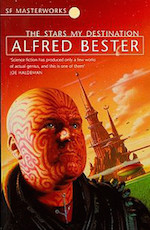 The UK edition of Bester’s The Stars My Destination draws inspiration from the central figure in Blake’s poem to describe its protagonist: Unassuming Gully Foyle, marooned in space and then abandoned by a passing ship, goes full Count of Monte Cristo in his need for revenge, and picks up quite the tiger face tattoo. Happening upon a fortune of platinum helps transform him into the nouveau riche “Geoffrey Fourmyle”—the wealthy, educated, physically fit persona he will use to take down the economic superpower Presteign family, who sent out the order not to rescue him. Even as Foyle gets the tattoo removed, he remains tiger-like, stalking his prey in his plan for vengeance.
Burning Bright by Melissa Scott
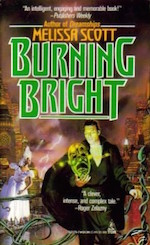 Scott’s standalone space opera christens the planet on which it is set not with tigers or forests, but the incredibly descriptive “burning bright”: nestled into the sweet spot of an interstellar trade route frequented by both humans and the alien hsai empire, Burning Bright enjoys a healthy tourism influx not just for the trade but for its other main attraction, the Game. This shared virtual-reality RPG invites players—such as pilot Quinn Loie, on shore leave while her ship is repaired—to shape the borders of the virtual world and create new scenarios for fellow players. But even as her new scenario attracts unusual attention, Quinn finds herself threatened in the real world, stuck between the two warring empires.
“In the Forests of the Night” by Jay Lake
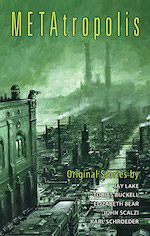 The first novella in John Scalzi’s collection METAtropolis also sets up the worldbuilding for the other four stories: in a futuristic “uncivilization,” cities are crumbling and reforming as their former citizens wage war, the technological haves versus the eco-survivalists have-nots. In Lake’s tale, Tygre (short for Tygre Tygre) enters the city of Cascadiopolis, located in the foothills of the Cascades near what used to be Portland, OR. Interestingly, Tygre’s name and arc have drawn comparisons not just to the Blake poem, but to Bester’s Tiger! Tiger! as well.
Her Fearful Symmetry by Audrey Niffenegger
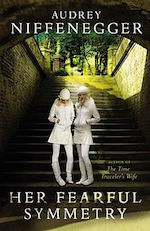 One of the most inventive allusions comes from The Time Traveler’s Wife author’s second novel, in which twenty-year-old twins Julia and Valentina inherit a flat from their deceased aunt, who was herself the twin sister of their mother… and who may live on as a spirit. As “mirror twins”—that is, identical twins with mirrored internal organs, Valentine’s heart residing on her right side—they embody the fearful symmetry of Blake’s poem. Critics have also pointed out that the flat bordering on Highgate Cemetery could make for a fun little pun.
“To His Coy Mistress” by Andrew Marvell
Had we but world enough and time,
This coyness, lady, were no crime.
We would sit down, and think which way
To walk, and pass our long love’s day.
“Vaster Than Empires, and More Slow” by Ursula K. Le Guin
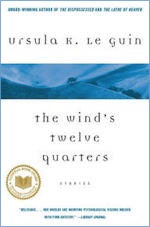 In this famous short story (collected in The Wind’s Twelve Quarters), Le Guin is in conversation with Marvell almost as much as the human survey team is with the planet to which they are sent—a strange world completely covered in vegetation, with no sign of animal life but thrumming with sentience through every blade of grass: the title is taken from a line describing how “Our vegetable love should grow/Vaster than empires, and more slow.” The story’s conclusion also makes a reference to another Marvell poem, “The Garden,” translating the phrase “a green thought in a green shade” rather literally when discussing the plant life’s consciousness and describing this alien world as “one big green thought.”
A Fine and Private Place by Peter S. Beagle
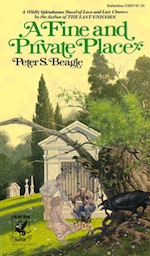 “The grave’s a fine and private place,” Marvell’s poem reads, “But none, I think, do there embrace.” Beagle challenges that notion with his wistful fantasy about a homeless, bankrupt pharmacist who has left society behind to live in a graveyard; there, he acts as the bizarre Cupid for two ghosts who have fallen in love—at least, for as long as they can before their unfinished business gets resolved and they must proceed to the true afterlife.
“The Fall of Rome” by W.H. Auden
The piers are pummelled by the waves;
In a lonely field the rain
Lashes an abandoned train;
Outlaws fill the mountain caves.
“Silently and Very Fast” by Catherynne M. Valente
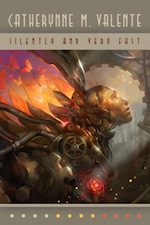 How fitting that Valente should draw the title of her Nebula Award-winning novella from Auden’s poem, as it takes place in the dreamworld between human Neva and AI Elefsis, who communicate more in story tropes than in actual words. Elefsis absorbs fairy tales like any other piece of information, knowing that when Neva sends her the image of a woman transforming into a crone it means to change the subject, and that she must express human notions of
 feel and love with strikeouts, not allowed to fully possess them. But this quasi-language has given Elefsis the mistaken impression that all stories have a happy ending—an interesting bit of parallelism to the fact that “Silently and Very Fast” is the final line of Auden’s poem.
Holy Sonnets: “At the round earth’s imagin’d corners” by John Donne
At the round earth’s imagin’d corners, blow
Your trumpets, angels, and arise, arise
From death, you numberless infinities
Of souls, and to your scatter’d bodies go;
To Your Scattered Bodies Go by Philip José Farmer
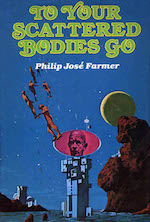 The first book in Farmer’s Riverworld series, in which humans are “reconstructed” in an artificial environment by the omniscient “Ethicals” studying them, makes use of the evocative phrasing from Donne’s sonnet: Adventurer Richard Francis Burton is one of the many “scattered bodies” who die on Earth, are briefly resurrected in some sort of limbo. While there are no angels blowing trumpets, there is someone with a weapon who blasts them to their next home, this mysterious planet on which they are expected to rebuild civilization with their fellow humans as well as various extraterrestrials. The purpose? A hint might be found near the end of the sonnet, as the speaker says, “here on this lowly ground/Teach me how to repent.”
What are your favorite poems that inspired SFF titles, and vice versa?

James Tiptree’s “And I Awoke and Found Me Here on the Cold Hill’s Side” is one of my favourite references, to John Keats’ “La Belle Dame Sans Merci”.
The Hyperion Cantos by Dan Simmons should definitely be on this list!
You should do one of these about Shakespeare!
You could make an argument for Brightly Burning, by Mercedes Lackey.
While not exactly a title inspired by poety, Tim Powers’ The Stress of Her Regard is most definitely inspired by poetry. A novel with Byron, Shelley, Keats and vampires cannot help but be inspired by poetry
@5: The Stress of Her Regard is taken from a poem, albeit one somewhat obscure outside of weird fiction circles: Clark Ashton Smith’s “Sphinx and Medusa”.
The titles of the four books in Dave Duncan’s “Man of his Word” series all come from Keats’ “Ode to a Nightingale.” The sequel series, “A Handful of Men,” uses titles from “To-Morrow” by John Masefield.
Consider Phlebas and Look to Windward by Iain M Banks – first thing that came to mind.
@6: I knew it sounded familiar, but I was unwilling to make the claim. Thank you for the correction! In any case, all and sundry should read that book. Along with Declare, TSoHR is Powers’ at his historical best.
Very nice post, and striking cover art for the Valente story, which I seem to have missed. It’s great that Clarkesworld has their Classic Reprint program, filling in for Ellen Datlow’s late lamented Sci-Fi (channel) series.
Thanks for the writeup!
@3: yes, Shakespeare, starting with all the titles from Seanan McGuire’s “October Daye” series. And, off the top of my head, Pratchett’s Wyrd Sisters and Witches Abroad, and Bradbury’s Something Wicked This Way Comes.
Marie Brennan’s Onyx Court series – Midnight Never Come (Christopher Marlowe), With Fate Conspire (Omar Khayyam) (and probably the other two in the series, but I can’t offhand place them)
From traditional sources–
Brown Girl In the Ring by Nalo Hopkinson, from a West Indian children’s song, and The New Moon’s Arms, from “The Ballad of Sir Patrick Spens”
Juniper, Gentian and Rosemary, by Pamela Dean, from a variant version of the ballad “Riddles Wisely Expounded.” And, of course, her and everybody else’s Tam Lin. Also, any novel by Pamela Dean is going to have lots and lots of poetry in the dialogue, too.
A String in the Harp, by Nancy Bond– a 1970’s YA novel based on Welsh mythology, with a title taken from Cad Goddeu, “The Battle of the Trees”
Kit Whitfield’s In Great Waters, from Psalm 107.
It’s not exactly poetry, but Cotton Mather’s book-length sermon “Wonders of the Invisible World” left us with a very poetic phrase that’s been used for a collection of short stories by Patricia McKillip and a YA fantasy by Christopher Barzak.
Does it count if you quote your own poem in your title? Ursula LeGuin and The Left Hand of Darkness: “Light is the left hand of darkness / and darkness the right hand of light.”
I can’t not mention The Dark Tower!
I’m sure you could also generate quite a list from Iliad/Odyssey/Aeneid/etc.
Bradbury certainly had plenty of stories at least titled from poems. “The Golden Apples of the Sun” from Yeats, and “A Miracle of Rare Device” from Coleridge’s “Xanadu”, to name just two.
Also I forgot about Neil Gaiman’s Sandman series. There are poetic allusions and direct quotes in every issue and every volume, but just for the titles alone (and treating song lyrics as poems (if it’s good enough for the Nobel committee, it’s good enough for me)):
Preludes and Nocturnes — T. S. Eliot, “Preludes” and “Nocturne”
Sound and Fury — Shakespeare (Julius Caesar); Dream a Little Dream of Me – Ella Fitzgerald
Men of Good Fortune – Lou Reed; Into the Night – Joe Jackson
A Midsummer Night’s Dream – obviously!; Façade – Edith Sitwell
“Season of Mists” — John Keats, “Ode to Autumn”
“A Game of You” is all musical – Slaughter on Tenth Avenue, Rogers and Hart ballet; Lullaby of Broadway, Al Dubin; Bad Moon Rising, Creedence Clearwater Revival; Beginning to See the Light, Velvet Underground; Over the Sea to Sky, Scottish traditional; I Woke Up and One of Us Was Crying, Elvis Costello
“The Wake” — besides the obvious triple meaning of the title, possibly an allusion to Roethke’s “The Waking”? “Sunday Mourning” – an echo of Wallace Stevens and “Sunday Morning”?
“Endless Nights” – William Blake — What I’ve Tasted of Desire, Robert Frost; The Heart of a Star, e.e. cummings; On the Peninsula, D. Nurkse
Like it or not, I must add Heinlein’s “To Sail Beyond the Sunset” – Tennyson’s Ulysses.
Greg Bear’s “Slant”, after Emily Dickinson’s “Tell all the truth but tell it slant”
Where Late the Sweet Birds Sang by Kate Wilhelm is titled after a Shakespearean sonnet (according to Google: sonnet 73)
@11: I immediately thought of the October Daye series, too.
I Sing the Body Electric, by, separately, Ray Bradbury and Walt Whitman.
Poul Anderson’s “Journeys End”, lifted from Shakespeare.
Guy Gavriel Kay’s Sailing to Sarantium is just substituting the place name in W.B. Yeats’ “Sailing to Byzantium”, and the poem begins with the line “That is no country for old men”, the McCarthy novel isn’t SFF but still.
And how could we forget “The Drunkboat” by Crodwainer Smith, which not only alludes to Arthur Rimbaud’s poem of the same name, but also has its central character called Rambo – as Rimbaud would’ve been pronounced by Cordwainer Smith – and includes the entire poem in translation as part and parcel of the story’s action.
I fell into the red red reds of love when I first read that story … I was the drunkboat sinking …
We’re missing two of the greatest and most direct- Dirk Gently’s Holistic Detective Agency by Douglas Adams (which makes heavy use of Kubla Khan and The Rime of the Ancient Mariner) and The Sea of Trolls by Nancy Farmer (a story built around a simple poem, one that made me laugh out loud when I made the connection.)