








In general, office jobs aren’t great. The fluorescent lights, the cheap carpet, that industrial off-beige color scheme—they all conspire to create environments that maximize efficiency at the cost of dignity, sanity, and souls. This makes them excellent fodder for stories that push into the realm of the fantastical, often with a satirical bent that exposes both the numbing inanity and the inhuman(e) horror of corporate life.
The best part of writing my novel Colin Gets Promoted and Dooms the World was fleshing out the ancient and sinister company at its heart. Dark Enterprises specializes in solving problems by doing terrible things, and it encourages an office culture that’s literal murder on its employees. The titular Colin works in Human Resources, where unlucky humans “donate” useful resources like despair, screams, and teeth. It’s fine, as jobs go, but Colin wants more. Unfortunately, things go a little sideways in his quest for a promotion, leaving the fate of the world hanging in the balance.
As awful as Dark Enterprises is, there’s plenty of competition for the title of “worst office jobs in speculative fiction.” Here are five of my favorite examples.
The Atrocity Archives by Charles Stross
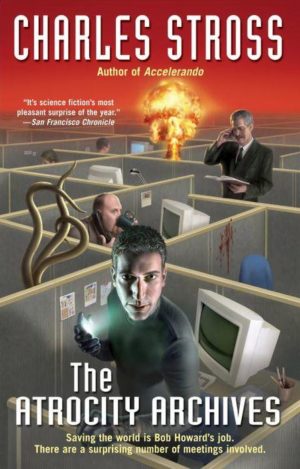
What if mathematics could rip open holes in reality and pull forth alien horrors? That’s the premise that anchors the Laundry series by Charles Stross, which centers around a clandestine British government agency known as—you guessed it—the Laundry. They’re tasked with monitoring researchers who might inadvertently stumble across a particular computational theorem, first discovered by Alan Turing, with the potential to attract eldritch Lovecraftian beings that would love nothing more than to devour our universe.
The Atrocity Archive follows Bob Howard, a computer scientist who was forcefully inducted into the Laundry and now finds himself trying to save the world. Unfortunately, he has to do so while contending with bureaucratic red tape, endless mandatory training seminars, and a mounting avalanche of emails. Stross himself was an IT worker for years before he started writing full-time, and it shows. He has an uncanny knack for juxtaposing the never-ending indignities of office life with occult conspiracies and literal Nazis.
The Other Black Girl by Zakiya Dalila Harris

Harris’ debut novel initially presents as both biting workplace satire and slow-burning thriller. Its protagonist, Nella Rogers, works as an editorial assistant at Wagner Books, an influential publishing house in New York City. She’s also their only Black employee, a lonely and alienating experience made worse by the oblivious microaggressions of her white coworkers.
Cue the arrival of “the Other Black Girl.” Hazel-May McCall is confident, personable, and skilled at code-switching, able to finesse her Blackness so she comes across to her white colleagues as a non-threatening token of diversity instead of an uncomfortable reminder of systemic racial inequity. Rather than being the ally Nella needs, however, Hazel actively undermines her at Wagner while at the same time offering community and fellowship within a network of Black professional women, all of whom found success after assimilating into white-dominated workplaces. I won’t give away the twist that comes late in the story, but it centers around homemade hair grease and a far-reaching conspiracy going back decades. This is what turns the book from a darkly satirical examination of workplace discrimination to something fantastical and deeply unsettling.
Sign Here by Claudia Lux

It’s hard to imagine a more literal corporate hellscape than the one presented in Claudia Lux’s Sign Here, which reimagines Hell itself as a realm of stifling bureaucracy and endless drudgery. Peyote Trip, known to everyone as “Pey,” has spent eons working his way up to the fifth floor and a job in the Deals Department, where he now convinces gullible or desperate mortals to sign away their souls in exchange for petty favors. The problem is, Pey hates his job. Hell sucks. Sure, the fifth floor is better than the gruesome tortures he suffered Downstairs, but the music up there is always a little too loud, the coffee is terrible, and the only booze available is Jägermeister.
Fortunately, Pey has a cunning plan. He’s learned of a loophole that will free him from Hell, and it revolves around the Harrison family. They have a swanky lake house in New Hampshire and also a bunch of dark and sordid secrets, making them ripe for some opportunistic deal-making. Pey’s schemes are complicated by the arrival of a new coworker named Calamity as well as his own history with the Harrisons, and there are some truly dizzying twists and turns as the story heads toward its climax. Pey is a compelling and relatable protagonist, but it’s Lux’s bleakly humorous vision of corporate Hell that will stay with you.
The Portable Door by Tom Holt

As workplaces go, J.W. Wells & Co. is… weird. Paul Carpenter realizes this almost as soon as he starts working there, despite being the kind of clueless person who generally notices very little. Maybe it’s the mysterious claw marks gouged into the wall of his miserable little office, or the stapler that keeps popping up in the unlikeliest of places. But hey, it’s a job. This unassailable fact, coupled with his falling head over heels for the other new hire, the prickly Sophie Pettifer, induces Paul to stay at the company despite its weirdness. As a result, he’s plunged into a world that is both very strange and frequently terrifying.
Beginning with The Portable Door, the hugely prolific Tom Holt has continued to mine this strange and terrifying world for fantasy gold. His J.W. Wells & Co. series currently stands at eight books, all of them revolving around an ancient company run by corrupt and megalomaniacal sorcerers. There are shapeshifting goblins, rogue dragons, and disgraced employees transformed into sentient office equipment, with Holt seemingly trying to one-up the zaniness with each subsequent book.
Company by Max Barry

This may not look like speculative fiction at first glance, but Max Barry’s satirical take on corporate life is so nuts that—for me at least—Company veers all the way into the realm of absurdist fantasy.
We follow the young and bright-eyed Stephen Jones as he starts a new job at Zephyr Holdings, a massive corporation that does…well, something, presumably. Only, Stephen can’t figure out what that “something” is. He’s placed first in Training Sales, where no one will tell him what they actually sell. The office environment is soul-crushing in its conformity, its employees fixated on the pettiest of problems. When a doughnut goes missing at the start of the book, its absence snowballs into mass paranoia, ruthless witch hunts, and team accountability drills. Even by the nonsensical standards of end-stage capitalism, this is strange.
The more Stephen questions the purpose of Zephyr Holdings, the more deeply enmeshed he becomes in the company’s inexplicable functioning. When he encourages his colleagues to push back against the system in which they’re trapped, management reframes his “disruptive thinking” as leadership potential and promotes him. There’s a terrible gravity at work in Barry’s fictional office, and as readers we can only watch helplessly as Stephen is pulled further and further into the horrifying reality of Zephyr’s nihilistic goals. More than any other, this book will make you shun office jobs for life.
Buy the Book

Colin Gets Promoted and Dooms the World

The description of Sign here seems a short hop from The Screwtape Letters.
Workplaces from hell play a big role in Snowcrash. I am thinking of the thrasher’s mother and her job for the Feds, that our fellow in the opening scrambling through the binders of procedures trying to find the policy on kitchen disasters, and maybe even the Deliverator.
I’m guessing ‘J.W. Wells & Co’ is a reference to ‘The Sorceror’ by Gilbert & Sullivan
I spent most of my working life as a government bureaucrat (now long retired), and the bureaucratic procedures is one of my favourite aspects of the Laundry Files. Well, “favourite” in the sense that their familiarity gives me a lot of rueful chuckles.
I would suggest Winston Smith’s job, as well, destroying the past to help the loathsome control the future.
“Then we came to the end” by Joshua Ferris fits the description of bizarre and phenomenally uncomfortable to the point of disturbing office interactions. And yet, it is also quite funny at times.
The absolute misery of Linus’s office in “The House in the Cerulean Sea” immediately jumped to mind.
Throwing in a plug for this one by my better half, Harry Turtledove. THE CASE OF THE TOXIC SPELL DUMP (1993!) is set in a world where all religions are true and magic functions as a technology. David Fisher is a bureaucrat, an inspector in the Environmental Perfection Agency (EPA), analyzing impact statements like the effect of introducing leprechauns to an area previously free of small magical Irish fae. Naturally, his latest assignment, checking out strange reports from a spell dump in the north of Angel City, gets far more complicated than pushing papers. Warning: this book is nonstop silly, heavy on the puns.
Franz Kafka’s The Castle (Das Schloss) is probably the first novel about an impenetrable bureaucracy, and I suspect Jeff VanderMeer’s Authority is heavily influenced by it.
In The Castlea protagonist named “K.” tries to negotiate the bureaucratic maze (which becomes ever more surreal), while in Authority the protagonist is part of the bureaucracy, but doesn’t seem to understand it, either.
Another good series about a different kind of workplace is 24/7 demon mart series by D.M. Guay. I’m on book 2 and it is very good.
David