







As I have recently become a completist when it comes to authors I like, I am presently on a Sarah Hall kick. In this case, “kick” means “compulsive journey to read all her previous books before Helm comes out in November.” I’ve read some of her books, but not all of them, so I have started with Haweswater, her debut, which is not at all speculative, though some of her work leans that way. What it is is gorgeous. And heartbreaking. Pages upon pages of description of life in a small English town, punctuated with sentences that illuminate character with breath-stopping precision, and ending with a landslide of grief.
I am not always a collector of sentences, except when I am. What stopped me in Haweswater was first a series of sentences in the prologue:
“Then there was the matter of his heart. Inside his old heart a new one was growing and pushing to get out, and inside that one another one, and another, all pushing to get out. So many hearts. And that was how grief worked inside the man. Filling his chest cavity so full of hearts that it almost became sore to touch on the outside and he stooped over with the weight.”
That was how grief worked inside the man. That was not where I thought that sentence was going, if I had any idea at all of its destination. That early in a book, it’s often hard to know. Grief, and hearts, and weights difficult to carry: with that, Hall gives you something to expect.
A few chapters later, though, I stopped dead at, “In this world there is always the intrusion of one structure or another into the sacred, self-governing heart.”
This line appears in the middle of a paragraph about a teacher who “brings with her a brilliant energy and liberating words, ideals belonging to the New World perhaps, or the Antipodes. And there are off-kilter tones in her speeches, also; she has her demons.” The teacher talks about Mary Shelley; the teacher says never to breathe a sigh of relief. And then Hall offers this line about structure.
I stopped. I flagged the page. And then I thought about how different readers might read that line differently. One person might sneer; another might not even pause. Yet another reader might pick the line apart for imperfections. Why do I love this sentence? Some nebulous combination of form and function. The way it sets structure against the idea of a heart, a heart as sacred, a structure as intrusive—sometimes, not always. The way it comes in a paragraph that describes a woman whose presence, in the small town where the book is set, is lightly at odds with the town’s way of doing things. It knots all the lines before and after it together into its own little sore spot.
I’ve been thinking about how writing works because of a lot of recent conversations about genre and style and quality and tropes and, well, all the things book people love to argue about. There are so many ways into and out of these conversations, so many different things being discussed—I often think it would help if we could all just specify from the get-go if we’re talking as readers, as writers, as both, and/or about writing, reading, or publishing, which are all different but interconnected things. Broad claims about what different genres are like, or how the writing in them works, inevitably lead to exceptions. There are always exceptions. There are usually rules, too, unspoken or otherwise.
A really fascinating recent post by Devon Halliday made a fairly successful attempt to define literary fiction in a way that had nothing to do with quality. “Literary fiction aims to draw attention to the language choices the writer is making,” she writes. “Commercial fiction aims to draw as little attention as possible to the language choices the writer is making.”
This is a broad generalization, yes, but Halliday is coming to this from a publishing perspective, and her post gets into how literary, commercial, and upmarket fiction is viewed from the publishing side. (It’s really interesting reading, if you are interested in that sort of thing.) I think, also, that you can apply this distinction within genres: There are literary SFF novels that do want you to pay attention to the language choices, and commercial SFF novels that are more interested in keeping you turning pages. They still care about their language and make choices; they’re just of a different sort.
It still starts to sound like a quality division to me. A little bit. Not terribly. I like both sorts of books, though. I like them for different reasons, the same way sometimes I want to go on a walk and just stomp my way through it, lost in thought, and sometimes I want to go for a stroll and notice everything, stopping to smell flowers and identify birds. These are both valuable things to me, however different the experience may be.
The Hall sentence above drew me up short in part because as I read it, as I fell in love with it, I thought, I want to read SFF that feels like this. Is “literary SFF” a thing a person can ask for without sounding like they’re insulting the commercial side of the genre? I don’t just mean that space where literary imprints have made room for serious novels about the climate crisis. I am grateful that they’re doing that, but I’ve read too many of those recently and they have been too often dour and overfamiliar to someone who’s read a lot of those books already.
I mean: What are your favorite sentences in SFF? What books have you stuffed with underlines and exclamation points, if you’re the kind of person who writes in your books? What kind of writing in this genre makes you pay attention to the words themselves?
I think a lot about the way Vajra Chandrasekera inserts “a little haha hoho, a little lol j/k” into the rich text that is Rakesfall—both the actual phase and the moments where the book is funny in ways a reader may not expect. I think about playfulness and tone, and about self-seriousness, and about what looks or feels like self-seriousness but probably isn’t meant to be. I think about the literary fiction novel Netherland, which I hated because it was full of beautiful sentences trapped in a frustrating story; I think about how there are still dozens of torn shreds of paper sticking out of my copy of David Mitchell’s The Thousand Autumns of Jacob de Zoet, because I was nowhere near a pad of post-its and I didn’t want to dog-ear the hardcover’s pages, but there were so many sentences I needed to keep. There are so many sentences I’ve failed to collect.
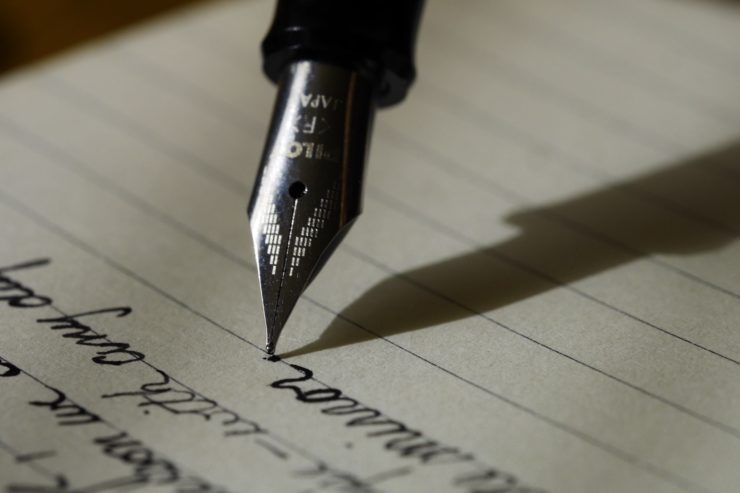
I tried to keep a commonplace book, but I bought a fancy notebook and a fancy pen—both mistakes; I should have gone cheap and sloppy, like my handwriting. Most of the things I’ve managed to write in it are little bits from essays and talks about writing, but sometimes fiction slips in. Sometimes it’s a line from fiction, but it does something else for me. “Our selves are rough and unrehearsed tales we tell the world,” wrote William Alexander in Goblin Secrets. “Didn’t I tell you it’s unwise to mistake the cruelties of others for your own failings?” says a character in Alaya Dawn Johnson’s The Library of Broken Worlds.
“Look how the big is made small. Look how the beautiful is also fearsome,” Rachel Hartman writes in Among Ghosts.
Sometimes it feels so revealing, sharing one’s favorite sentences with the world. There is no good and bad when a sentence moves you; there’s only what it does and how it does it. Genre and literary are not mutually exclusive; there is no hierarchy between them unless we put it there. These categorizations can meld, they can divide, they can overlap, they can be both at once. When I’m reading, the important distinction is between what I want to read and what I don’t want to read. Does it matter if it’s “good”? Good according to whom? What does it do? How does it make you feel?
Here is another sentence I’ve loved recently, one so brief and complete that I managed to remember to write it down: “Love is what remains of our reading life,” the poet Mary Ruefle writes in the notes to The Book. The note is about a piece in which she tries to remember a story she read. She remembers dogs barking, and faces in windows; she calls it “a personal exercise in literary memory, one I failed in every way.”
Will I remember the sentences from Haweswater, the ones that began this column? Or will I remember the characters and the feel of how Hall describes a place so clearly it’s like you can see all the way to the mountains and the soil and beyond? Will you remember whether a book was “good,” or only that you loved it, whether for the story or the sentences, or the way it made you feel? If all that remains is a fleeting image of a lamb, or the sound of water, and the knowledge that you loved it, well, what more could you ask for, really.

By the sheerest coincidence, one of my favorite lines in fiction was in the footer of this page when I read the article:
It says so much with so little….
Even when I’m writing a page turner, I hope that the words will come out in a way that strikes like an epiphany, that makes the reader stop and enjoy the poetry. (It almost never happens, but…)
I’d say anything by Bradbury would count; he had the ability to paint very vivid images in the simplest words and short sentences. They always felt very literary to me.
My favourite SFF books have sentences that live rent free in my head. Some SFF authors whose stunning sentences make me pause and bask are Premee Mohamed, Iona Datt Sharma, Susanna Clarke, Kerstin Hall, Amal El-Mohtar, Kathleen Jennings, Nghi Vo, and Sharang Biswas.
My favorite sentences tend to be ones that do a huge amount of characterization or scene setting in a very few words, rather than those that flow lyrically or generate poetic imagery.
For example, from Tanya Huff’s Smoke and Ashes: “The television remote was not in the pizza box under the couch.” That sentence tells us SO MUCH about the character and living circumstances of the protagonist, Tony. That there was a pizza box under the couch – so normal that it wasn’t worth remarking on, except on the way to his goal. That Tony would think to look in it for the remote – that it might be a likely place to find it.
Or these from Survival, the first book in Julie Czerneda’s Species Imperative trilogy: “Bah! There[s no sex in this one either. The offending book sailed over Mac’s head, landed with a bounce, then began slithering down the massive curve of rock.” Having already learned in the first chapter that these were two scientists researching salmon in the pacific northweast, the opening lines of the second tell us SO MUCH about what their daily lives, as salmon researchers, are like.
Those are the two that immediately came to mind when I read the title of this piece. There are more, in a notebook… somewhere in my house, but those two _always_ come to mind when I think about great sentences.
I don’t have my copy of The Fellowship of the Ring at hand, but one great sentence that I’m probably not remembering precisely is “Aragon sat with his head bowed to his knees; only Elrond knew fully what this hour meant to him.” This was when the Fellowship was at Rivendell finishing the last preparations for leaving.
“Literary SFF” is probably my favorite subgenre, and it’s so pleasant to read your take on beautiful language and categorizing and how it’s not about quality, per se, but about style. For me, if a book has beautiful sentences and beautiful structure, it almost doesn’t matter what it’s about, I’ll enjoy it regardless! I have a truly terrible memory, so every time I write a book review I include lines I really liked, which are often what I found beautiful (or the ones that made me laugh, or cry).
But some books rise to the surface more than others when I think about beautiful sentences: The Last Unicorn, the Locked Tomb series, and the Imperial Radch series, all of which I could quote from on a better memory day. Other recent delights for me include Archangels of Funk by Andrea Hairston, The Naming Song by Jedediah Berry, The River Has Roots by Amal El-Mohtar, Notes From a Regicide by Isaac Fellman, Awake in the Floating City by Susanna Kwan, and The Incandescent by Emily Tesh.
I love this a lot a lot a lot
The value judgment of “genre fiction,” as if just writing on a certain subject is a pejorative.
The joy in a perfect sentence, and how it can be found anywhere, and hit you differently each time.
My tastes don’t generally lean toward things that smack too much of “literary”, but I think Gene Wolfe, whose Book of the New Sun i am quite fond of, fits the bill.