





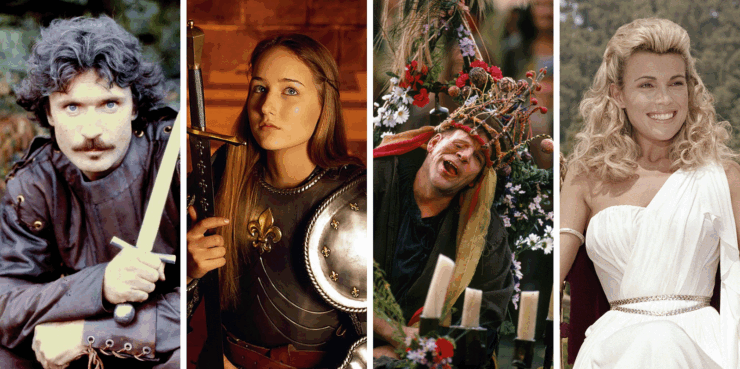
Success breeds imitation. That’s why, ever since the first movie tickets were sold for a profit, the most popular films always portend a swarm of knockoffs, often with comically lower budgets and lesser-known actors.
These days, plenty of movies that seem to pop up on streaming services almost instantaneously in the wake of a big hit movie often have the feel of an imitation. Several tiers below that are the ubiquitous mockbusters, the kind of movie that tends to end up in the DVD bargain bins of convenience stores. Zero-budget and straight-to-video, these movies often have deliberately misleading titles that get conflated with big Hollywood pictures. And whenever a “real” movie is based on intellectual property in the public domain, a mockbuster is virtually guaranteed. And why not? The producers don’t even have to change the title! In fact, the term “mockbuster” appears to have been coined in reference to the movie H.G. Wells’ War of the Worlds, released by Asylum Films the day before the premiere of Steven Spielberg’s 2005 adaptation.
Back in the ’80s and ’90s, however, many of these seemingly redundant movies emerged from the bizarro world of made-for-TV movies. I have written about TV movies before (here and here), and not because I think they’re good. It’s more like processing some traumatic accident. I find myself asking: Why did this have to happen? Who’s responsible? How do I move on?
Shockingly, though, a few of these unnecessary TV movies might nevertheless surprise some viewers. Despite lowered expectations, many of them were serious (if flawed) attempts to tell a story. Of course, as one would predict, many other examples would never even make it to the bargain bin. Here are a few that range from “hey, not bad!” to “what were they thinking?”
Robin Hood (1991)
I’ll start with one that’s worth a shot. In May 1991—about a month before Robin Hood: Prince of Thieves premiered in theaters—the British-made Robin Hood debuted on FOX. This may be a TV movie, but it was not made for TV. Instead, it was intended for release in American theaters until it became obvious that it would get snowed under by the looming Kevin Costner-led blockbuster.
That’s a shame, because this movie features several elements that were fresh at the time, including a “gritty” medieval look, a serious (but not too serious) take on the characters, and a more independent Maid Marian who joins the action rather than waiting to be rescued. The cast has some people worth watching. Patrick Bergin plays a charming Robin Hood. In my recollection (I was 13 at the time), FOX’s relentless ad campaign prominently featured Uma Thurman as Marian. No objection there. Jurgen Prochnow (Das Boot) and Jeroen Krabbé (The Fugitive) are the bad guys, and a young Owen Teale (Game of Thrones) is Will Scarlett. Most important, this movie is comfortable with a smaller scale. Rather than telling a globe-trotting story involving the Crusades and court intrigue in faraway London, this is a more focused and realistic narrative about a local conflict.
I always viewed this one as a pleasant surprise, a thoughtful companion to the fun but somewhat overblown theatrical release that arrived a few weeks later. Why choose? You can like them both!
The Hunchback of Notre Dame (1997)
By the 1990s, Victor Hugo’s The Hunchback of Notre-Dame had been adapted so many times that it seemed inevitable that Disney would eventually give it a try. Somehow, they produced a version of this heartbreaking story that featured not only singing gargoyles, but an uplifting theme and a happy ending. Even the most skeptical critics had to admit that Disney succeeded.
A year later, TNT attempted a serious take1 on the story, with no singing gargoyles. And they brought out the big guns: Richard Harris as the villainous Dom Frollo, Salma Hayek as the gypsy dancer Esmeralda, and a barely recognizable Mandy Patinkin as Quasimodo, the tragic bell-ringer. IMdb has a funny story of how Patinkin tried but hilariously failed to secure the title role for the Disney film, which led directly to him getting the role here. And hey… wait a minute… is that Nigel Terry from Excalibur? Yes! It is!
The production values may not have aged well, but they garnered four Emmy nominations back in the day. More than that, the movie offers some smart, sensitive, and nuanced commentary on class, faith, and human progress. Still, the film is held back by the limited scope of a TV movie. There’s a lot of creative camera work to make the tiny crowd of extras resemble a massive Paris uprising. The big action set pieces are somehow less impressive than a previous made-for-TV adaptation from 1982, starring Anthony Hopkins. And the runtime may be too compact to explore all the relationships, from the unrequited love stories to the fraught mentor-mentee tension between Quasimodo and Dom Frollo. So, your mileage may vary with this one. But if you need more adaptations of this story in your life—like the people who run this blog that I discovered—then it’s worth a try.
Joan of Arc (1999)
In the fall of 1999, director Luc Besson followed up The Fifth Element (1997) with The Messenger: The Story of Joan of Arc, starring his then-wife Milla Jovovich. Critics were not receptive. Many pointed to the disjointed themes: the movie had feminist aspirations, but also casually toyed with the idea that Joan was mentally ill. The most generous reviews tried to compare the film to Braveheart (1995), arguing that it was a clumsy patriotic epic that was meant to be more fun than historically accurate… not exactly a ringing endorsement.
Expectations for a TV movie, however, are mercifully lower. And so the two-part Joan of Arc released on CBS earlier that year enjoyed a warmer reception. Rather than speculating about the main character’s psychological state, this version opts for a paint-by-numbers narrative, no doubt tested to please a wider audience. Joan of Arc plays it so safe that if you search for reviews, you’ll find many conservative-leaning websites praising the film for not bashing the Catholic Church.
At the time, the major networks were on a roll with high-concept miniseries. Among these, Merlin (1998) with Sam Neill might be the best known. Joan of Arc has a similar feel, especially when it comes to the talented cast. Leelee Sobieski takes the title role, supported by Peter O’Toole (who won an Emmy), Olympia Dukakis, Shirley MacLaine, and Neil Patrick Harris (back when most people would still point to the screen and say, “Doogie Howser?”) Whereas The Messenger received multiple Razzie nominations, this redundant TV movie was rewarded with four Emmy nominations and thirteen more from the Golden Globes.
I don’t really know what any of that means, though. Miniseries are notoriously bloated, and this is no exception. By the time it reaches its first battle scene, most feature-length films would be over. Joan of Arc might be more useful as an artifact of how religious piety (and zealotry) was depicted in popular culture in the late 20th century. After all, the movie starts with Joan thanking God while burning to death, an act of fanaticism that I hope would be explored and deconstructed a bit more in the present day. Besides, can anyone really top Jane Wiedlin’s Joan from Bill and Ted’s Excellent Adventure? That’s a debate for another time.2
Goddess of Love (1988)
Let’s crawl out of the Middle Ages and into the modern world, where we find a movie that is much closer to the classic mockbuster model that we love to ridicule. I’m talking about Goddess of Love, released by NBC in 1988. Props to fellow Reactor writer Reneysh Vittal for reintroducing me to this mess. I remember that NBC promoted this movie so relentlessly that there was no escaping the ads—even David Letterman satirized the promotional campaign run by his own network.
So here’s the plot: on Mount Olympus, which looks strangely like a backyard in Beverly Hills, the god Zeus (John Rhys-Davies!?) punishes a disobedient Venus by imprisoning her in statue form. Her only way of escaping is to make a man fall in love with her. Centuries later, the statue is delivered to 1980s Los Angeles. Through a silly sequence of events, a hairdresser named Ted places his engagement ring on the statue’s finger, bringing the goddess to life. While Ted dodges her increasingly aggressive advances, Venus discovers the wonders of modern America. And yes, in typical ’80s fashion, that includes a credit card and a makeover.
Goddess of Love is a remake of a comedy from the 1940s, but its inspiration (and much of its script) appears to be drawn from Mannequin, the critically panned but financially successful rom-com released a year earlier. Perhaps the most blatant rip-off involves Mannequin’s main comic relief, Hollywood Montrose (Meshach Taylor), a gay character whose positive portrayal was considered trailblazing for the time. Goddess goes for the same laughs by casting Little Richard in a similar role… but they don’t commit to the bit, leaving him mostly out of the plot.
Even if Little Richard had the chance to carry the movie, he would have been weighed down by the puzzling decision to cast Wheel of Fortune’s Vanna White in the lead. I don’t blame them for trying, but the script does her no favors. Maybe this could have worked if, like Arnold Schwarzenegger’s early performances, she only had to deliver a handful of quippy, memorable lines. But no: she’s expected to be funny, cutesy, sexy, emotional, and sometimes scary. Even for a more experienced actor, it’s a lot to ask. If NBC ever re-ran this one, it was certainly without the relentless ad campaign.
Am I leaving out any redundant, ripped off, or mockbuster-adjacent examples from my list of TV movies? I’m not entirely sure if I want to know, but if you have any that have stuck with you over the years, please add them in the comments. And may the goddess of love have mercy on our souls.

Well, a series and not a movie: the 11 episode Blue Thunder TV series was a sequel, of sorts, to the movie of the same name… except that in the movie, the potential for the super duper helicopter to be abused was such that it was destroyed at the end of the film, whereas in the TV series felt Blue Thunder’s very special abilities were pretty sweet and should absolutely be used.
TV series spinoffs/adaptations of movies are a different category, though, since they’re from the same studios and often some of the same creators as the films they adapt. If we’re talking TV shows that imitate unrelated movies rather than adapting them directly, Airwolf qualifies more as a TV knockoff of Blue Thunder. It actually premiered just 16 days after the Blue Thunder TV series, though it ran a lot longer.
You know, I think my memories of Airwolf and Blue Thunder merged at some point. AirThunder. Blue Wolf.
Bad Wolf?
Unsurprising, given that they were on at the same time.
I have Blue Thunder on Blu-ray and watched it last summer. It’s actually aged pretty well.
I love that version of Robin Hood. I hunted it down on DVD.
It seems highly unfair to include the Bergin/Thurman Robin Hood in an article about made-for-TV imitations of theatrical films, because it was neither. It was not made for TV, as you even admit, and it was not an imitation trying to capitalize on the other movie, but a parallel production that was pushed out of theaters by the Costner movie. And it’s enormously better than the Costner movie, so it’s doing it an injustice to dismiss it as an imitator.
A similar situation happened with Filmation Associates’ superb 1979 animated movie Flash Gordon: The Greatest Adventure of All. Because Dino De Laurentiis had the movie rights to Flash Gordon, the movie was only aired once on television in 1982 and then never broadcast or released in the US again (though an overseas home video version can be found on YouTube), even though it’s a better, more authentic Flash Gordon movie than the De Laurentiis one. Most of its content was reedited and reanimated into the first season of Filmation’s 1979 Flash Gordon TV series, but the series omitted the more adult aspects of the feature film version, like the opening scenes set during WWII, a subplot about Ming the Merciless colluding with Hitler, and the skimpily torn clothes Flash and Dale Arden were wearing for much of the film. (Although the clothes were reanimated mainly for the sake of continuity, since movie material was rearranged and spread out throughout the season. Princess Aura’s bikini was preserved intact, such as it was, for the series version.)
According to an article in Premier Magazine from when Prince of Thieves came out (I’m going from memory, since Premier seems to be largely unavailable online), Costner was being pursued by the producers of both movies, and there was quite a bit back-and-forth before he committed to Prince of Thieves.
I have trouble understanding why they both would’ve wanted Costner. Even aside from him not being one of the Robin Hoods who can speak with an English accent (thank you, Mel Brooks), I’ve always found Costner one of the most uncharismatic actors alive. When I saw Prince of Thieves, it was like there was a Costner-shaped void in the middle of the movie where the title character was supposed to be.
I’ve only ever liked Costner in No Way Out. After I saw the Bergin-led Robin Hood, I could not understand why people liked Prince of Thieves.
The Bergin version is available on blu-ray and some streaming platforms, too. And, yes, much better than the Costner version.
I’m also a fan of the classic Errol Flynn version, and of course Daffy Duck’s.
If you want to talk about Robin Hood knockoffs, we should include The Sensational Character Find of 1940, Robin the Boy Wonder. The opening splash page of Dick Grayson’s debut issue in Detective Comics #38 stated explicitly that he adopted “the name and spirit” of Robin Hood, no doubt the Errol Flynn version, hence his red and green outfit with a laced-up jerkin and his swashbucking, joking personality. Yet as Flynn’s Robin Hood faded from popular awareness over the decades, people started assuming that Robin was named after the bird, even though there’s no reason for Batman’s sidekick to be named after a bird. (Although it seems reasonable that the people who decided to bring the second Robin, Jason Todd, back to life as the Red Hood may have had Robin Hood in mind, though I’ve never seen it stated, and of course the Red Hood is a reuse of an identity originally used by the Joker, Jason’s murderer. So it could be coincidence.)
The run of classic literary adaptations that the major networks did as TV movies/miniseries in the 90s deserve to be better known. You mentioned Merlin with Sam Neill. There was also the surprisingly decent Gulliver’s Travels starring Ted Danson: one of the only adaptations I know of to include the whole book, plus a post-journey framing narrative that, while not in the book, IMO actually enhanced the story & themes. Then there was The Odyssey starring Armand Assante, which was IIRC needlessly horny and unintentionally goofy. They tried to stuff these TV movies full of big name stars. For some reason Isabella Rossellini kept turning up in them; she was Nimue in Merlin and Athena in The Odyssey and she was in an adaptation of Don Quixote with John Lithgow in the title role, that I’ve never seen but was apparently part of this run as well.
There’s also Dark Prince: The True Story of Dracula (2000) and Attila (2001) that both seem to pattern themselves after Braveheart. I liked them both, however Attila is more noteworthy for starring a Pre-300 Gerard Butler playing a similar role.