





In a future where people can travel back in time and do anything they want without consequences, one disgruntled young man decides to visit his parents two years earlier.
Short story | 5,030 words
Gray doesn’t understand the temporal mechanics perfectly, but he’s pretty sure he understands them good enough: any past you go back into, the universe or “physics” or God or whatever protects itself from interference by making the past you’ve gone back to a sort of parallel branch, a side room, a curiosity where all lives are fake, at least when compared to the real ones happening in the universe you time-traveled from.
First, this means that paradoxes are, technically, possible—things are fixable, or ruinable—but in order to ever get wrapped up in one of those backbendy stories, you would have to somehow wriggle back into time without the universe noticing you. Which either no one has done so far, or everyone already has, resulting in the mess society and the climate and politics and everything else is.
But?
Gray know probably nobody’s messing with things. All the things broken in his world can’t be traced back to this or that despot living or dying, or some random butterfly either flapping its wings or getting stepped on before it could—they’re just the result of, you know, humans humaning, shooting their own feet every second or third step, then limping ahead to do it again, any and all lessons woefully unlearned. How the species has made it far enough to come up with time-travel tech, much less commercialize it, is the biggest mystery of all to Gray.
It doesn’t mean he can’t take a ride through the time-stream, though.
If you don’t want to go back more than five or ten years, it’s almost affordable, even.
Not that Gray is all that interested in the commercial routes into the past, all that tourist stuff, “exit through the gift shop,” no thanks.
But his buddy Timoth knows a guy who, you know, knows a guy.
As luck would have it, too, Gray is just off what he calls a caper, but is probably, technically, more of a scam. One that’s netted him a stack of credits on the sly, credits he’s pretty sure are flagged and tagged, meaning as soon as he tries to spend them through any portal associated with any of his profiles, well, that’ll be that.
The guy Timoth knows at two removes, however, has a stack of stolen profiles he can shunt the funds through, not quite ever washing it and making it legit, but tangling its backstory enough—all in half a blink of server-time—that it would take some serious AI tunneling to ever unravel. And, for a score this small . . . would that really be worth it?
Gray doesn’t know the answer, but his credits seem to spend, anyway.
The ride he’s taking is urban legend, but also not legend at all: you get sent back anywhere under ten years ago, even yesterday if that’s your kink, and you’re there for a whole day, no more, and, while there, any and all crimes you might elect to indulge yourself in?
They don’t really count.
Everything in this side branch of the real timeline is fake. So? Any murders you might perpetrate, are they really even killing at all? Is it murder to slowly carve pieces off a cardboard cutout of a person? It isn’t, Gray knows. Cardboard cutouts are nothing, who cares about them, they’re not anything close to alive.
It’s the same in the parallel branches the universe kicks up when it senses one more idiot falling backward through the years.
Gray’s pretty sure he’s not actually a killer, but, all the same, he halfway suspects that going back two or three years and pulling a massacre, or maybe just a spree in a neighborhood, it’ll either be therapeutic, let him unbottle some rage he doesn’t even know he’s carrying around, or it’ll show him this isn’t really for him, thus saving him digital incarceration for trying something like that out here.
Story on the streets, though, is that once you go back, pitch a tent in whoever’s backyard and steal whatever your murder weapon’s going to be, you can sort of get addicted to the rush. Well, the rush coupled with there being no consequences, but that itself is tempered, exaggerated . . . something, by how whenever you land in this past, you’re pretty sure you’ve slipped through without the universe clocking you.
It all feels real. It feels like there might be actual consequences.
That’s what Gray’s paying for.
“Fifty more to bring,” the guy in the food court says, sitting across the booth from Gray, Timoth already retreated into the shops like he always does, sure there’s a deal waiting.
“Bring what?” Gray asks.
“First time?” the guy says with a shrug, leaning back to take Gray in.
Gray doesn’t dignify that. Which, he knows, just pretty much broadcasts it.
“Going to visit an ex, a stepdad, an old teacher, what?” the guy goes on, his grin so oily it’s practically leaking off his face.
“Bring what?” Gray asks again, leaning forward, paranoid everyone’s tuning them in.
The guy chuckles, looks both ways as well, then opens the right side of his jacket to show the machete hanging by a string from his shoulder.
“That’s real blood,” the guy says.
He lets the jacket cover the machete again.
“Thought material couldn’t come back?” Gray says.
“Nobody understands,” the guy says, disgusted. “You don’t go anywhere, yeah? It’s more like you stay in one place, and everything around you rewinds. Earth’s orbit and rotation, the galaxy’s spin cycle, all the stars out there screeching backward through their paths.”
“But you land close to yourself, don’t you?” Gray asks. He’s pretty sure he read this somewhere, from an official source, that you always touch down in the past within shouting distance of wherever past-you happens to be.
“You don’t have to anymore,” the guy says, tracking a large dog walking through the food court with no leash, no owner, meaning it’s no dog at all, but has a person at the controls, either embedded or remote.
Gray tears his own eyes away from the dog, says, “But—”
“But that’s the big boys, up on the forty-fifth level,” the guy says. “The eggheads up there figured out how to reroute the magnetism that draws you to yourself in the past, like . . . it’s like nature or whatever, it can’t tolerate there being two exactly similar things, right? So, it pushes you together as best it can.”
“But this is the fourth level,” Gray says.
“Older, more stable tech,” the guy says with a shrug. “Yeah, you’ll come down within forty yards of wherever you are in Fakeland.”
Fakeland. Gray looked away so the guy wouldn’t see his grin. That’s the perfect term, though. This is going to be like going into a room of balloons, and popping whichever ones you want dead. Or maybe you just pop all of them.
“And it’s safe?” Gray asks.
“It’s worth it,” the guy says back, holding Gray’s eyes like a challenge.
“I still don’t know how blood came back on your—”
“Maybe it’s the blood of the last client,” the guy leans forward to hiss with a grin. “The one who tried to pass hot creds off as squeaky clean.”
Gray gulps, sort of, maybe just mentally, but manages not to flick his eyes away.
“Just yanking your tether,” the guy says, doing his eyebrows up and down more lecherously than Gray really prefers. “It’s not blood at all. Just rust. Here, feel.”
He reaches into his jacket, pulls sharply down, blowing the slipknot, and lays the machete down on the table between them.
It’s . . .
“Prop?” Gray says, bending the blade.
The blood isn’t rust, it’s paint.
The guy’s grinning so wide.
“If you don’t have the extra fifty, then you get there,” he says, “you have to source your own instrument of . . . whatever it is you’re going to perpetrate.”
“Timoth says you do provide a—”
“Tent, yeah. Everyone thinks they can go back and just murder for twenty-four hours straight, never get tired, but after two or three adrenaline spikes, trust me, you want a little napsy-poo, a little shut-eye, a little downtime.”
“But I pay for the whole twenty-four even if I don’t kill anyone?” Gray asks.
“I never know what you do back there,” the guy says. “Nobody does. That’s sort of the idea, isn’t it? Get cold feet, go hog wild, it’s the same to me.”
“And you’re here monitoring the . . . the—”
“You can say it, big guy.”
“The pod.”
“We don’t call them that anymore.”
“The time-trav—”
“The WC,” the guy over-enunciates. “You’re just stepping into the water closet to do your necessaries, and when you come out, you’re still washing your hands, and, while you’re in there—”
“Nobody’s watching.”
The guy nods once, lips pursed, and snakes the rubber machete back into his jacket.
“Help?” he says, when he doesn’t have enough fingers to get the slipknot working.
Gray reaches across with the pad of his index finger, presses down on the twine until the machete’s ready for the next unwitting client.
“Hey, fools!” a person with an ant head says, suddenly beside the table.
“Timoth,” the guy says, unimpressed with the holo-mask. It’s a good one, though, you can hardly even see the projector-collar, and, more important to Timoth, Gray knows, it was probably the deal of a lifetime.
“So you doing it, killer?” Timoth asks, nudging his way onto the slick bench seat beside Gray.
The guy’s already looking at him, waiting.
“Tonight?” Gray says.
The first thing Gray does, two years in the past—the cost goes up the farther back you go—is lower himself to the grass, rub a blade between his fingers.
It feels real as hell.
Because he chose “night” as his landing point, the guy at the controls had made him close his eyes for sixty seconds, standing alone in the WC, so his pupils could adjust. The tech naturally tries to land you away from prying eyes, so you can step in out of nowhere, not blip in, starting a panic, but . . . variables, all that. “You never really know,” the guy said, like it was no big deal.
In the wet grass beside Gray is the single-use tent he had been holding on to when the air fizzed around him. He supposes he believes he was stable and everything else was rewinding around him, like the guy assured him was the case. But that’s not even a little bit what it felt like.
Who cares.
He knows the back of this house. Knows it all too well.
Forty yards away, probably less, he’s in the guest bedroom that used to be his own bedroom. It’s where his parents told him to sleep for the three months he’d moved back in, to save enough for another deposit, on the condition that “this was temporary,” that “this wasn’t going to be a thing.”
No, he’s not here to slaughter an ex, to torture a teacher.
It might be therapeutic to pay a visit to his dad, though.
Especially wearing, after many sincere assurances it would be safe, Timoth’s ant mask.
Everyone was right: he could get addicted to this.
Because he knows this backyard, grew up in it, he also knows the garden shed.
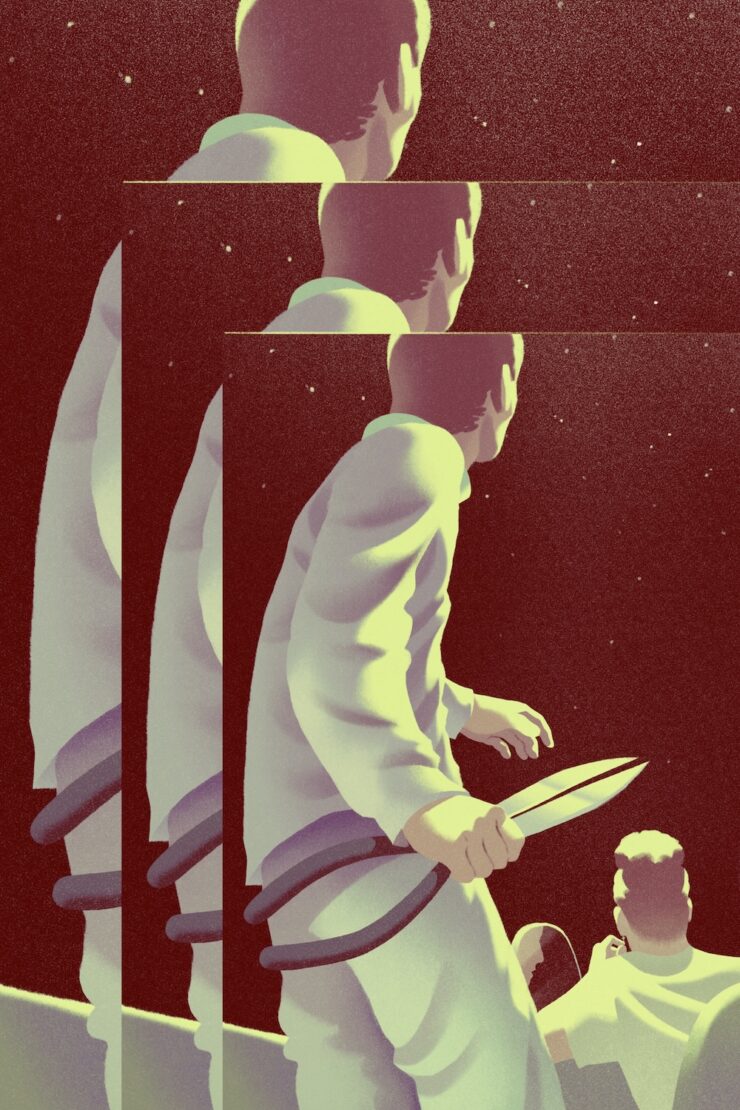
It’s where Dad keeps the pruning shears.
Sitting in that musty darkness, his outdated Tab back with Timoth, because two devices with the same identifiers connecting to the same network rings bells better left unrung—no Tab, no flashlight—Gray uses a whetstone from his dad’s workbench to sharpen the twin blades, dangling spit down onto the edge to make the rasp really sing.
What makes this maybe even better is that it’s his dad who taught him about sharpening things.
The guy had warned him that if he didn’t set his tent up immediately, then he might be too tired to do it later, but, all the same, the tent and its stakes and the rubber mallet to drive those stakes in are still right where they fell. Well, right where they “phased in,” or whatever the time-travel word is.
If this even is time-travel, Gray corrects.
Back home, there are those who insist it’s all holo-ware and sensory manipulation—time-travel is some elaborate ruse, some hard-light construction of the past, complete with sound effects, tactile junk, all that.
The reason they keep insisting on it’s all a ruse is that, since every past you go to is a side branch, showing no effects in the main timeline, there’s no way to prove it isn’t.
For Gray, though, if it feels real, it’s real, right?
Real enough.
Whether his dad here is fake because he’s in a side branch or because he’s projected light in a contained chamber . . . is there really a difference?
But, if this is holo-ware, then it’s high-grade stuff, probably higher than you could reasonably expect to negotiate for in a food court.
“It’s real,” Gray says to himself, sharpening the blade in patient circles, then testing it on a label he peels off a new hammer from the workbench.
Which, he knows, “real” could refer either to this “past” or to the holo-ware, but who cares. He paid his credits, he’s taking his ride.
When both blades are dangerously sharp, he drips a single drop of oil into the bolt at the hinge and wisps the shears open and shut.
Deadly.
This is going to be fun.
To get into the house, he stations himself outside his own window, waits until he sees his own shape darkening the door for a moment, meaning this past-him is sloping to the kitchen to snake something from the fridge now that the parents have retired early to their room like they always do.
Gray slides the window open.
It’s unlocked because two years ago he was still sneaking smokes every chance he could.
Standing in his own room, he can taste the nicotine on the air, and wants to go back again, just to breathe that wonderfulness in, never get the cure, who cares how many credits the treatment’s saved him over the last couple years.
This isn’t what he’s here for, though.
And: he has to be careful. And fast.
Steeling himself for the chance of a confrontation with himself, he steps into the dark hallway.
No one, nothing.
In the living room, past-him is . . . he doesn’t remember. Oh, yeah: going through his mom’s purse. Not specifically to steal any credits or whatever, but, just to see if there’s any worth stealing?
Gray grins at himself: that rapscallion.
It’s a word Timoth has been trying to bring back, the last couple weeks. It’s working, Gray guesses.
Walking by the mirror in the hallway, though, he startles back into the opposite wall, the shears coming up in defense.
A giant ant is looking back at him.
Gray raises his hand to his face and the skin on the back of his fingers crackles, passing through the holo-field, probably disrupting the illusion.
He nods to himself that he can do this, though. That he’s supposed to look scary.
And? That he has no memory perma-lodged in his head of having encountered any bipedal ants two years ago, that means this is Fakeland, doesn’t it?
Well, either that or this him from the future of this past successfully avoided getting seen. By anyone who lived.
You’re not supposed to fall for that, Gray hisses to himself. But it’s so hard not to—this feels like the real and actual past, like he wriggled through while the universe was putting out some other fire.
Gray shakes his head no, that he’s not falling for that, he’s not like everyone else who always does.
He’s not special, he didn’t wriggle through.
He’s just here to have some harmless fun.
Never mind if the footprints he leaves are bloody or not.
He stands with his back to the wall beside his parents’ room, listening for the sound of even breathing, but each moment longer he hesitates, he knows, the higher the chance past-him rounds the corner, rings the alarm, messing everything up.
But?
Does Gray remember something like that? A dream, maybe? About . . . no, no. He’s never dreamed of an upright, walking ant, has he? And, his parents are definitely and for sure still alive. He can feel their judgment all the way from two years in the past.
No, no: from Fakeland’s temporary version of two years ago.
Why is it so hard to remember that? It’s just—every time he stops concentrating on it, it’s like his mind starts to wrap around every other rational possibility. And the first of those is that he’s standing in the hallway of his house deep in his own timeline.
What if those freaks who insist time-travel is a ruse foisted on a whole generation are halfway right, right? What if there’s no time-travel, but there is teleportation? Could the guy have blipped Gray across the city instead of two years back in time?
No, no, he tells himself. You’re being an idiot, you’re wasting your own credits. Never mind if they’re not really yours.
What if the guy knows that, though? What if, when the credits hit his account and ring whatever alarms, start whatever automatic processes . . . can Gray get stranded back here? And, if that happens, there’s no way he can ever catch up, is there?
No, no, no! he tells himself, his fists to his temples, scattering the ant-mask.
The reason he wouldn’t have to worry about catching up with where he came from is that that’s impossible in this pretend-world, this dead branch, this doomed timeline, this . . . this meaningless place.
Where you can commit whatever murder you want, and it won’t count. Not in the least.
Gray flinches when past-him in the kitchen fumbles a saucepan or baking sheet or something, and, after that sound’s gone, both the him in the hall and the him in the kitchen are frozen in place, hardly breathing, listening with their skin.
Does past-him have a sense he’s not alone? But, if he does, then . . . then he’s got to be thinking it’s his mom—their mom—standing in the doorway of the master bedroom, trying to confirm she heard what she maybe heard: her son, cooking well after midnight, and, if history’s any indication, leaving the counter and the range a mess.
Sorry, Mom, Gray says inside.
He didn’t leave the kitchen like that out of meanness back then, if that changes anything. It was more thoughtlessness. It was more being so stoned and hungry he could only think half a step ahead, “the goldfish life” Timoth calls it, where you’re forever always in the moment, aren’t dragging some complicated past behind, aren’t concerned with what’s coming.
Back then, two years ago, yeah, Gray had been living the goldfish life, he supposes.
Maybe his parents were right to continually inform him that his time back in what used to be his bedroom was temporary. It was their way of nudging him out into the world.
It didn’t mean they had to be so judgmental about it, though.
Gray thins his lips, nods to himself that he can do this, this is what he paid to do, this is what everyone on one of these little murder trips does, and he’s about to roll his parents’ doorknob sideways, pivot into the room in his unsettling mask, when . . .
Past-him crosses the hallway, moving from the kitchen to the living room.
Gray’s hand wraps tighter around the shears. The lie he’s telling himself is he can kill that dude down there, too. Metaphysically, philosophically, whatever, he knows not one molecule in the real world feels the impact if he does—lots of cause here, no real effect—but . . . could he?
Would the two of them be too evenly matched?
Oh, oh: except—of course, of course—past-him eating his noodles or whatever in the living room, he wouldn’t be seeing his own face coming for him, would he? He’d be seeing someone in a hard-light ant mask better suited to kids than adults. The two of their sets of reflexes and muscles and defensive techniques would of course be identical, for whatever that’s worth—Gray’s never been a fighter—but Gray does have these razor-sharp, greased-deadly shears. And the element of surprise has to be worth something.
What of the psychological damage he’d carry back to the future from cutting his own throat, though, and watching the life bleed from . . . from himself?
No, let’s not, Gray tells himself.
And past-him seems to agree: instead of looking down the hall, seeing the top-heavy shape down there, he keeps his head thrust forward over the bowl, the better to slurp his steaming hot noodles in.
Gray gulps thanks, and, before he can stop himself, he turns that doorknob, he pivots in like playing a holo-game, and—
His mom is sitting at her antique dressing table, her head tilted over to run a dangly earring in.
She doesn’t turn around, doesn’t stop what she’s doing, but she is seeing him in the mirror.
“Gray?” she says.
It makes Gray touch his face, his mask, but . . . it’s his mom, right? Moms know their children by the shape of their shoulders, by how they stand.
That doesn’t explain why she’s getting gussied up at two in the dark morning, though.
“Just let her be, son,” Gray’s dad says, and Gray wheels his head over to his dad, emerging from the walk-in closet with a dress over his arm. That he doesn’t react to the ant mask means that, from the open closet, he saw Gray first in the reflection.
Without breaking stride, he ceremonially delivers the dress to Gray’s mom, says, “This one, dear?”
“Perfect,” she says, standing to hold it up, inspect it, pinch a bit of lint away from the hip.
“Dad, what?” Gray manages to ask, touching the ant mask’s off button so it’s just a collar.
“Just go back to . . . to whatever,” his dad says back, his eyes watching his wife so closely. So lovingly.
“Mom?” Gray says then, like he feels he has to.
“Look away, you two,” his mom says, and starts undressing, making Gray look away. “Okay!” she says a moment later.
She’s in the dress now. And has her jewelry on. And—and her makeup, it’s smeared, it’s too thick, it’s wrong, it’s like a child did it.
“Just let her be,” Gray’s dad whispers, then, to Gray’s mom: “Fabulous. You’re going to be the belle of the ball again.”
Again, Gray registers.
At which point, his mom leans into the mirror, dabs her lipstick, then, without looking, reaches for the tissue dispenser. But it’s empty, from . . . from other nights of this, Gray has to guess.
“A minute!” his mom announces chirpily, holding her finger up for them to wait, and trails into the bathroom for a tissue.
In her absence, Gray’s dad sags onto the bed.
“Dad?” Gray says.
“It’s not for you to worry about, son.”
“She does this every night?” Gray asks.
His dad looks up, looks to the bathroom, says, “Not every night.”
“Where does she think she’s going?”
His dad shrugs one shoulder, pooches his lips out, says, “Some dance from when she was young? I don’t know.”
“But she never goes, does she?” Gray says, feeling shelves of memories and certainties falling over in his chest, scattering across the floor of his life.
“We—we both go, after you’re asleep,” his dad admits, his eyes shinier than Gray’s ever seen them.
Gray sits on the bed beside his dad, his fake father, and, for the first time ever, he places his hand on his dad’s knee.
His dad, like he’s been waiting his whole life for this, claps his hand down over Gray’s, and Gray feels his eyes filling.
“Those?” his dad asks then, about the shears.
Gray looks down to them on the bed, between him and his dad.
“I sharpened them for you,” he says, finally.
He can tell his dad isn’t quite buying this, but he doesn’t push back, either. There’s more pressing issues, right now: Gray’s mom is making her grand entrance from the bathroom, twirling once, so light on her feet, her dress swirling around her legs.
“You look seventeen again, dear,” Gray’s dad says, and stands, holds his hand out. Gray’s mom, everything about her “princess,” places her delicate hand in his, and Gray’s dad nods, grins a painful grin, Gray thinks. “Son,” he says, meaning make way.
They’ve got a dance to go to.
Gray retracts his legs so they can pass, and, when he realizes past-him is eating noodles down the hall, he panics, looks around. His first impulse is to call after them, stop them, or let his voice warn the fake version of him eating noodles in the living room, but . . . that’s no better: past-him, hearing his own voice, will have to come investigate, won’t he?
No, no, but he can’t let his mom and dad see him also down there, in different clothes.
Hating himself for it—it feels worse than killing them, at least in the moment—he reaches back with the shears, sweeps everything off his dad’s nightstand.
The crash stops all other noise in the house.
And, thankfully, he hears his own bedroom door quietly click shut: past-him heard, doesn’t want another confrontation, is hiding again.
Thank you, thank you.
“I’m sorry,” Gray says to the empty room, and, creeping down the hall to the kitchen, to get to the backyard, wait for his return-trip to auto-activate, he sees, just for a moment, the silhouette of his dad in his pajamas, dancing with his mom, who’s dressed to kill, is in another world, a better place.
Of course they wanted him gone. It could only be so long until he figured out what was happening to her. And then, he knows, he never leaves, he stays to help, and his life never really gets started.
“I love you,” he says to them, for what he thinks might be the first time ever, and it’s not loud enough for them to hear, and it doesn’t matter because they’re just dancing through Fakeland, but . . . but it feels real.
This was worth every stolen credit.
He sets his tent up around the corner, behind the tree, where there’s zero chance anybody’s going to be, and coming back to his home timeline is as easy as falling asleep in those nylon walls, waking in the guy’s WC.
Gray steps out groggy, breathing deep.
“Hey, clean, nice,” the guy says, looking Gray up and down.
He’s playing with a finger puzzle made of paper.
Gray looks down to his clothes: no blood.
“What’d you use, man?” Timoth asks, stepping in to unlatch his ant mask from Gray’s neck, get his toy back, inspect it for damage.
“Hammer,” Gray lies.
“Nice, nice,” the guy says.
“Your mom, even?” Timoth says, looking up from the mask.
Gray nods yes, even his mom.
“It feels so real,” he says then, to both of them.
“It is real, man, that’s the magic,” the guy says, flinging the paper puzzle onto his station with disgust. “It just doesn’t count.”
Gray swallows, nods, and, walking back through the food court with Timoth, who’s of course wearing that idiot mask, Gray’s more aware of the vibrancy of the colors smeared all around him, can taste the pungent flavors on the air.
“You keep touching everything,” Timoth says from behind his ant head. “It’s weird.”
Gray wasn’t aware, but, yeah, he guesses he has been dragging his fingertips across the backs of all the benches, on all the little half walls.
“Just making sure it’s real,” he says.
“Toady’s?” Timoth says then, about the club they usually end up at each night, blotto’d out of their minds, drooling into their chests, knowing numbness isn’t exactly happiness, but it’s sort of close, in that it doesn’t hurt.
“The goldfish life,” Gray says.
“If it works, it works,” Timoth says with a shrug.
“Not tonight,” Gray says, which is how he gets time and freedom to cross town, comb his hair for once, knock on his parent’s door.
His mom sees his face in that way moms can and, without any words at all, pulls him into a hug.
“Son,” his dad says from his chair, and Gray nods to him, can’t seem to stop nodding. At first when he steps over to his dad, pulls him into a hug, his dad holds his hands up, not sure what’s happening. But, by slow degrees, his dad’s hands finally pat Gray’s back.
“Hungry?” his mom asks, and Gray is, so they eat, they talk, they laugh, and, finally, Gray is invited to sleep in his own bed if he wants.
He does.
And, when he hears his parents’ feet shuffling down the hall, one in slippers, the other in the fanciest heels, he doesn’t follow, just lets them have their dance.
He rolls over, faces the wall, the window, remembers lying here so many nights, growing up, impatient for his life to finally start, ready to escape this prison, and when his index finger, up by his face, starts keeping time with the drum, he smiles to be part of this with them.
But then . . . drums?
The music in the living room, though, it’s in his mom’s head, isn’t it?
Gray holds his breath, listens harder, harder.
It’s not drumming, it’s . . . it’s tapping.
“No,” he says, his face going cold. His whole body, really.
He knows what he’s hearing, now. It is regular like a drumbeat, but it’s deeper, thunkier: the delicate sound of tent stakes in the backyard, getting hammered into the ground here in what Gray guesses he has to admit is Fakeland.
But it sure does feel real.
“The Belle of the Ball” copyright © 2025 by Stephen Graham Jones
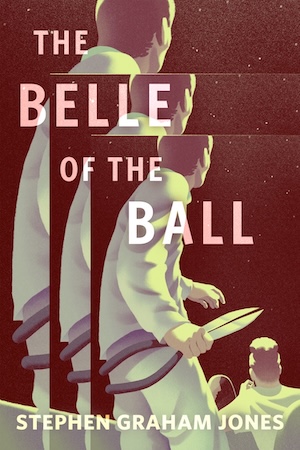
Art copyright © 2025 by Leonardo Santamaria
Buy the Book
The Belle of the Ball

Excellent, it’s a nice surprise to see a story from one of my favourite authors here today.
Sad… but original.
Amazing. So much to think about, so many twists and turns.
SGJ never ceases to entertain, and leave his audience wanting more.