





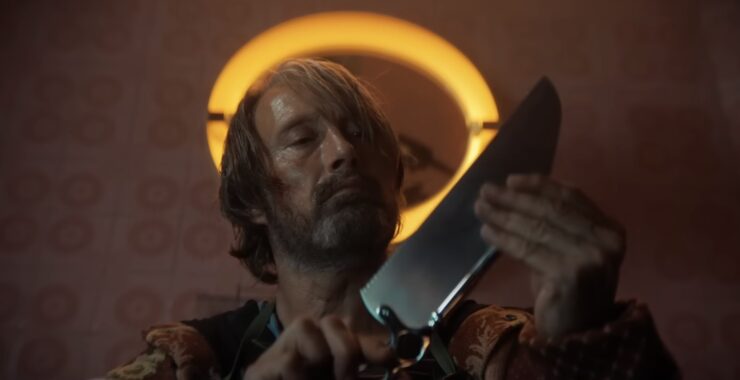
Bryan Fuller’s Dust Bunny has been hailed by many as a grim fairy tale of the sort that doesn’t get much play these days, which seems a fair assessment: Unless you plant yourself firmly in the horror genre (a la Stranger Things), most of our modern fantastical stories with children steer clear of darker themes. Yet fairy tale—the old kind with blood and death and dread—is pretty firmly where Dust Bunny resides.
Having said this, I didn’t find Dust Bunny’s darkness to be what set it apart, despite the focus on hitman shenanigans and parent murder. Nor was I particularly interested in what kind of fairy tale it is so much as whose. But there’s another layer here that hopefully isn’t getting missed in the excited chatter—namely, I can’t say that I’ve run across too many fairy tales that center entirely on building your ideal family, and the trials that come with it.
And I’m not just saying this because I happen to be a queer writer talking about the work of another queer writer and filmmaker, knowing that queers are famously fans and proponents of found family narratives. I’m saying it because Dust Bunny is genuinely one of the most moving treatises on the value and importance of found family that I’ve ever experienced. Because, in this story, family is something hard won and frightfully difficult to assemble. You don’t just stumble across your family and enmesh seamlessly—you must be willing to fight for the privilege of having one.
That’s important because the narrative of (straight, cisgender, heteronormative, biological, nuclear) family is very much the opposite: You are born into a family; you are made from bits of the people who created you; you grow together and, therefore, you must all love each other. It doesn’t really matter if you don’t entirely get along or what hurts occurred in the past because this structure is built-in, unassailable, and sacrosanct. Betraying the pact of familial bond is portrayed as evil of the highest order in our society—take a look at the recent backlash against children who choose to sever contact with their parents, if you doubt it. Only a monster would ever consider doing so.
But Dust Bunny is a story about monsters.
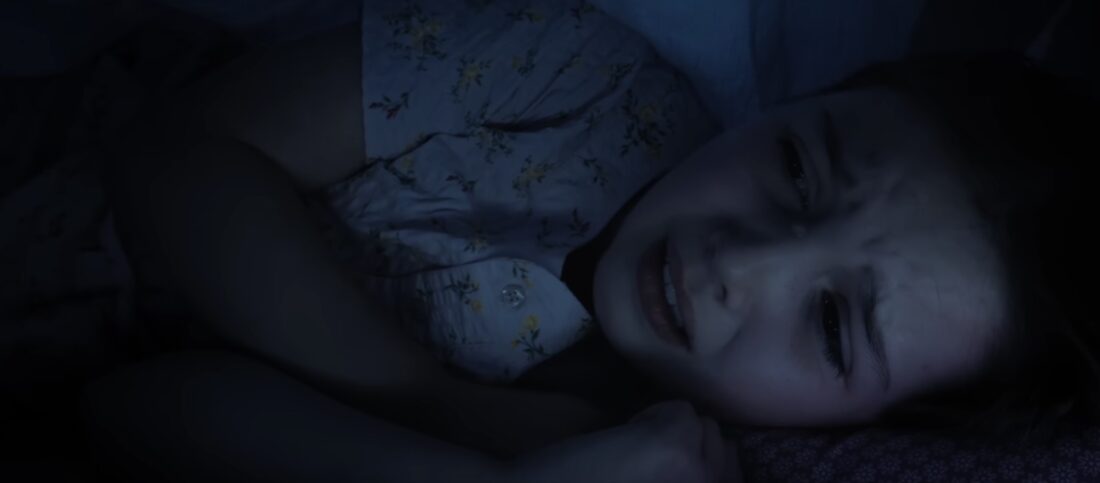
It’s a story about monsters who love monsters, and perhaps how we’re all just monsters desperately reaching out for other monsters who will care for us. How do I know this? (Aside from the the fact that Bryan Fuller’s Hannibal was telling the same story, using very different relationships?) Well, when I reviewed the film, I pointed out that one of the central questions the story posed was whether the monster under Aurora’s bed was real, or simply a metaphor for her own lived trauma. Thankfully, what we find is so much more beautiful than that. But to fully explain what I’m getting at, we’ll have to dig a little deeper.
To recap briefly: In a large unnamed city, Aurora lives across the hall from Resident 5B, and is guided toward him by a wish. She follows him into the dark one night and learns that he’s a killer, but misunderstands what sort—she believes he kills monsters (fantastical), when 5B is actually an expert at killing human beings (a different kind of monster). When the monster under her bed devours her parents, Aurora hires 5B to kill it. 5B inspects her home and believes that her parents were murdered by someone who meant to kill him and got the wrong apartment number. His handler insists that 5B must kill Aurora because she’s seen too much, but he’s adamant about keeping the girl safe, so everything gets messier from there as more assassins come after both him and the girl. Aurora continues to insist that the monster is playing a part in these affairs, while 5B insists that it’s imaginary, created to help her cope with being witness to so much violence and death.
The movie eventually reveals that the monster is real, of course. But I would argue that the monster is still a metaphor—just not the one we’ve been trained to expect. Aurora’s monster is, in fact, a metaphor for her and her own monstrosity. The monster is still absolutely real in the tangible sense, still an agent of murder and chaos. But the monster is also a piece of the little girl who created it.
It is a tacit understanding of this that prompts 5B to tell Aurora at the end of the film, “It’s your monster. You have to live with it.” And he would know better than anyone, wouldn’t he? 5B has his own monster to contend with—the one that lets him kill other people for money after being trained to do so by his mother. You see? Monsters and more monsters, not simply one furry monster who lives under the floor, waiting for tasty parents to eat.
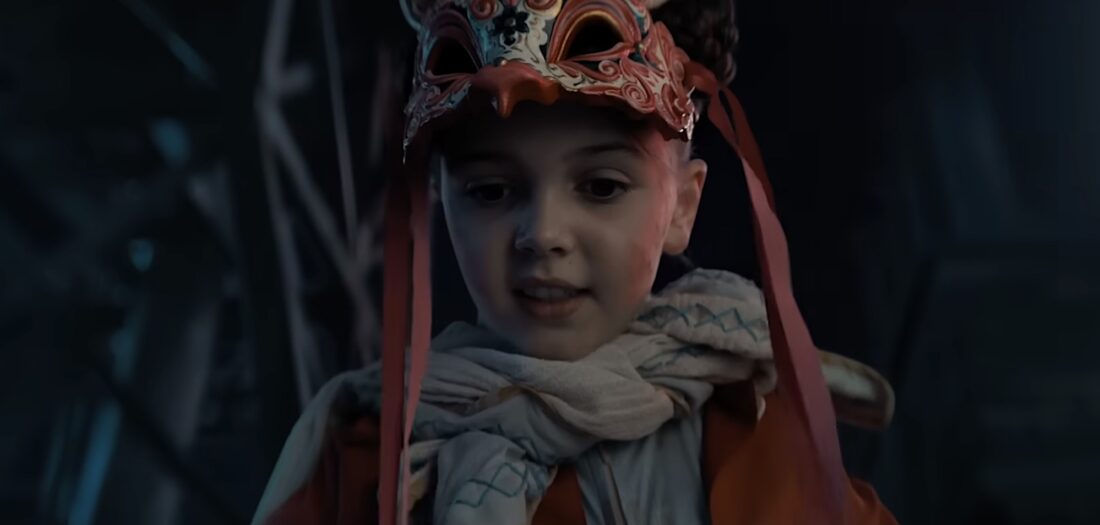
There are hints to this connection all over the place, right from the beginning: When Aurora follows 5B and witnesses his slaying of a monster (in truth, several people under a New Years’ dragon costume) in Chinatown, she watches from a nearby building rooftop while wearing a bunny mask she finds in a trashcan. Year of the Rabbit or not, the mask is our first clue that the dust bunny under her bed is aligned with Aurora in some way. But it is perhaps more important to note that the monster comes into being because Aurora wishes it into existence; in effect, Aurora is less a human child protagonist in this tale, and more of a magical creature herself.
So, whose fairy tale is this?
When I ask this question, I’m not asking which character maintains the focal perspective—that is largely Aurora throughout the story. There are moments where the audience gets to witness 5B’s activities away from her, but the POV (in terms of narrative journey, at least) is pretty evenly split once Aurora and 5B meet. What I mean is that fairy tales often center on a character or characters who come into contact with magical, terrible things: witches, wolves, evil queens, people turned into animals. Those magical things can make the lives of these characters better or worse, but they are still the figures the fairy tale enacts its mechanics on.
There’s an argument to be made that Dust Bunny is 5B’s fairy tale. Both he and Aurora are missing something in their lives, but he is not a magical being unto himself, no matter what Aurora thinks—he’s a huntsman or woodsman, an outside party that comes into contact with the extraordinary and lets it change him. And to some extent, I think that the movie agrees with this reading because the structure of its opening supports the theory pretty flawlessly.
Put it this way: Dust Bunny has practically no dialogue until Aurora enlists 5B’s services to kill the monster under her bed. We get very basic, rote lines between Aurora and her foster parents, platitudes and worry and a child’s fearful pleading. But characters in the film don’t really start talking to each other—don’t come alive as complex people—in any meaningful way until Aurora is sitting in 5B’s kitchen, telling him what happened to her parents. She pays him with money she steals from a Sunday mass service in the city; decked out in cat eye sunglasses, scarf over her hair, Aurora takes the offering plate and runs out into the sunlight, elated and grinning.
In stories such as these, evoking the Church (which was relatively common, in an oblique sense after a certain point in time) and so pointedly going against it would almost guarantee comeuppance on the someone who did wrong. After all, Aurora stole money that would have been put to Godly use, donated by humble, hardworking believers. But we never hear another word about it—5B doesn’t even bother to scold Aurora for theft when she tells him where the money came from. If you’re some stripe of Christian, you might assume this means that the money went to its rightful use in helping a kid who just lost another set of parents. To me, it can’t help but read as one very powerful little girl stealing from an institution that has absolutely no hold over her. She’s got nothing to worry about from that crew.
You know, like the old fairy tales. Where coding morality wasn’t really the point of the exercise.

We eventually find out from Brenda, the FBI agent posing as a social services worker, that Aurora has lost several sets of parents—three to be precise. (It’s a little fuzzy on whether they were three sets of foster parents, or if the first set to die were her biological parents.) When 5B questions Aurora about these deaths, she admits that they are her fault; she wished for a monster to kill her first parents. When he asks why, she only says, “They weren’t very nice to me.” The allusion is to some form of abuse, though it’s possible that their crimes were less severe… not likely, I’d wager, but possible.
It gets uglier when her latest foster parents are added into this picture, however. Though they seem relatively benign at the outset, a later view of their living room shows a portrait with the two of them… and a blank-faced little girl with long brown hair. Dollars to doughnuts, this duo had been “shopping” for a child in the foster system, and already decided what they wanted her to look like. Presumably Aurora’s face would have been added to the painting if they’d decided to go through with the adoption. (Let’s not even get into the fact that they were having her call them “mommy” and “daddy” before said adoption took place. If you know anything about foster care, you know that’s not a great call unless the child requests it.)
The result of all these potential parents getting gobbled up is that Aurora believes herself “wicked” and thinks that the monster is eating her subsequent families (and potentially her now) because she doesn’t deserve family after what she’s done. But 5B doesn’t agree with this assessment. He looks at Aurora and sees her for what she is beneath the unlikely circumstances and the magic he doesn’t yet believe in: a frightened child. One so terrified of the beast she called into existence that she won’t even touch the floor in her own home. He’s the wicked one, obviously, him, the hired killer who’s unbothered at the idea of cutting up dead bodies into little pieces and packing them away into cute panda rolly suitcases.
The fact that Aurora wants to watch and help him do this, that she delights in seeing him slay that dragon, well, that’s just normal kid stuff.

5B was a child once, too, of course, and this is where we come to Laverne, his handler and also, unfortunately, his mother. It’s here that a head-to-head is put to incredible use, showcasing the difference in having family through obligation versus family through choice.
Nearly the first words out of Laverne’s mouth are that she’d hug 5B, but that’s not really her thing. He settles for placing his hand over hers; in fact, he’s always seemingly looking for excuses to touch her, to create some outward indication of the bond between them. He is always honest with her, as well, even when it seems obvious that she’s never truly honest with him. She frequently puts down any inkling of emotionality he displays, and every suggestion she makes is truly an order at its heart: Kill the kid; lie low until the heat on you blows over; stop thinking that taking care of a little girl will “fix” your brokenness.
Deep down, 5B knows his mother will never be kind of the familial connection he keeps seeking—at one point, he tells Aurora that he used to think his mother was “the most beautiful woman in the world” before realizing that this was a sort of trick played on him by his brain to blind him to her faults. Even so, he reaches out for connection, closeness, a shared rapport with the woman who made him.
Laverne’s only true ways of connecting with him are by trying to murder a child he keeps telling her to leave alone, and sharing food. Even in this, it’s important to note the contrast: 5B feeds Aurora, too, but always as nourishment and with the intent to share, a growing affinity built on a foundation of dim sum and sliced apples. Laverne likes to use food to placate and quiet—she frequently asks if 5B wants food when she’s trying to redirect him, and then does the same to Aurora after telling the girl point blank that she’s not old enough to be a whole person in Laverne’s eyes. (Aurora’s vindictive plucking of flowers from the vase at their table afterward might be her biggest power move of the whole film.)
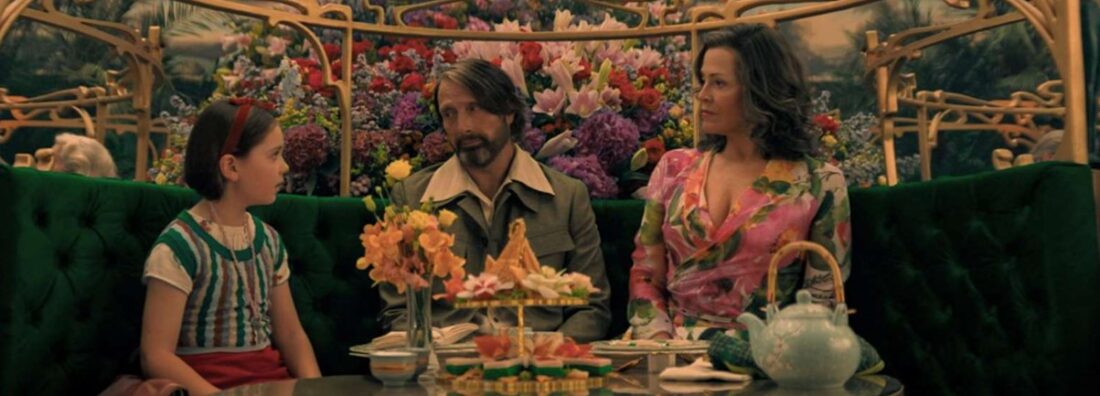
This difference then goes one step further: When Laverne tries to quiet Aurora by asking if she wants a sandwich, 5B replies that the girl doesn’t eat pork. Aurora is visibly shocked that he remembers this—he only knows it from one conversation that they had about cutting up a dead body. When 5B told her that it was like a butcher cutting up a pig, she told him, “I like pigs.” …And that was all it took. Because love is consideration, and consideration is often simply keeping details about people in your mind so you can better care for them.
How little has Aurora been loved that she found this one instance of remembrance so jarring?
It’s here that we reach a pivotal turning point in the story, though nothing truly momentous seems to have occurred. Aurora invaded this lunch between 5B and Laverne to tell her hitman off for trying to leave her behind, but leaves that meal knowing that something has altered between them. She doesn’t want to be a hiring client anymore—she wants to be family.
The rules of engagement have changed.
‘Found family’ is such a funny term because it evokes the opposite of what it is—as though you could just stumble across a box in an alley that is full of all the love and connection you’ll ever need. But a found family is built of a deliberate choice that people make together, over and over. 5B has already chosen Aurora, whether he realizes it or not, in his willingness to fight for her and his desperation to keep her safe, his exasperation and gentle structure. Now she—magical creature that she is—has to fight for him.
Perhaps it seems awful to say that a child should ever have to do anything to be loved, but here’s another place where the importance of fairy tales comes into play. Because fairy tales are a special type of story, one that often acknowledges that children aren’t idiots, and that their lives are just as hard as adult ones. This isn’t about what’s right or fair for the kid. It’s just about what’s true.
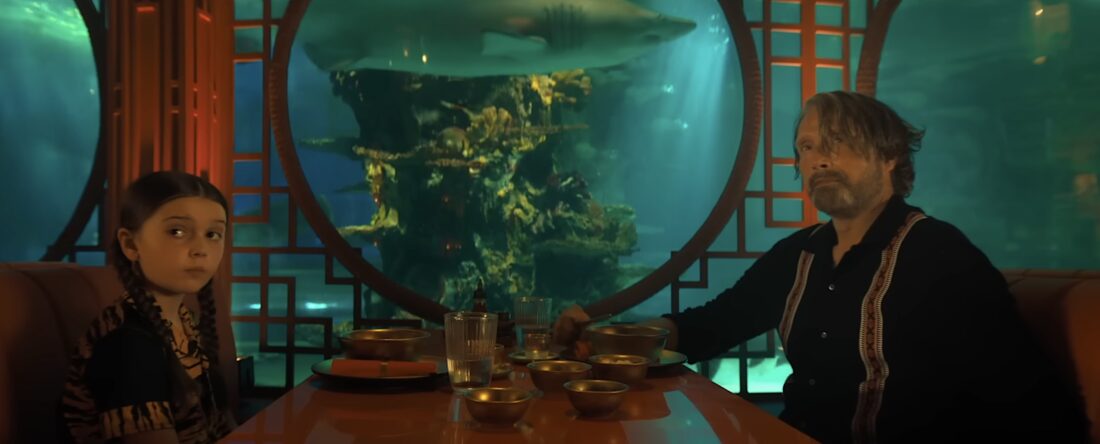
Aurora starts strong straight away. At dim sum, she suggests that 5B could become her father, then insists that she’s his kid when the Conspicuously Inconspicuous Man shows up to throw down the hitman gauntlet. He sees Aurora and balks, then tells 5B that he doesn’t mean to question the guy’s parenting, and Aurora readily replies, “Then don’t.” When they leave the restaurant, she tries out holding 5B’s hand, and he allows it.
But a hit squad follows them home. And there’s still an ever-hungry monster under the floor to contend with—the one ready to swallow Aurora whole for her wickedness, screams and all.
There’s give and take in the final showdown at Aurora’s apartment. 5B hasn’t fully proven himself either because there’s a final step he must take toward sharing a reality with the girl. That comes when he finally learns that the monster is real, and is eaten by it… but survives due to applying thumb-sucking deterrent to himself (after getting a helpful clue from Brenda earlier in the day). In many ways, that is his most important test—proving that he could survive being eaten by it. By the monster, Aurora’s own monstrosity, a terror made of her own wishes.
When the monster gets another shot as they make to escape, it’s Aurora’s turn. She stands between it and 5B, shields him—and they realize that the monster is hers. She can control it, and it never would have eaten her because she created it. The dust bunny was constructed for and by Aurora, a shade of her own wants and needs and dreams. And it’s then that you notice the equation here was always very simple: Though she didn’t know it, Aurora could have stopped any of her parents from being eaten.
That never happened because it wasn’t until this moment that she ever had family worth defending.
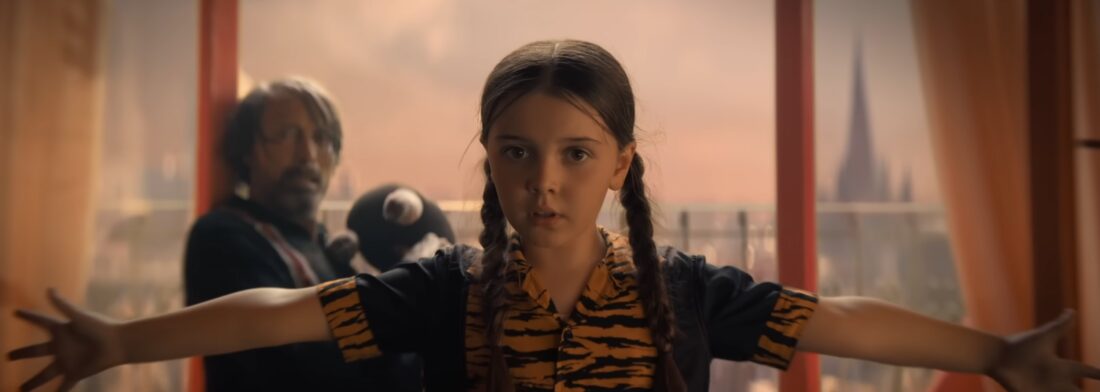
Monster finds monster. Monster wraps shared monstrosity in a bow with apple skins, packs it neatly alongside rabbit dumpling heads and weird bear costumes and hippo rafts that roll down living wallpapered hallways like some sort of whimsical Charon’s ferry. What will the monsters create together, now that they’ve found each other?
The labels here don’t matter, or perhaps they do for their reasoning: Before being eaten herself, Laverne says that being called mom is “hurtful” (wow). But 5B says that he doesn’t want to be Aurora’s dad because “all your dads die.” Again the juxtaposition: One of these things is self-centered and cruel. The other is simply true. So 5B suggests that Aurora will eventually think of something else to call him, and since he can’t pronounce her name right, he’ll default to “little girl.” It’s not father and daughter, and honestly, who cares?
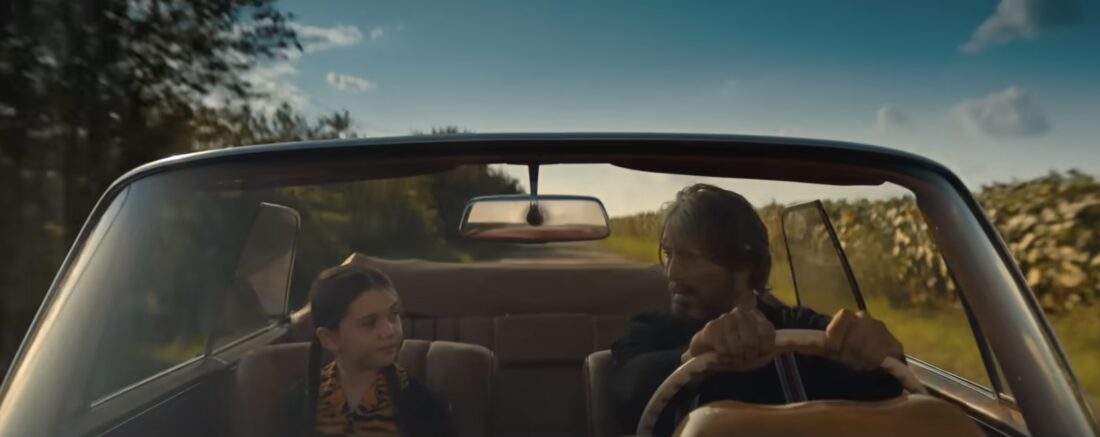
As the film comes to a close, they drive down a highway alongside a field of sunflowers while a peppy, foreboding ABBA song plays for the audience:
I am behind you
I always find you
I am the tiger
And you’d be inclined to assume that the “tiger” is Aurora’s monster, whose shadow is shown galloping beneath their car, following them to their next home. But… did you notice it? Aurora’s outfit?
It’s covered in tiger stripes.
5B found a magical being who changed his life. Always behind him, able to track him down… and exactly who he needed. A fairy tale ending, indeed.
